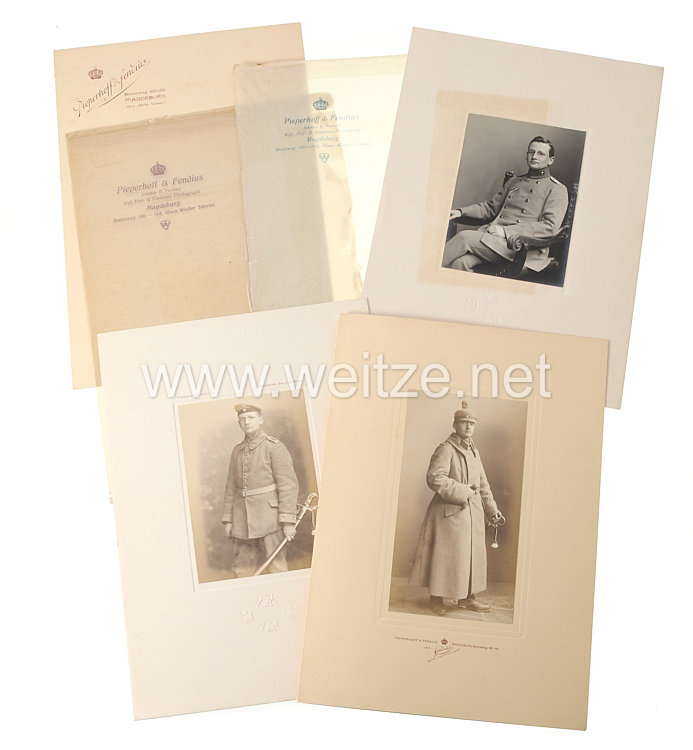
This remarkable collection of four large-format studio photographs from World War I impressively documents the military career of a German soldier from his beginnings as a simple gunner to officer rank. Created between 1914 and 1916 at the renowned Pieperhoff & Fendius studio in Magdeburg, these photographs offer not only a personal insight into the career path of an artilleryman but also possess considerable value for uniform studies.
The Field Artillery formed the backbone of the German armed forces during World War I. With over 5,000 guns at the outbreak of war and continuous expansion throughout the conflict, this branch played a decisive role in German warfare. Artillery was responsible for approximately 70 percent of all war casualties and emerged as the dominant weapon of industrialized warfare.
The first photograph shows the soldier as a Gunner (Kanonier) in peacetime uniform around 1914. The Prussian peacetime uniform of the artillery was characterized by the distinctive dark blue tunic with red facings and braiding. The service cap and walking-out belt completed the outfit for off-duty service. This uniform still followed 19th-century traditions and would fundamentally change with the outbreak of war.
The second photograph documents promotion to Lance Corporal (Gefreiter) and already shows adaptation to wartime reality. The Field Blouse M 1914 represented one of the first responses to the requirements of modern warfare. Made from field-gray cloth, it replaced the impractical peacetime uniforms. The Krätzchen, a field-gray side cap, was introduced as lightweight headgear for trench warfare. The saber, the traditional edged weapon of the artillery, initially remained part of the equipment but increasingly lost practical significance in trench warfare.
Particularly noteworthy is the third photograph featuring the Pickelhaube with cover. The Pickelhaube, symbol of the Prussian and later German army since 1842, received a white cover for peacetime from 1892. With the outbreak of war, field-gray covers were introduced to camouflage the reflective surface of the leather helmets. The field-gray coat (overcoat) was an essential part of winter equipment and provided protection against the often extreme weather conditions at the front.
The fourth and final photograph shows the pinnacle of the military career: promotion to Lieutenant (Leutnant). The Litewka, a hip-length uniform tunic with stand-up collar, was worn by officers and differed significantly from enlisted uniforms in cut and quality. The visible Iron Cross 2nd Class indicates proven bravery in the field. This decoration, established in 1813 by King Frederick William III and renewed in 1914, was awarded approximately five million times during World War I.
The fact that all four photographs were taken in the same studio and presented in matching mounts underscores their significance as personal memorabilia. Magdeburg, as an important garrison town, was a center of Prussian military tradition. The Pieperhoff & Fendius studio was among the established photographic studios specializing in military portraits.
Such photo series were widespread during World War I. Soldiers had themselves photographed during home leave to document their promotions and military achievements for relatives. The professional studio photographs with their theatrical backdrops and careful lighting stand in stark contrast to the often shocking realities of front-line life.
From a uniform history perspective, this collection exemplifies uniform development during the first war years. The transition from colorful peacetime uniforms to functional field-gray combat dress was almost complete between 1914 and 1916. This development was driven by the necessities of trench warfare, improved firepower of weapons, and the importance of camouflage in modern combat.
Social advancement from simple enlisted rank to the officer corps was by no means automatic in the Imperial Army. However, the enormous casualties at the front and massive personnel requirements led to increasing promotion of non-commissioned officers and proven enlisted men to officer status. Field officers who distinguished themselves through performance and bravery supplemented the traditional career officers and reserve officers.
This photographic documentation of an individual military career possesses considerable historical and cultural value today. It provides insights into career paths, uniforms, and the visual self-representation of soldiers during World War I, representing an important testament to this epochal turning point.