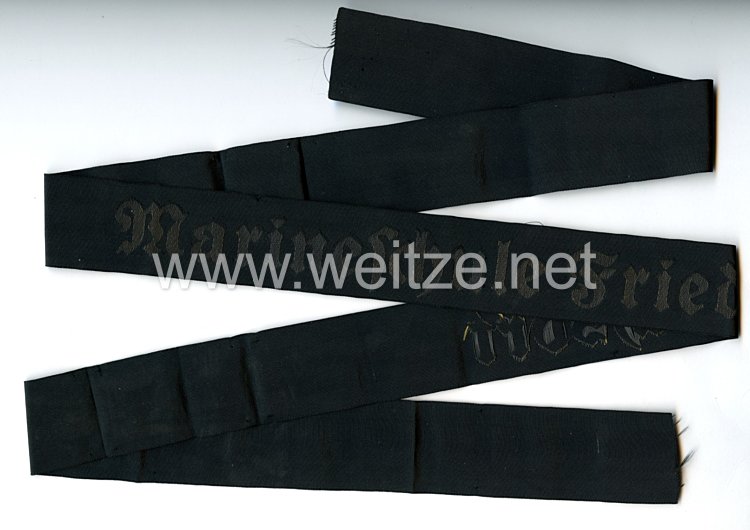
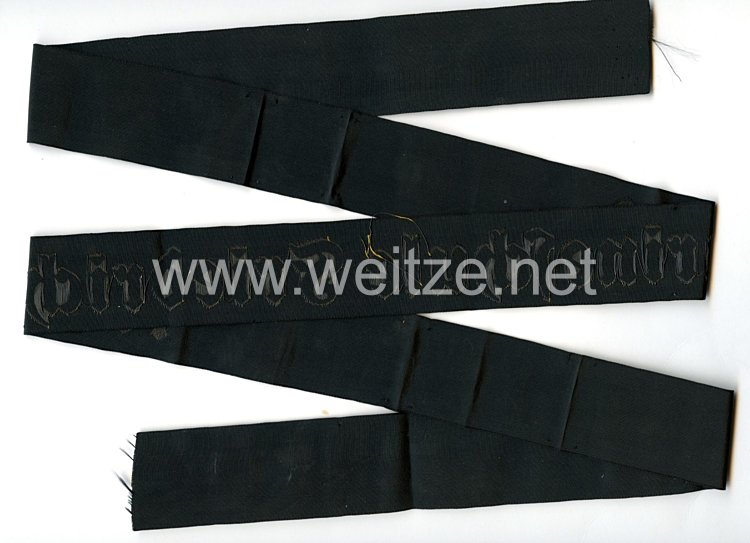
Kriegsmarine Cap Tally "Marineschule Friedrichsort"
The cap tally of the Naval School Friedrichsort represents a significant artifact from the history of the German Kriegsmarine. Measuring 114 cm in length and crafted from metallic thread, this tally exemplifies the traditional identification marking worn by naval personnel who completed their training at one of the most important educational establishments of the German Navy.
The Naval School Friedrichsort was located on the Kiel Fjord in Schleswig-Holstein and played a central role in the training of naval officers and petty officers. The institution had its roots in the Imperial Navy and continued through the Weimar Republic and the NS period. The Friedrichsort location was strategically advantageous and offered ideal conditions for maritime training.
Cap tallies were an integral component of the German naval uniform and served to identify affiliation with specific ships, units, or training facilities. The tradition of cap tallies dates back to the 19th century and was continued by the Wehrmacht's Kriegsmarine. According to the Kriegsmarine's uniform regulations, enlisted men and petty officers wore a black band with gold-colored lettering on their Bordmütze (also called Schiffchen or side cap).
The manufacture of such tallies was carried out through specialized handwork. The metallic thread used, often made from gilt or brass-colored material, was woven or embroidered onto a black background. The inscription “Marineschule Friedrichsort” was executed in the characteristic Gothic script typical of Kriegsmarine cap tallies. The standard length of approximately 110-115 cm allowed the tally to be tied around the cap with a bow at the back of the head, with both ends and their finishes hanging visibly.
Training at the Naval School Friedrichsort encompassed various courses for different ranks and assignments. Prospective officers were instructed in navigation, seamanship, weapons technology, and military leadership. The school possessed modern training facilities and utilized the Kiel Fjord for practical exercises. During World War II, training was intensified to meet the growing demand for qualified naval personnel.
The present specimen displays the typical signs of wear of an authentic cap tally from this era. The mentioned pinprick-sized holes indicate that the tally was actually attached to a cap. Attachment typically occurred by sewing onto the cap using fine stitches, which explains the described holes. Condition 3 corresponds to a used but largely complete state of preservation with visible signs of aging and wear.
Such cap tallies today possess significant military-historical and collectible value. They document not only the uniform history of the Kriegsmarine but also the organizational structure and various units of the German Navy during the period from 1935 to 1945. For collectors and historians, authentic specimens are of particular interest as they represent direct testimonies of maritime history.
The historical classification of such objects requires care and knowledge of contemporary manufacturing methods and regulations. Authentic cap tallies made from metallic thread differ from later reproductions through the quality of workmanship, the type of material used, and the characteristic patina. The black base band typically consisted of wool fabric, while the lettering was woven from gilt or brass-colored metallic threads.
After the end of World War II and the dissolution of the Kriegsmarine, many such memorabilia were retained by former naval personnel or entered private collections. Today they serve as important material sources for naval historical research and provide insights into the daily life and organizational structure of the German Navy of this epoch.