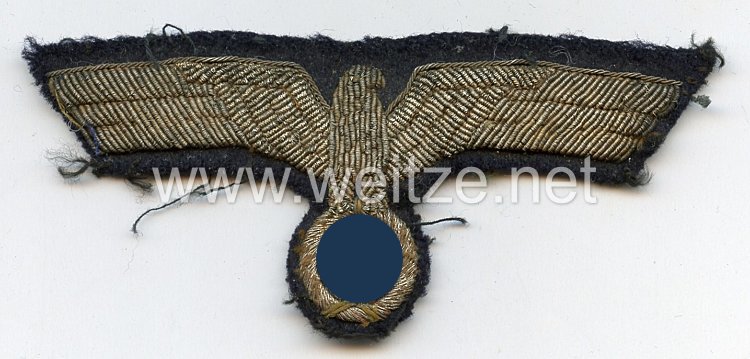
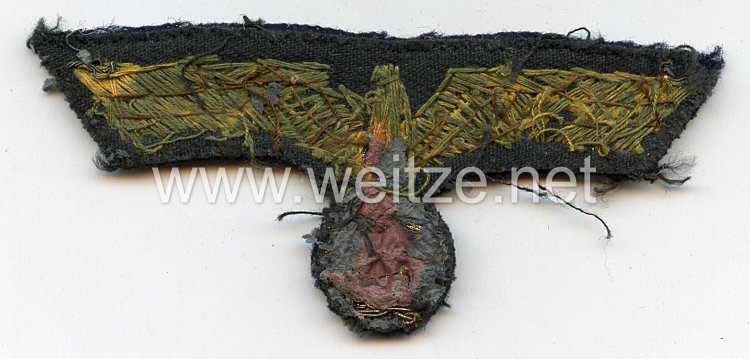
Kriegsmarine Breast Eagle for Naval Officers

Hand-embroidered metallic thread on dark blue, removed from uniform, Condition 3
429325
125,00

Kriegsmarine Breast Eagle for Naval Officers

The Kriegsmarine Breast Eagle for Naval Officers represents a significant insignia piece from the German naval forces during World War II. This hand-embroidered example made with metallic thread on dark blue backing exemplifies the high craftsmanship standards that applied to Kriegsmarine officer uniforms.

The Kriegsmarine was officially established on June 1, 1935, after Nazi Germany rejected the restrictions of the Treaty of Versailles. Under the leadership of Grand Admiral Erich Raeder and later Karl Dönitz, the Kriegsmarine developed into a significant naval force. Uniform regulations and associated insignia were strictly controlled and followed precise guidelines.

The breast eagle, also known as the national emblem (Hoheitszeichen), was worn on the right breast of the uniform jacket. The design featured a stylized eagle with spread wings, holding the swastika in its talons—the official symbol of the National Socialist state. For Kriegsmarine officers, various versions were prescribed depending on the type of uniform and rank.

The hand-embroidered variant in metallic thread described here was typical for higher-quality officer uniforms. Unlike machine-made or woven versions common for enlisted ranks, hand-embroidered examples displayed significantly higher quality and detail. The metallic threads typically consisted of silver-plated or aluminized wire embroidered onto the dark blue cloth base material. This elaborate handwork was executed by specialized military effects manufacturers or private master tailors.

The dark blue backing corresponded to the characteristic color of Kriegsmarine uniforms. The Navy traditionally used dark blue cloth, which distinguished it from the field-gray uniforms of the Army and the blue-gray of the Air Force. This color scheme had a long tradition in the German Navy, dating back to the Imperial Navy (Kaiserliche Marine).

The Kriegsmarine uniform regulations were codified in several dress orders that distinguished between different uniform types. These included full dress, undress, service dress, and shipboard dress. The breast eagle was prescribed on most of these uniform variants, with the execution varying according to the occasion.

The fact that this specimen was removed from the uniform is not unusual. After the war ended in 1945, many uniform parts bearing National Socialist symbols were removed, partly by order of the Allies and partly by the wearers themselves. Many veterans removed the national emblems to continue wearing uniform parts or to eliminate the political symbols while keeping the uniform as a memento.

From a conservation perspective, such textile objects show typical signs of aging. The metallic thread can oxidize, and the backing material can fade or become brittle. The quality of the original materials and storage conditions over decades significantly influence the state of preservation. Classification as “condition 3” indicates visible signs of wear, though the object remains clearly identifiable and largely complete.

For collectors and military historians, such insignia are important study objects. They provide insights into manufacturing techniques, material usage, and the organizational structures of the Kriegsmarine. Simultaneously, they raise important questions about handling objects from the National Socialist period. Their preservation and scientific documentation serves historical research and education, while critical examination of this dark chapter in German history remains necessary.

The legal situation regarding such objects varies by country. In Germany, trade in items bearing unconstitutional symbols is generally punishable by law, though exceptions exist for art, science, research, and education. Museums and serious collectors bear special responsibility in handling these historical artifacts.

The historical context of these insignia extends beyond their mere function as uniform decoration. They represent the visual manifestation of a military organization that served a criminal regime. The Kriegsmarine participated in the Battle of the Atlantic, operations in Arctic waters, and other naval campaigns that cost hundreds of thousands of lives. Understanding these objects requires acknowledging both their material culture significance and their association with one of history's darkest periods.

r