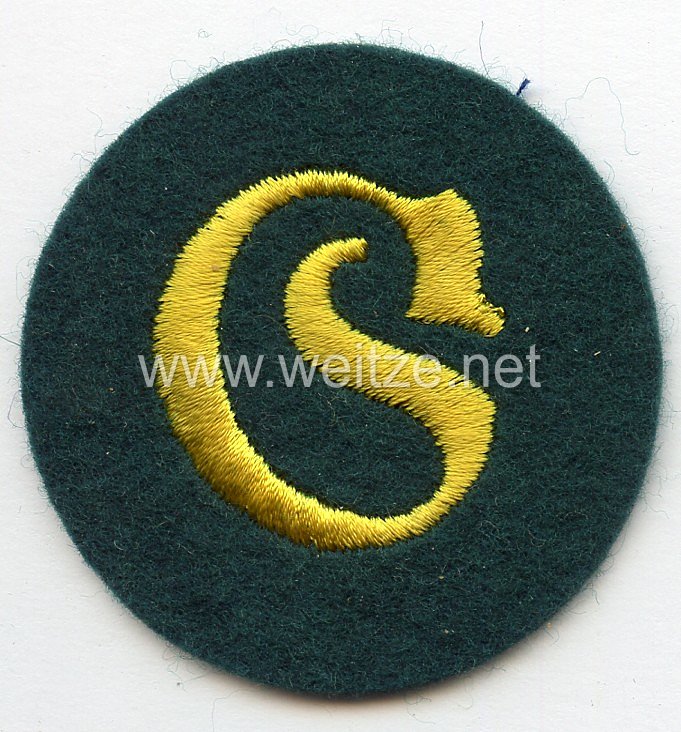
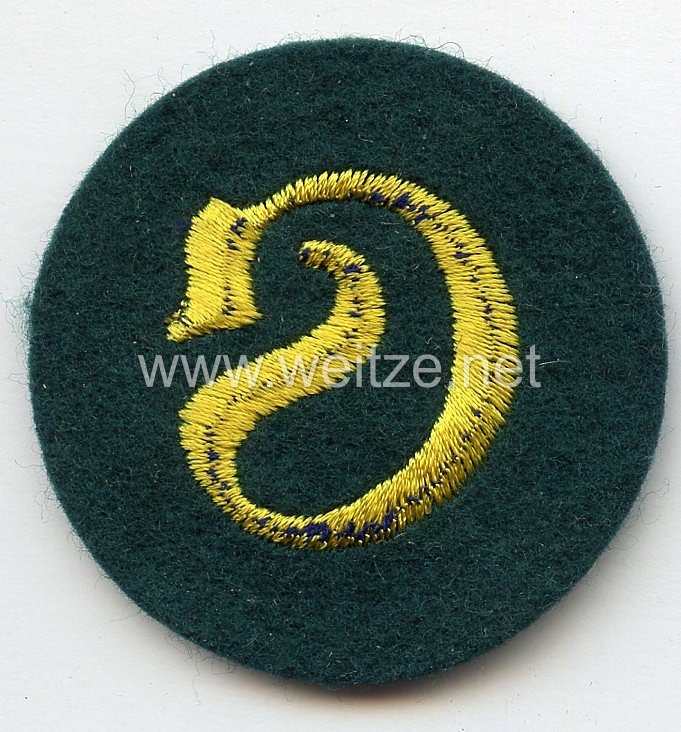
Wehrmacht Heer Sleeve Insignia Schirrmeister (Harness Master)
The Schirrmeister (Harness Master) sleeve badge of the Wehrmacht Heer represents a fascinating example of the differentiated identification systems employed in the German Wehrmacht between 1935 and 1945. This specific badge identified non-commissioned officers and enlisted men who were entrusted with the administration, maintenance, and repair of horse harnesses, saddles, and other riding equipment – a function that remained significantly important throughout World War II despite the increasing motorization of the Wehrmacht.
The Heeresdienstvorschrift (Army Service Regulation) precisely regulated the wearing and design of such career badges. The Schirrmeister badge was machine-embroidered on green cloth, using yellow thread to depict the characteristic motif – typically crossed needles or similar craft-specific symbols. The color combination of yellow on green corresponded to the Waffenfarbe (branch color) of mounted troops and cavalry, emphasizing the close connection of this function to mounted warfare.
The role of the Schirrmeister had deep historical roots in Prussian and German military tradition. Specialized craftsmen for equipment maintenance were already indispensable in the armies of the 18th and 19th centuries. With the founding of the Reichswehr in 1921 and later the Wehrmacht in 1935, this system was formalized and expanded. The Schirrmeister was not an officer but belonged to the non-commissioned officers or enlisted men with specialized training – comparable to today's specialist NCOs.
The Wehrmacht relied on surprisingly extensive horse contingents during World War II. Estimates suggest that the German army used approximately 2.75 million horses during the war, primarily for logistics, artillery traction, and supply transport. This dependence on horses, especially on the Eastern Front, made the Schirrmeister's work essential to the war effort. A poorly fitting harness could lead to injuries to the animals, which could significantly impair a unit's transport capacity.
The machine embroidery of these badges was standard from the late 1930s onward. Unlike hand-embroidered badges, often used for officers, machine-made badges were more cost-effective and faster to produce. The quality of embroidery varied depending on the manufacturer and production year. Various companies in Germany, but also in occupied territories, produced such badges, with quality standards declining particularly in the later war years.
The badge was worn on the left upper arm of the field tunic or service dress, typically about 10 to 15 centimeters above the elbow. The exact position was regulated to ensure a uniform appearance. In addition to the Schirrmeister badge, numerous other career badges existed for various specializations: Waffenmeister (armorer), Feuerwerker (artificer), Beschlagmeister (farrier), Trainmeister (transport master), and many others.
The green base color of the cloth corresponded to the Waffenfarbe of various branches of service. Green was originally the color of riflemen and mounted troops but was also used for certain special services. The yellow embroidery contrasted clearly with the green background and made the badge highly visible – an important aspect for the quick identification of specialists in military daily life.
After World War II, such badges became sought-after collectibles. They document not only the military organization of the Wehrmacht but also the technical and logistical realities of warfare in the first half of the 20th century. For military historians, they offer insights into the structures and daily functioning of the German armed forces.
The preservation of such badges varies greatly. Condition 2 in collector nomenclature typically denotes a lightly used but well-preserved condition with minimal signs of wear. Such pieces may show slight discoloration, minimal thread loosening, or small storage marks, but are fundamentally complete and display the motif clearly recognizable.
Today, these artifacts serve primarily for historical research and documentation. They recall a time when, despite technical modernization, traditional warfare methods and the associated crafts still played a central role. The Schirrmeister badge symbolically represents the transition between traditional and modern warfare – an era in which horses and tanks, craftsmanship and industry existed side by side.