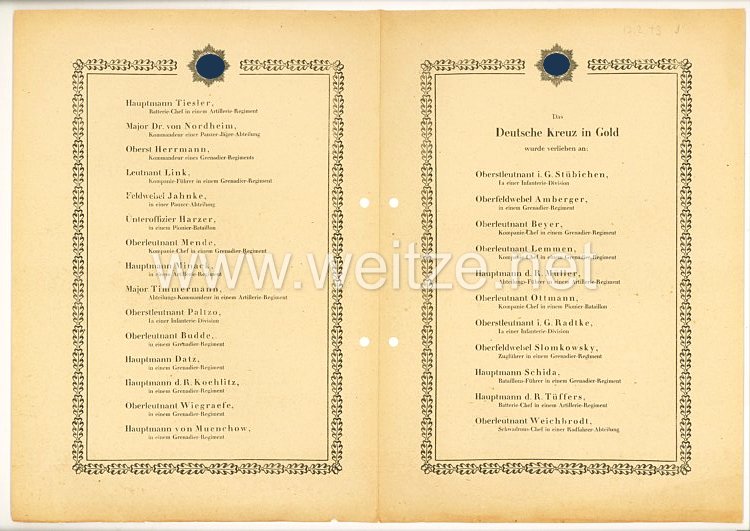
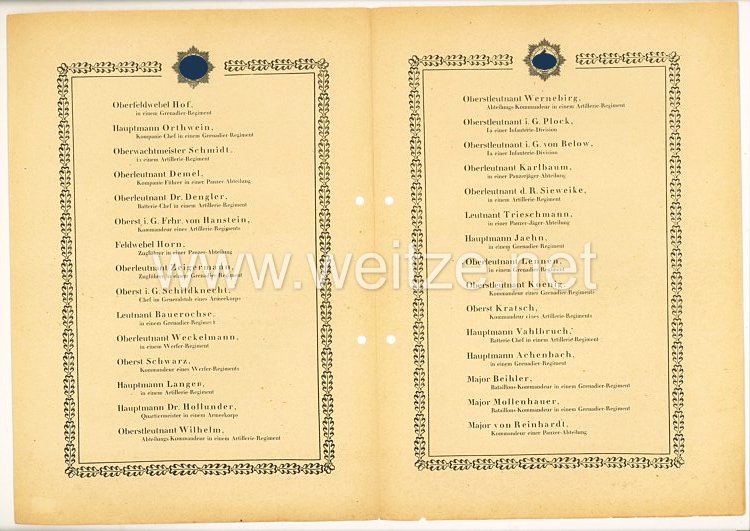
Award List for the German Cross in Gold - February 1943

DIN A4 double sheet in used condition.
349324
100,00

Award List for the German Cross in Gold - February 1943

The Award List for the German Cross in Gold from February 1943 represents a significant contemporary historical document from the Second World War era. Such lists documented the official awards of one of the most important decorations for bravery in the German Wehrmacht and constitute an essential component of the Third Reich's military decoration system.

The German Cross in Gold was established through a foundation decree dated September 28, 1941, by Adolf Hitler as Führer and Supreme Commander of the Wehrmacht. This decoration was intended to fill a gap in the existing order system between the Iron Cross First Class and the Knight's Cross of the Iron Cross. The German Cross existed in two grades: in Gold for bravery before the enemy and in Silver for wartime merit.

The German Cross in Gold was awarded for repeated acts of bravery that did not meet the requirements for the Knight's Cross but significantly exceeded the level required for the Iron Cross First Class. The decoration was awarded on all fronts and in all branches of the Wehrmacht (Army, Air Force, and Navy) as well as in the Waffen-SS.

February 1943 marks a particularly critical point in the course of the Second World War. That month saw the end of the Battle of Stalingrad with the capitulation of the 6th Army on February 2, 1943, which represented a turning point on the Eastern Front. Simultaneously, fighting intensified in North Africa, and the Battle of the Atlantic raged against Allied convoys. During this phase of the war, particularly many decorations were awarded for the fierce combat operations.

The award lists themselves were created in A4 format as double sheets and served the administrative documentation of medal awards. They typically contained the name of the recipient, their rank, unit affiliation, and the date of the award. These lists were maintained by various offices and were part of the official military administration. They served both for documentation and for announcing awards within troop formations.

The awarding of the German Cross in Gold involved an extensive bureaucratic procedure. The nomination had to be made by the unit commander and forwarded through the military chain of command to the High Command of the respective Wehrmacht branch. Final approval was given by the Führer and Supreme Commander of the Wehrmacht; later, this authority was partially delegated to army group and army commanders.

The external appearance of the German Cross in Gold was distinctive: it consisted of a golden star with a superimposed swastika in the center, surrounded by a wreath. The decoration was worn on the right side of the chest and was significantly larger than other medals, making its wearers immediately recognizable. In soldiers' slang, it was also referred to as the “fried egg” or “tin plate.”

By the end of the war, approximately 24,204 German Crosses in Gold had been awarded. Most awards went to members of the Army (around 18,000), followed by the Air Force (about 4,000) and the Navy (approximately 400). The Waffen-SS received around 1,600 awards. These numbers illustrate the relative rarity of this decoration compared to the Iron Cross, which was awarded millions of times.

The historical significance of such award lists lies in their documentary value. They enable the tracing of military careers and the verification of decorations today. For military historical research, they are indispensable primary sources providing insight into the decoration system, military organization, and the intensity of combat operations at specific times.

The condition as a used document underscores the authentic use of this list in the military administration of that time. Such documents were produced in multiple copies and distributed to various offices, demonstrating their official function as administrative records. Today, they are important witnesses to a historical epoch and serve the scholarly examination of Second World War military history.