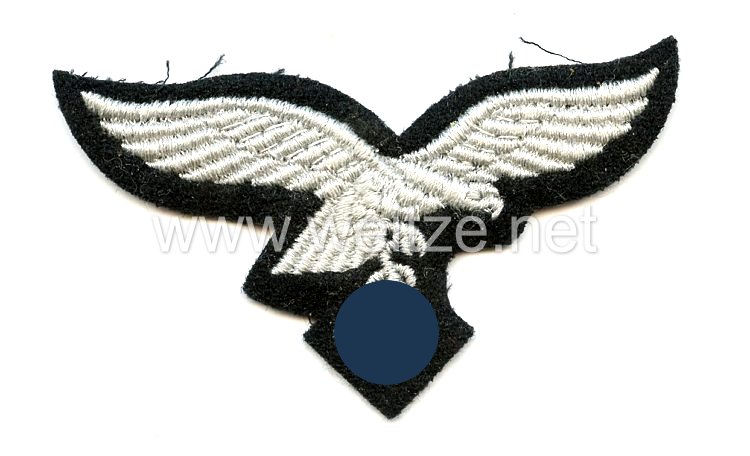
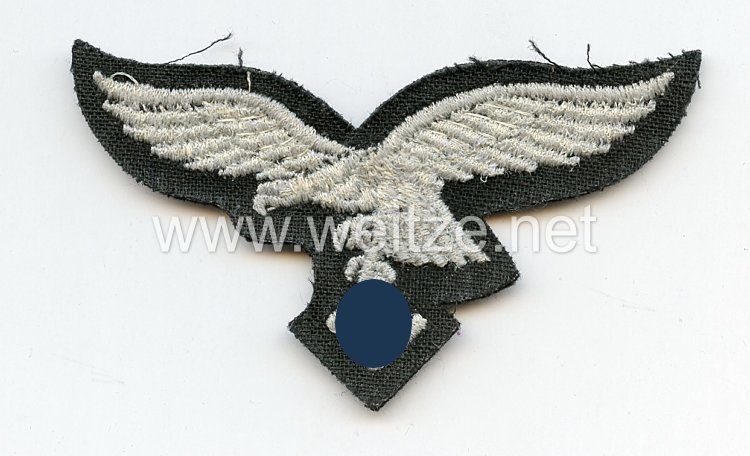
Luftwaffe Visor Cap Eagle for Members of the Fallschirm-Panzer-Division Hermann Göring
The Luftwaffe cap eagle for members of the Fallschirm-Panzer-Division Hermann Göring represents a fascinating chapter in German military history during World War II. This badge, machine-embroidered on black cloth, was part of the headgear for enlisted ranks of one of the most unusual and elite formations of the Wehrmacht.
The Fallschirm-Panzer-Division Hermann Göring originated from the Regiment General Göring, founded in 1935 as a police unit. After integration into the Luftwaffe, this formation developed continuously. In 1942, it was expanded to the Brigade Hermann Göring and fought in North Africa under the command of Major General Wilhelm Schmalz. The unit distinguished itself through intense combat in Tunisia before being transferred to Sicily following the Axis capitulation in North Africa in May 1943.
Further expansion to the Fallschirm-Panzer-Division Hermann Göring occurred in 1943. This unusual designation reflected the hybrid nature of the unit: although it belonged to the Luftwaffe and contained paratrooper elements, it possessed full armored capabilities. This dual nature made the division one of the best-equipped German formations, as Hermann Göring, as Commander-in-Chief of the Luftwaffe, could ensure that “his” division received preferential access to weapons, equipment, and personnel.
The cap eagle itself followed general guidelines for Luftwaffe insignia, but with specific features for this special formation. The machine-embroidered version on black cloth was characteristic of enlisted ranks. Unlike the hand-embroidered or metal versions for officers, these machine-made eagles were more cost-effective to produce and were manufactured in larger quantities.
The black cloth background was a hallmark of armored troops, who traditionally wore black uniforms - a practice that originated from the practical requirements of tank crews, where oil stains and dirt would be less visible. The use of black cloth for the Hermann Göring Division emphasized its tank status, while the Luftwaffe eagle indicated its institutional affiliation.
The division fought on several critical fronts of the war. After battles in Sicily and Italy, it was expanded in 1944 following heavy losses to the Fallschirm-Panzerkorps Hermann Göring, which comprised two divisions. The units fought on the Eastern Front in the final phase of the war and were involved in desperate defensive battles on Reich territory.
The manufacture of such badges was carried out by various civilian contractors commissioned by the Wehrmacht. Quality could vary depending on the manufacturer and production period. Earlier war years generally showed better material quality and finer craftsmanship, while towards the war's end, resource scarcity led to simplified designs and inferior materials.
The unworn specimen, as mentioned in the description, offers a unique insight into the original condition of these military insignia. Such pieces may never have been issued, remained as warehouse stock, or were procured as replacements but never used. The condition grade of 2+ indicates a very well-preserved object that might show minimal storage traces.
Today, such militaria are important historical artifacts of interest to collectors and historians alike. They document not only military uniform regulations but also the complex organizational structure of German armed forces during World War II. The Hermann Göring Division stands as an example of rivalries between different Wehrmacht branches and the special status certain units enjoyed through the patronage of high-ranking Nazi leaders.
The historical significance of such objects lies in their ability to preserve material evidence of a past era. They serve as reminders of the young men who wore these badges and the tragic events of World War II. For military historical research, they provide valuable information about uniform regulations, production methods, and the organizational development of military units.