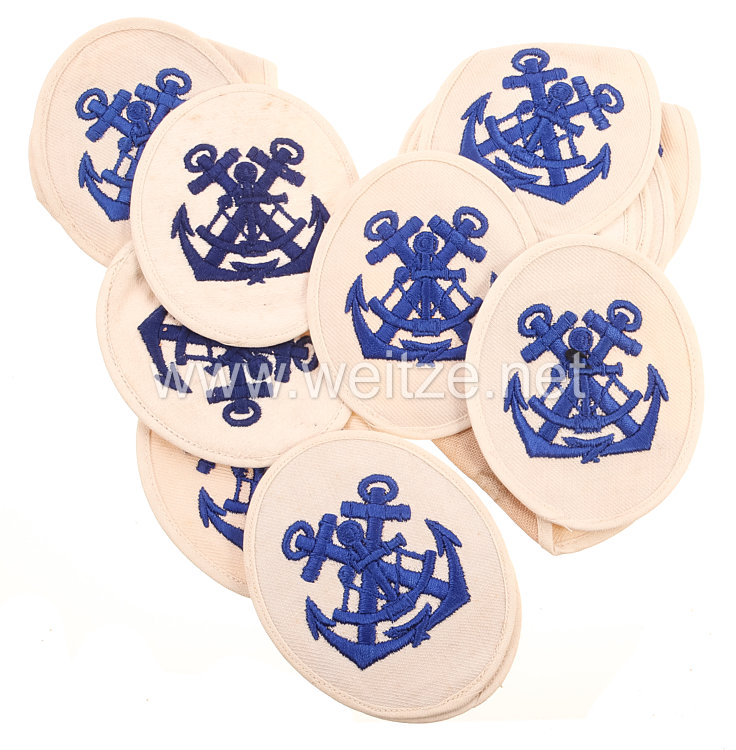
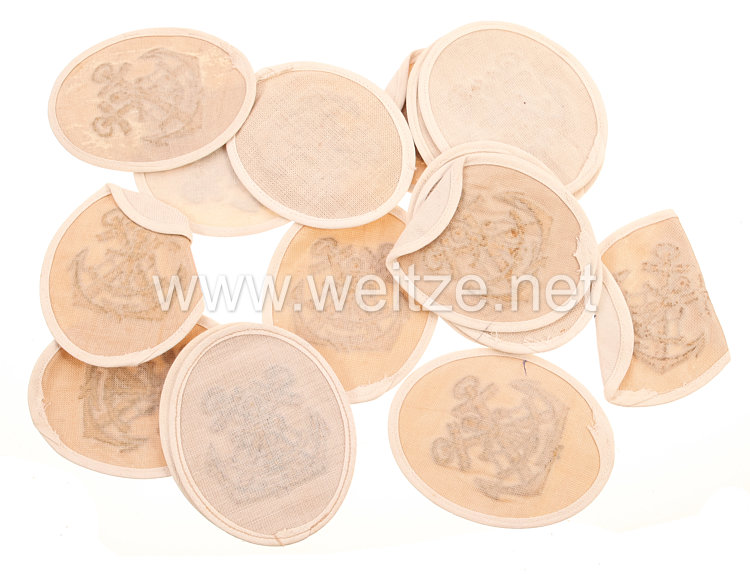
Kriegsmarine Sleeve Insignia Career Path Survey Petty Officer Third Class
Price per piece: 12 Euro.
Condition may vary.
The Kriegsmarine sleeve badge for Vermessungssteuermannsmaate (Survey Quartermaster's Mate) represents a fascinating example of the complex rank insignia and career track structure of the German Kriegsmarine during World War II. These specialized badges were worn on the white summer blouse and identified petty officers in a highly specialized technical career path.
The Kriegsmarine, officially established on June 1, 1935, adopted and expanded the rank system of the Weimar Republic's Reichsmarine. The career track badge system developed from the necessity to organize an increasingly technically specialized navy. The rank of Steuermannsmaat corresponded to the grade of a petty officer (Maat) in the quartermaster career track, with the designation “Vermessung” (survey) indicating further specialization.
The survey career track within the Kriegsmarine was of particular importance for navigation and naval warfare. Survey personnel were responsible for nautical calculations, chart maintenance, position determination, and the creation of precise navigation data. In an era before GPS and modern electronic navigation systems, this expertise was absolutely critical to warfare.
The sleeve badge itself followed the strict regulations of the Anzugsordnung für die Kriegsmarine (Dress Regulations for the Navy, M.Dv. Nr. 52). These regulations, introduced in 1935 and revised multiple times, detailed the appearance of all uniform components. Career track badges were worn on both upper sleeves and combined various elements: the basic form often showed an anchor or other nautical symbols, surrounded by a wreath. For technical career tracks like the survey track, specific symbols were added to indicate the specialty.
The white summer blouse on which this badge was worn was part of the summer uniform and was worn in warmer climates or during summer months. It was made of white cotton fabric and differed significantly from the dark blue standard uniform. Badges for the white uniform were often embroidered in dark thread to create a clear contrast against the light background.
These badges were manufactured by various authorized producers, including both military depots and private firms. Quality could vary, with early war years generally showing higher-quality embroidery work. As the war progressed and material shortages increased from 1943/44 onward, quality was often reduced, and machine-made or simplified versions were increasingly used.
The rank of Maat was the first petty officer rank after the enlisted grades of Matrose and Obermatrose (seaman and able seaman), or in the specialized career tracks, the equivalent specialized ratings. A Vermessungssteuermannsmaat typically had several years of service and had completed specialized training. The career ladder continued through Obermaat to the chief petty officer equivalents (Bootsmann, Oberbootsmann, Stabsoberbootsmann) and potentially to promotion to officer.
Training for this career track took place at specialized naval schools, where navigation, astronomy, cartography, and mathematical calculations were taught. The Naval Academy Mürwik and other training facilities played a central role here. The training was demanding and required considerable mathematical and technical abilities.
After the war ended in 1945, the Kriegsmarine was dissolved, and its uniforms and badges became historical artifacts. Today, such sleeve badges are significant military historical objects that document the complex organizational system of the Kriegsmarine. They provide insights into the technical specialization and hierarchical structure of a modern 20th-century navy.
For collectors and historians, the condition of such badges is significant. “Condition 2” typically indicates good to very good condition with minor signs of wear but without significant damage. The embroidery should be intact, and colors should still be recognizable, even if minor signs of aging are accepted.
These career track badges represent not merely military insignia but rather testimony to the sophisticated organizational structure that characterized modern navies. They reflect the transition from traditional seamanship to increasingly technical and specialized naval operations that characterized mid-20th century naval warfare.