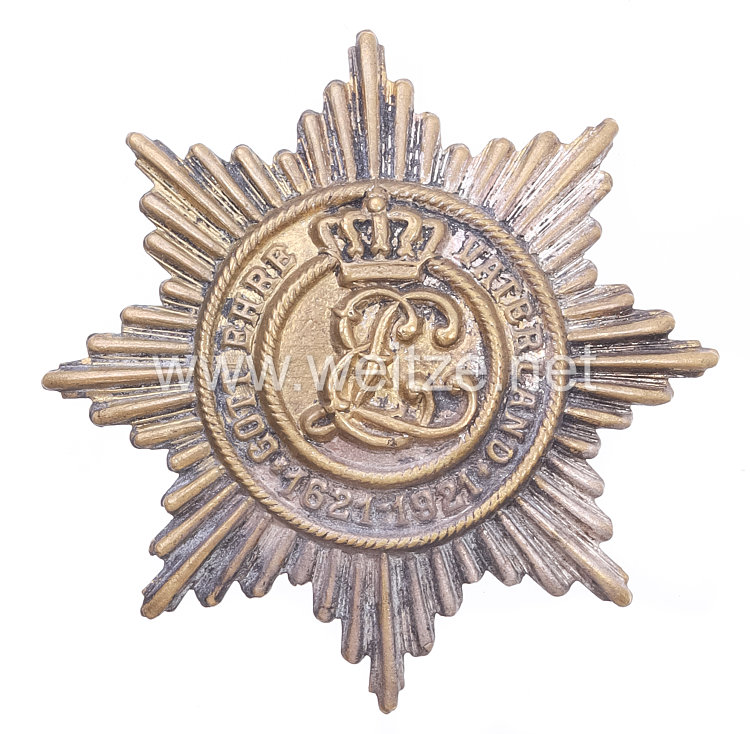
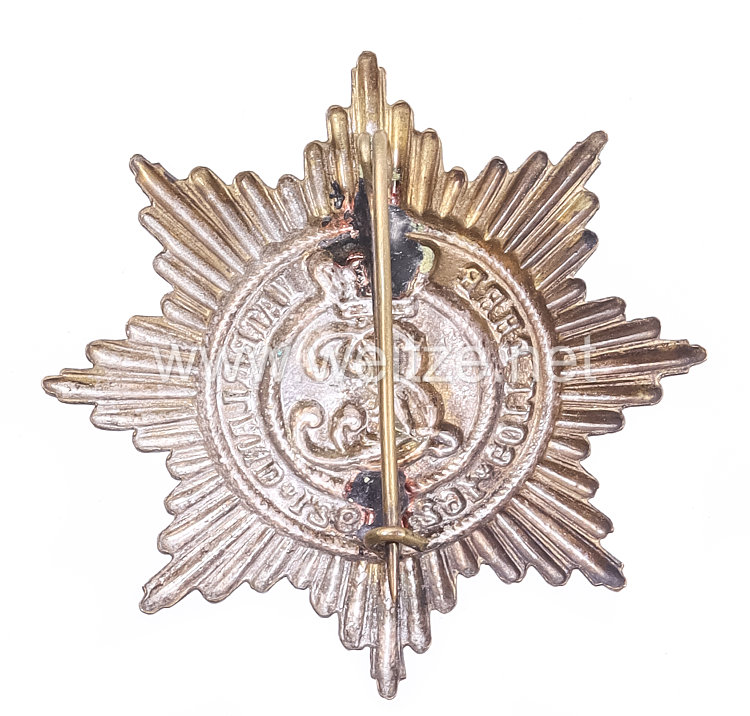
Hessen Anniversary Badge for Former Members of Leibgarde-Infanterie-Regt. Nr. 115, 1921

Stick pin badge in the form of the Hessian Star, at the center the crowned regimental cipher “EL” with inscription “Gott Ehre Vaterland 1621 . 1921”
398124
85,00

Hessen Anniversary Badge for Former Members of Leibgarde-Infanterie-Regt. Nr. 115, 1921

The Jubilee Badge of Former Members of the Leibgarde Infantry Regiment No. 115 from 1921 represents a significant commemorative piece connected to one of Hesse's most traditional military formations. This pin badge was created to celebrate the 300th anniversary of the regiment and embodies the deep connection of former soldiers to their unit, even after the collapse of the German monarchy and the end of World War I.

The Leibgarde Infantry Regiment No. 115 traced its roots back to 1621, when military units were established in Hesse during the Thirty Years' War. The history of this regiment reflects the complex political and military development of Hesse over three centuries. As a Leibgarde (Life Guard) regiment, the unit maintained a particularly close relationship with the Hessian princely house and enjoyed high prestige within the German military hierarchy.

The design of the badge in the form of the Hessian Star carries particular symbolic significance. The Hessian star was a traditional heraldic symbol of the Grand Duchy of Hesse and later the People's State of Hesse. At the center of the badge is the crowned regimental cipher “EL”, standing for “Ernst Ludwig,” the last Grand Duke of Hesse and by Rhine, who reigned from 1892 to 1918. The inscription “Gott Ehre Vaterland 1621 . 1921” (God Honor Fatherland) references Prussian-German military traditions and marks the three-hundredth anniversary of the military tradition.

After World War I and the November Revolution of 1918, German armed forces were drastically reduced according to the Treaty of Versailles. The old imperial regiments were dissolved, and the Reichswehr was created as a new, significantly smaller army. For many former soldiers, this meant the end of their military careers and the loss of their identity as members of traditional units.

During this period of upheaval, numerous veterans' associations and regimental societies emerged to keep the memory of old units alive. These organizations cultivated camaraderie, organized meetings, and commemorated fallen comrades. The year 1921, when this jubilee badge was created, was a time of intense memorial culture in Germany. Despite defeat in the World War and political upheavals, many veterans held fast to their military traditions.

The production of such commemorative badges was widespread in the Weimar Republic. They served not only as personal mementos but also as recognition symbols at veteran meetings and as emblems of belonging to a particular military tradition. The badges were typically manufactured by specialized firms that focused on military decorations and commemorative items.

The pin badge could be worn on civilian clothing, allowing former soldiers to demonstrate their military past in civilian life. This was especially common at memorial events, regimental meetings, and national holidays. The use of the crown in the regimental cipher, although the monarchy had already been abolished, shows the conscious preservation of monarchist symbols in veteran circles.

The Leibgarde Infantry Regiment No. 115 had participated in numerous wars and campaigns during its existence, including the German wars of unification in the 19th century and finally World War I. The regimental history was marked by military honors but also by heavy losses, especially in the material battles of World War I on the Western Front.

From today's perspective, such jubilee badges are important historical sources for researching German military history and the memorial culture of the Weimar Republic. They document how former soldiers dealt with the loss of their old order and how military traditions continued to live on in the new democratic society. The badges are also testimonies to the craftsmanship of metalworking and the design of military insignia in the interwar period.

Collectors and historians today value such objects as material remnants of a bygone era. They help to understand the complex social and cultural dynamics of the Weimar Republic, in which old traditions met a new political reality.