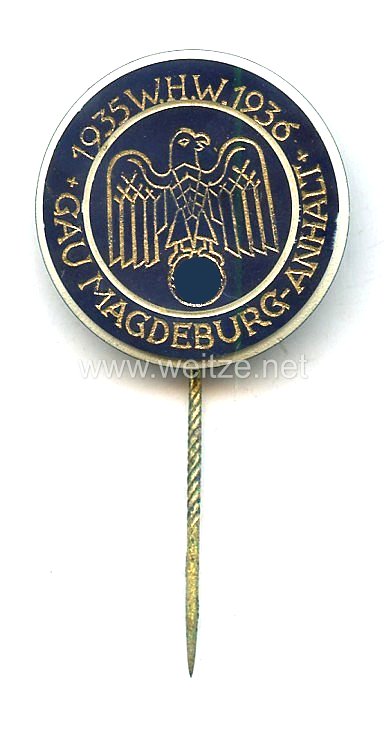
WHW - Gau 14: Magdeburg-Anhalt - 3rd WHW 1935/36 1st Gau Collection 16.17.11.1935
This badge represents a significant artifact from the National Socialist welfare and propaganda organization known as the Winterhilfswerk des Deutschen Volkes (Winter Relief Organization of the German People, WHW). This specific badge originates from Gau Magdeburg-Anhalt (Gau 14) and was issued for the first Gau collection of the third WHW year 1935/36 on November 16-17, 1935.
The Winterhilfswerk was officially founded on September 13, 1933, and developed into one of the largest National Socialist collecting organizations. Under the direction of the Nationalsozialistische Volkswohlfahrt (National Socialist People's Welfare, NSV), the WHW organized annual collections from October to March to support needy “fellow nationals” during the winter months. However, the organization served not only social purposes but was also an important instrument of National Socialist propaganda and mass mobilization.
The administrative structure of the WHW followed the territorial division of the German Reich into Gaue (regions). Gau Magdeburg-Anhalt, designated as Gau 14, comprised areas of the Prussian Province of Saxony and the Free State of Anhalt. Each Gau organized its own collections and issued specific badges, resulting in a remarkable diversity of regional collectible material.
The badge described here, made of blue synthetic resin, is characteristic of early WHW production. From 1933 onwards, millions of badges were manufactured in various materials, including metal, wood, glass, porcelain, and increasingly synthetic resin (Bakelite or similar materials). The use of synthetic resin enabled cost-effective mass production while maintaining attractive aesthetics. The badges were distributed to the population in exchange for donations and were meant to be worn publicly to demonstrate participation in the “people's community.”
The collection year 1935/36 was the third complete year of the Winterhilfswerk and marked a phase of consolidation and expansion of the organization. By this time, the collections had already become an integral part of public life in National Socialist Germany. Social pressure to participate was considerable, and refusal to donate could result in negative consequences.
The designation “1st Gau Collection” indicates that this was the first of several regional collections within the WHW year. In addition to nationwide collections, individual Gaue organized additional local campaigns that featured specific themes or motifs. This decentralized structure led to an enormous variety of badges with regional characteristics, landmarks, and cultural motifs.
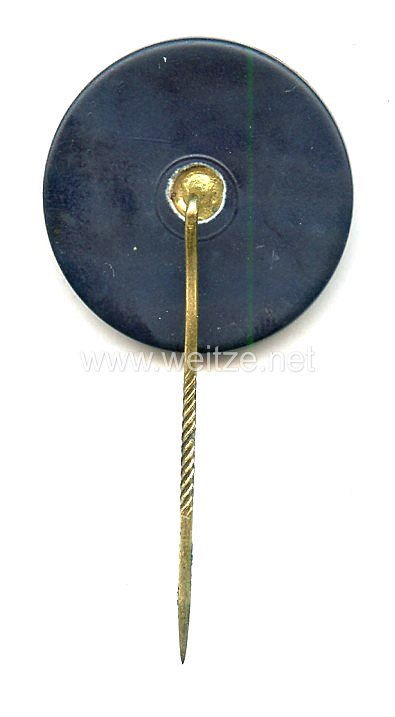
The pin construction of the badge corresponds to the standard type of WHW badges: a simple pin on the reverse allowed attachment to clothing. The stated “Condition 2” according to standard collector classification indicates good preservation with possibly minor signs of wear.
From a historical perspective, WHW badges are significant sources for researching National Socialist everyday culture and propaganda. They document the penetration of daily life by NS organizations and illustrate the connection between apparent charity and ideological indoctrination. The collections generated considerable financial resources, whose exact use often remained opaque.
The systematic recording and cataloging of WHW badges began in the 1930s and continued after 1945 by collectors. Today, these objects are important museum and scholarly sources that provide insight into production techniques, iconography, and the organization of National Socialist welfare. Gau Magdeburg-Anhalt produced a variety of regional badges throughout the WHW years, which today contribute to the documentation of local NS history.