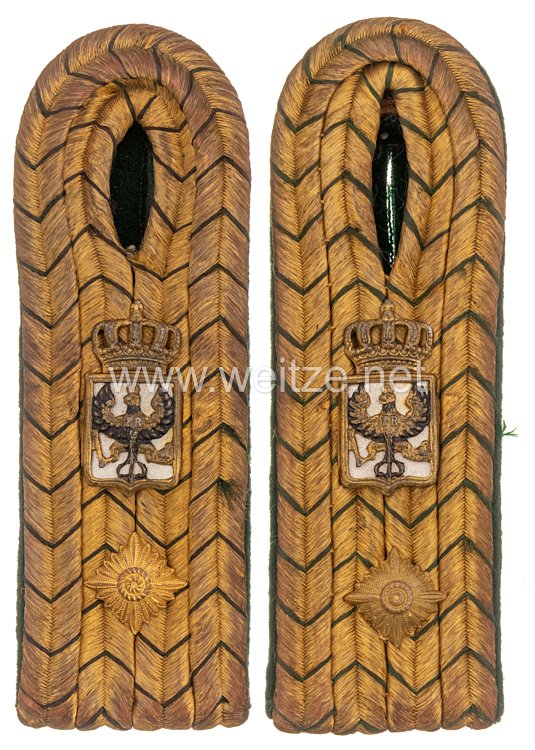
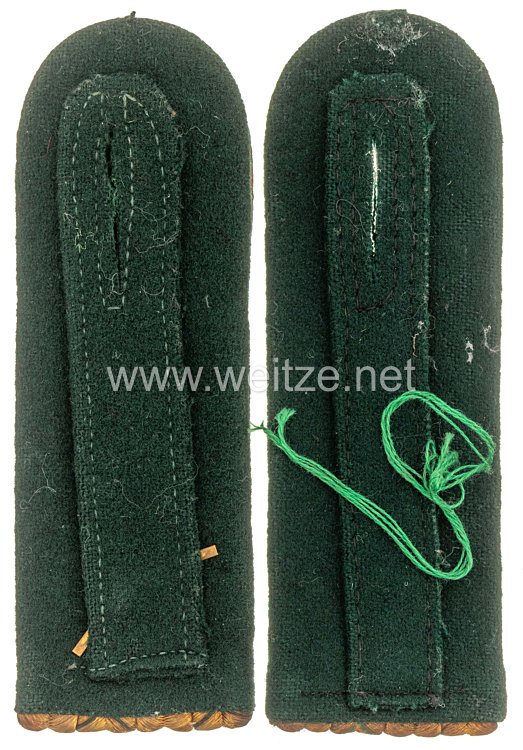
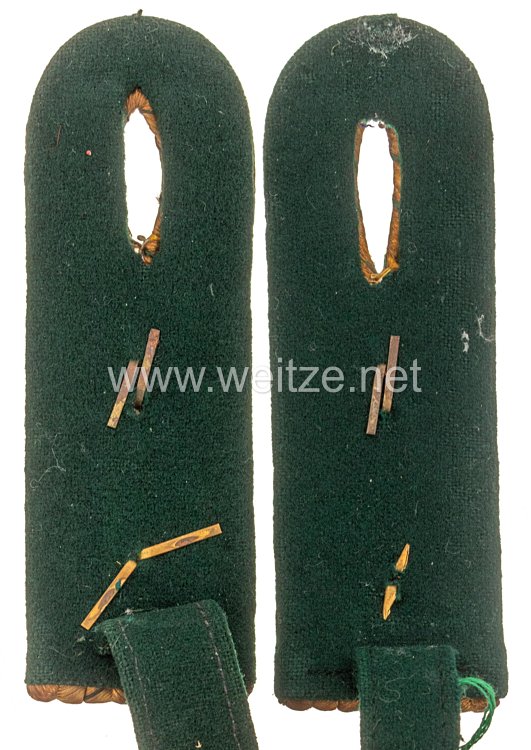
Prussia Customs Pair of Shoulder Boards for a Senior Customs Inspector

Circa 1910. Condition 2.
414123
120,00

Prussia Customs Pair of Shoulder Boards for a Senior Customs Inspector

These shoulder pieces for a Senior Customs Inspector from around 1910 represent a fascinating chapter in Prussian administrative history. They belonged to the uniform of a high-ranking official in the Prussian Customs Administration, an institution that played a central role in the economic and financial policy of the German Empire.

The Customs Administration in Prussia had a long tradition dating back to the 18th century. After the founding of the Reich in 1871 and the creation of the German Customs Union (Deutscher Zollverein), the customs system became increasingly standardized, but remained largely under Prussian administration. Customs officials were civil servants with quasi-military status, which was reflected in their uniformed appearance and clear rank insignia.

The Ober-Zoll-Inspektor (Senior Customs Inspector) was a higher administrative official within the customs hierarchy. This position was in the upper management level of the customs administration and carried considerable responsibility. An official in this position supervised several customs stations, was responsible for the training and control of subordinate customs officials, and bore responsibility for the proper collection of customs duties in his district.

The shoulder pieces (also called epaulettes or shoulder boards) served to immediately identify the wearer's rank. They were worn on both shoulders of the uniform and were characterized by specific design features. The rank insignia of the Prussian Customs Administration were strongly influenced by military models, with the various ranks recognizable through different designs of shoulder pieces.

Around 1910, when these shoulder pieces were made, the German Empire was at the height of its economic power. The Customs Administration was an important instrument of economic policy and state financing. Customs revenue formed a significant part of state income and financed, among other things, the expansion of the navy and the growing bureaucracy of the Reich.

The uniform regulations for customs officials were regulated in detail and regularly updated. The shoulder pieces had to comply with exact specifications regarding material, color, size, and decorations. For higher officials such as the Senior Customs Inspector, the shoulder pieces were generally more elaborately designed than those of simple customs officials. They could feature gilded or silvered elements, fringes, or specific stars and buttons that indicated the respective rank.

The production of such uniform parts was carried out by specialized military effects factories that produced for both the military and uniformed civilian authorities. These manufacturers were usually located in Berlin, Hamburg, or other larger cities and employed highly skilled craftsmen. The quality of workmanship was high, as these uniform pieces were often worn for years and were meant to underscore the representative character of the Prussian administration.

The customs officials themselves were a distinct social group within the Prussian civil service. They enjoyed a secure income, pension entitlements, and a respectable social status. A career in customs administration was coveted and required appropriate training and examinations. Advancement to Senior Customs Inspector was the result of many years of service and proven performance.

With the end of World War I and the collapse of the monarchy in 1918, the Customs Administration also changed fundamentally. The Weimar Republic reformed the administrative structures, and many of the old Prussian traditions disappeared. The splendid uniforms and rank insignia of the Imperial era were increasingly replaced by simpler forms.

Today, such shoulder pieces are significant collectible objects that provide insight into the administrative history of the Empire. They document not only the hierarchies and structures of the Prussian bureaucracy, but also the craftsmanship and culture of representation of that era. For militaria collectors and historians, they are valuable witnesses to a vanished world in which rank and status were immediately recognizable through external signs.

r