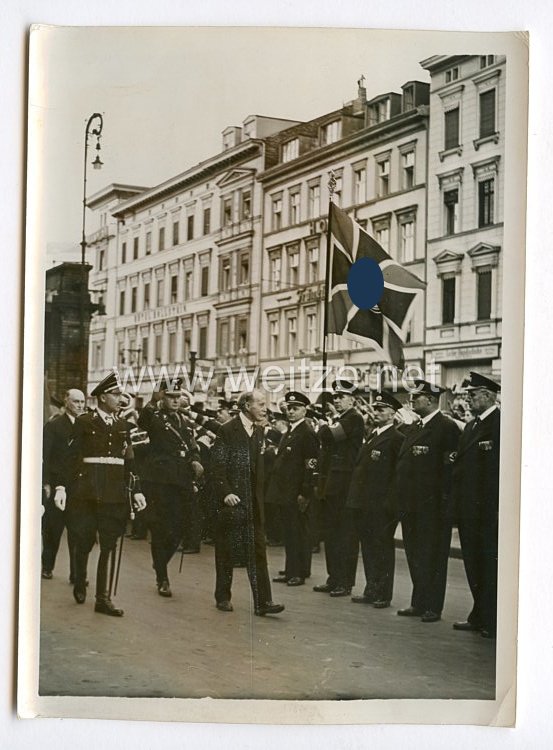
Third Reich Press Photograph. English Front-Line Soldiers in Berlin. August 4, 1938.

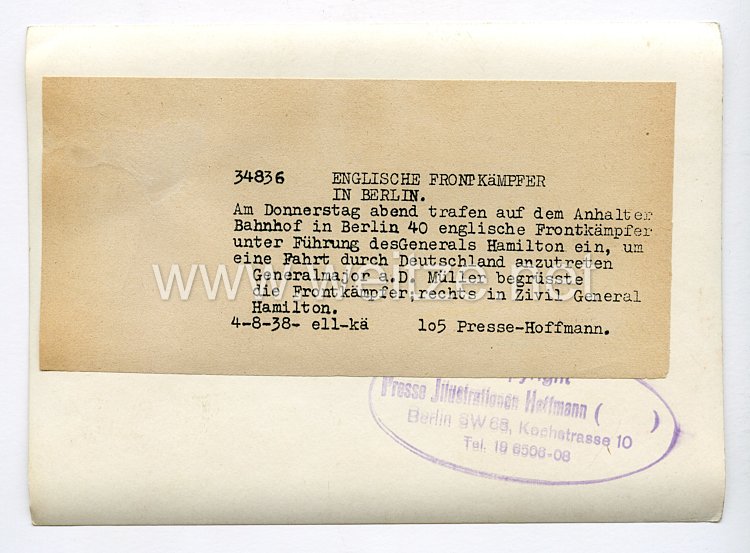
Dimensions approx. 13 x 18 cm, with description on reverse, used condition.
310223
25,00

Third Reich Press Photograph. English Front-Line Soldiers in Berlin. August 4, 1938.

This Third Reich press photograph dated August 4, 1938, documents a significant moment in Anglo-German relations immediately before the outbreak of World War II. It shows English front-line veterans during a visit to Berlin and represents a fascinating period document of the Nazi propaganda machine.

Historical Context: In the summer of 1938, Europe stood at a critical turning point. The appeasement policy of the British government under Prime Minister Neville Chamberlain attempted to prevent another war through concessions to Nazi Germany. In this context, various exchange programs and visit diplomacy took place, in which veterans' organizations also played a role.

The British Legion, the largest veterans' organization in Great Britain, maintained contacts with German veterans' associations during the 1930s. These meetings were supposedly intended to promote understanding between former war enemies, but were skillfully instrumentalized by the Nazi regime for propaganda purposes. The visit of English front-line veterans in August 1938 took place only a few weeks before the Sudeten Crisis and the Munich Agreement.

Press Photography in the Third Reich: The Reich Ministry of Public Enlightenment and Propaganda under Joseph Goebbels strictly controlled all photographic reporting in the German Reich. Press photographs were centrally registered, provided with descriptions, and distributed to newspapers and magazines. The reverse notation on such photos typically contained precise information about date, location, and image content, as well as often instructions for use.

The format of approximately 13 x 18 cm corresponds to the standard format for press photos at that time. These were taken by official photographers or photojournalists commissioned by the Propaganda Company and distributed through the German News Bureau (DNB) or the Scherl Picture Service.

Propaganda Significance: Such images of international visitors, especially from the former enemy country of Great Britain, served several purposes: They were intended to demonstrate international recognition of the Nazi regime, emphasize Germany's alleged willingness to make peace, and create the impression that even former enemies accepted the “new order” in Germany. At the same time, such visits were used to present guests with the regime's supposed achievements.

Diplomatic Background: The year 1938 witnessed numerous attempts at diplomatic engagement between Britain and Germany. Veterans' organizations were often used as unofficial channels for building bridges between nations. However, the Nazi regime viewed these exchanges primarily as opportunities to influence foreign opinion and demonstrate Germany's supposed normalization and peaceful intentions, even as it prepared for territorial expansion.

Collector and Documentation Value: Today, such press photographs are important historical sources for researching Nazi propaganda and the pre-war period. They document not only the events depicted but also the way the regime visually conveyed its messages. The used condition with reverse notation increases the documentary value as it proves actual use in press work.

The authenticity of such documents can often be verified through various characteristics: stamps from news agencies, handwritten notes, censorship markings, or publication dates. The specific date of August 4, 1938, falls during a phase of intense diplomatic activities and growing international tensions regarding Czechoslovakia.

Academic Assessment: For historians and collectors of military antiques, such press photographs represent important primary sources. They complement written documents and help understand the visual culture and propaganda strategies of the Third Reich. At the same time, they require critical examination, as they were deliberately created for propaganda purposes and cannot be understood as neutral documentation of historical events.

These photographs serve as reminders of how totalitarian regimes manipulate images and narratives to shape public perception both domestically and internationally. The fact that British veterans were willing to visit Nazi Germany in 1938 reflects the complex and often naive attitudes prevalent in some circles before the full horror of Nazi ideology became apparent to the world.

r