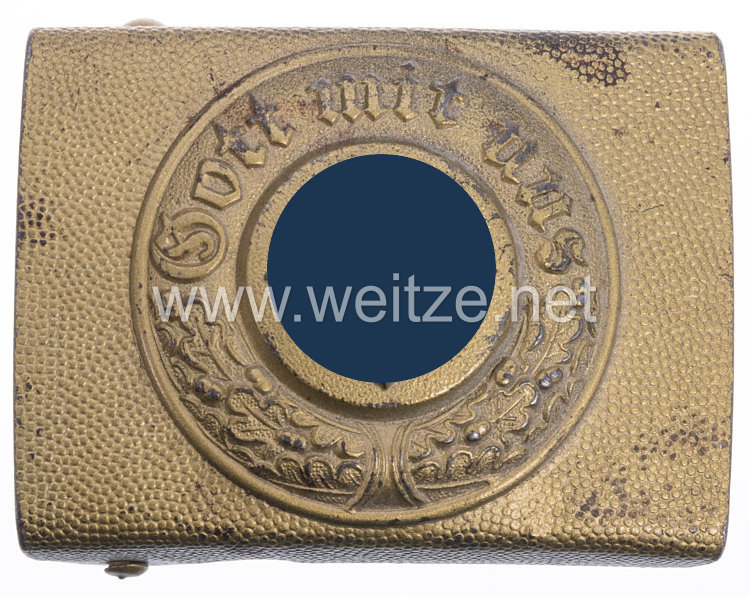
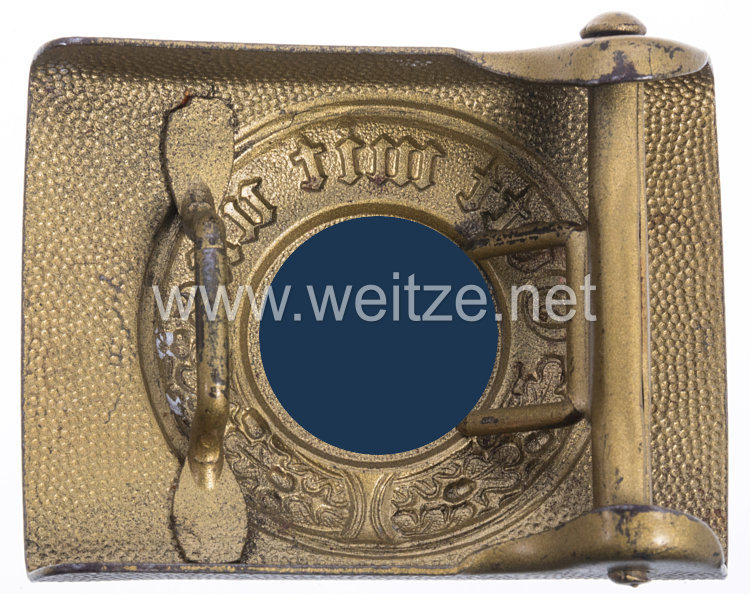
Third Reich German Police Belt Buckle for Water Protection Police and Traffic Officials

Gilded steel, reverse side marked manufacturer C.T.D., condition 2
344923
385,00

Third Reich German Police Belt Buckle for Water Protection Police and Traffic Officials

This belt buckle of the German Police from the era of the Third Reich represents a significant artifact of police uniforming during the National Socialist period. This particular specimen was manufactured for members of the Water Protection Police (Wasserschutzpolizei) and traffic officials and bears the manufacturer's mark C.T.D. on the reverse.

The Water Protection Police formed a specialized branch of the German police organization responsible for safety and order on waterways, in harbors, and on inland shipping routes. Following the Regulation on the Uniform Organization of the Police of June 17, 1936, all police units in the German Reich were consolidated under the umbrella of the Order Police (Ordnungspolizei or Orpo) and uniformly outfitted.

The belt buckle itself is made of gold-plated steel, indicating a higher-quality version for certain ranks or special purposes. Gold plating was typically regulated according to rank or departmental specifications. While ordinary police officers often wore belt buckles made of blackened or nickel-plated metal, officers and higher officials generally received gold-plated versions.

The manufacturer's mark C.T.D. most likely stands for Christian Theodor Dicke of Lüdenscheid, a significant manufacturer of metal goods and military equipment items. Lüdenscheid developed into a center of the German metal goods industry during the 19th and 20th centuries and housed numerous companies that produced uniform parts, medals, and equipment for the Wehrmacht and police. The allocation of manufacturing contracts in the Third Reich was centrally managed by the Reich Ministry of the Interior and subject to strict quality controls.

The design of police belt buckles followed the uniform regulations of the Order Police, which specified in detail which ranks and assignments were to wear which versions. Special regulations applied to the Water Protection Police, as these units conducted both land and water-based operations. Traffic officials, who also wore this buckle type, were responsible for monitoring road and sometimes rail traffic.

The Order Police under the leadership of SS-Obergruppenführer Kurt Daluege comprised from 1936 onwards all uniformed police forces of the Reich, including the Protection Police (Schutzpolizei), Gendarmerie, Municipal Police, and indeed the Water Protection Police. This reorganization served the centralization and militarization of the police, which increasingly assumed not only civil order duties but also military and security police functions.

During World War II, police units, including the Water Protection Police, were also deployed for war-essential tasks. The Water Protection Police supervised the transport of war-essential goods on inland waterways, secured port facilities against sabotage, and conducted control duties. In occupied territories, German police units also assumed occupation functions.

The present belt buckle in Condition 2 indicates good preservation with minor signs of use. Such equipment items were mostly confiscated and destroyed after the war's end in 1945, which is why preserved specimens represent historical collectibles today. They serve the scientific research of the uniforming and organizational history of the German police during the Nazi era.

From today's perspective, such objects are important material witnesses of a dark epoch in German history. They remind us of the role of the police in the National Socialist apparatus of oppression and serve historical reappraisal. Museums and research institutions preserve such pieces to make the material culture of this period accessible to future generations and contribute to critical engagement with the past.

r