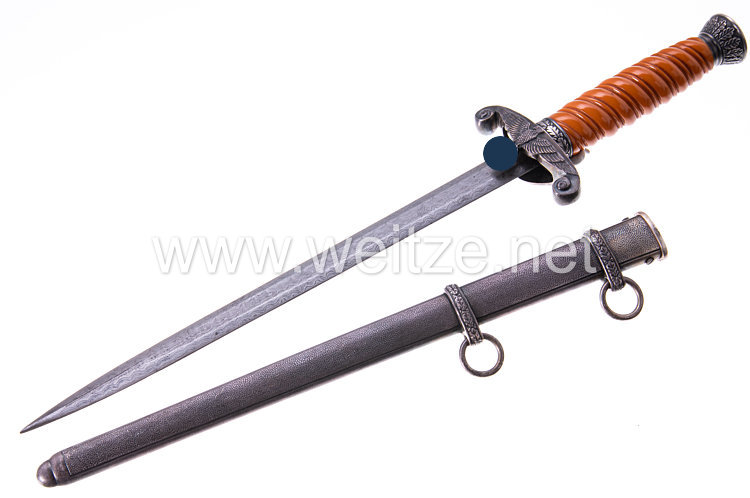
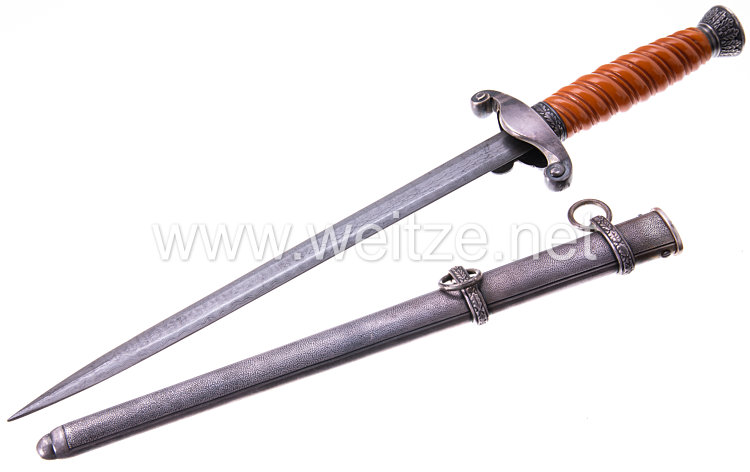
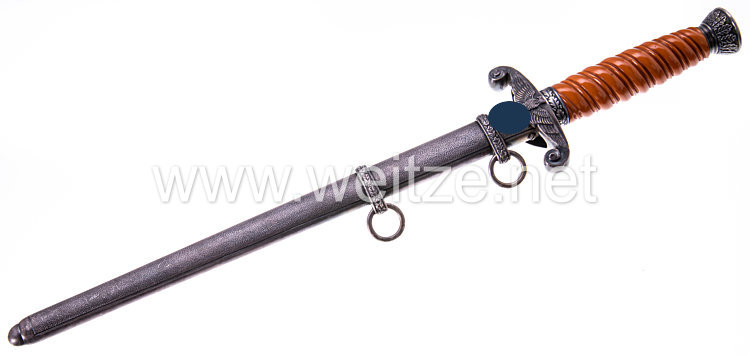
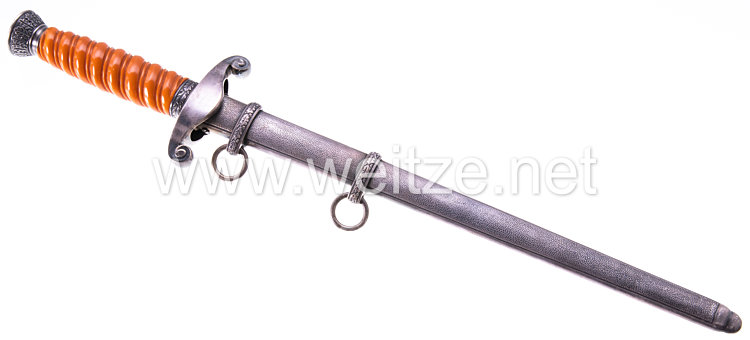
Wehrmacht Heer (WH) Officer's Dagger with Genuine Damascus Blade
The Wehrmacht Heer Officer's Dagger represents one of the most characteristic pieces of equipment of the German Army during the National Socialist period. As a ceremonial sidearm, it did not serve as a combat weapon but rather as a symbolic badge of officer rank, worn on representative occasions and during parades.
The introduction of the Army dagger occurred through the Army Regulation of July 1, 1935, which governed the wearing of edged weapons for officers and officer candidates of the Wehrmacht. The design followed traditional Prussian-German military models and was intended to symbolize continuity with the Imperial armed forces. The dagger was mandatory for all officers from lieutenant upward and was worn with the full dress uniform.
The firm Carl Eickhorn, Solingen, under the brand name Alcoso, was among the most significant manufacturers of Wehrmacht daggers. Alcoso was one of several renowned Solingen blade factories with centuries-old traditions in producing high-quality edged weapons. Early Alcoso productions were characterized by particularly careful workmanship and high-quality materials, making these daggers still sought after by collectors today.
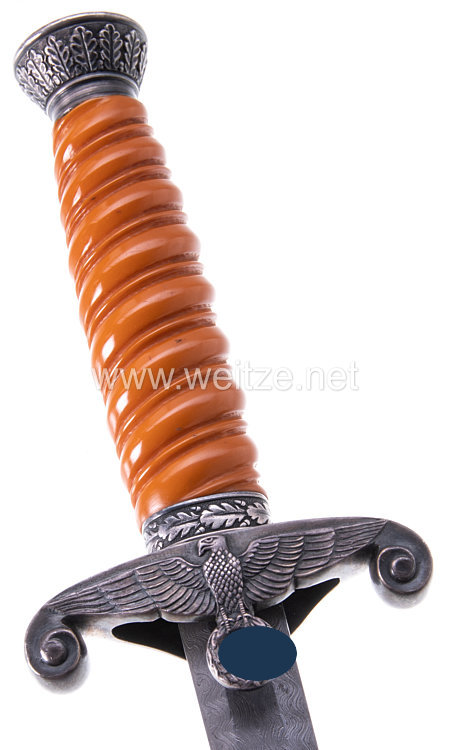
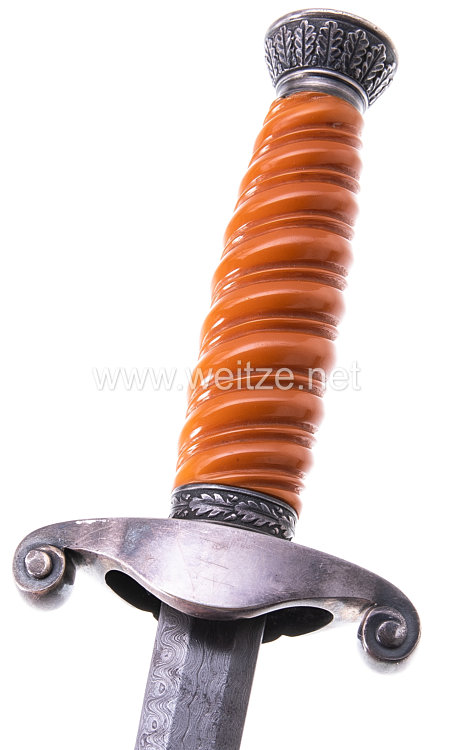
The present example exhibits several characteristic features typical of the early production phase. Particularly noteworthy is the Damascus blade, manufactured from repeatedly folded and forged steel. Damascus steel is created through the repeated folding and welding of different steel grades, producing the characteristic grain pattern. This elaborate technique was already known in antiquity and was perfected in the Islamic world as well as in Europe. Damascus steel blades were considered particularly high-quality and were significantly more expensive than standard steel blades.
The marking with the number “0” on the tang indicates an early serial number or quality control marking. The absence of the manufacturer's designation on the blade itself is not unusual for early Alcoso products, as marking practices changed over the course of production time.
The orange plastic grip was a characteristic feature of Army daggers and distinguished them from daggers of other Wehrmacht branches. The Navy, for example, used grips made of white celluloid, while the Air Force preferred yellow grips. The plastic used was usually Bakelite or a similar phenolic resin, considered a modern material in the 1930s.
The silver-plated non-ferrous metal fittings show the typical execution of Army daggers. The crossguard bears the national eagle, the state emblem of the German Reich, holding an oak wreath with swastika in its talons. The particularly large eagle was a distinguishing feature of Alcoso products and differed in size and detail from the versions of other manufacturers.
The fittings typically consisted of nickel silver or other copper alloys and were electroplated with silver. The mentioned patina is a natural aging process of the silver, caused by oxidation, and is valued in historical objects as a sign of authenticity.
The scabbard of the Army dagger was traditionally manufactured from metal and coated with black lacquer. It featured two suspension rings for attachment to the hanger, which consisted of black leather belt with silver-plated fittings. The undamaged preservation of the scabbard is remarkable, as these were frequently damaged through use and storage.
The production of Wehrmacht daggers was strictly regulated and subject to military acceptance regulations. Each dagger had to meet certain quality standards before being approved for delivery. The use of Damascus steel was optional and left to the individual buyer, as officers had to procure their daggers themselves.
After the war's end in 1945, many Wehrmacht daggers were taken by Allied troops as souvenirs or melted down during denazification. Today, well-preserved examples, especially with Damascus blades and from renowned manufacturers like Alcoso, are sought-after collector's items that represent important witnesses to German military history.
The rating of condition 2 corresponds to the preservation grade “good to very good” on the collector's scale and underscores the quality preservation of this historical object over more than eight decades.