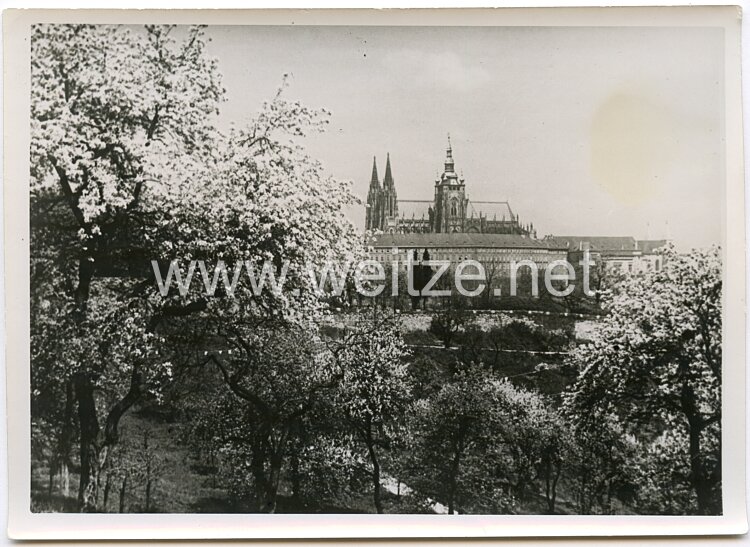
Press Photograph, Prague Capital of the Protectorate of Bohemia and Moravia 1939

, approx. 18 x 13 cm, condition 2.
234722
20,00

Press Photograph, Prague Capital of the Protectorate of Bohemia and Moravia 1939

Press Photography from the Protectorate of Bohemia and Moravia 1939

This press photograph documents a significant chapter in 20th-century European history: the establishment of the Protectorate of Bohemia and Moravia in March 1939. This image exemplifies the intensive propaganda activities of Nazi Germany and the systematic documentation of the territorial expansion of the German Reich.

On March 15, 1939, German troops marched into the remainder of Czechoslovakia, after the Sudetenland had already fallen to the German Reich in autumn 1938 through the Munich Agreement. One day later, on March 16, 1939, Adolf Hitler signed the decree establishing the Protectorate of Bohemia and Moravia in Prague. Thus, the Czechoslovak Republic, which had only emerged after World War I in 1918, effectively ceased to exist.

Press photography played a central role in the Nazi propaganda system. The Reich Ministry for Public Enlightenment and Propaganda under Joseph Goebbels strictly controlled the distribution of photographic material. Press photos were systematically distributed to German and international newspapers to shape the official representation of events. The photographs were intended to demonstrate the alleged order and legitimacy of German rule.

Prague as the capital of the Protectorate became the seat of the German Reich Protector. The first office holder was Konstantin Freiherr von Neurath, a former Foreign Minister. Prague Castle, for centuries a symbol of Bohemian statehood, became the residence of the German occupation power. This symbolic appropriation was to be photographically recorded and disseminated.

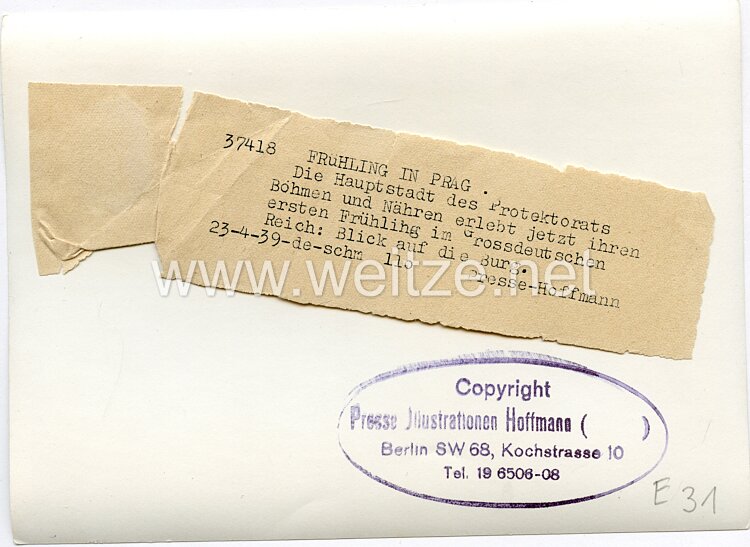
The photographers who produced such press images often worked for official agencies such as the Wehrmacht's Propaganda Companies (PK) or for Scherl-Bilderdienst, one of the largest German photo agencies of that time. The photographs were provided with stamps, captions, and often with censorship marks. The reverse sides frequently bore detailed information about location, date, and image content, as well as usage instructions for editorial offices.

The format of approximately 18 x 13 cm corresponds to a typical press photo format of the late 1930s and early 1940s. This size allowed for practical handling in editorial offices and was well-suited for reproduction in newspapers and magazines. Prints were usually made on special photographic paper with a characteristic surface texture.

For the population of Bohemia and Moravia, the German occupation meant the loss of state sovereignty. While Slovak territories formed a formally independent but German-dependent state, the Czech heartlands were placed directly under German administration. The Protectorate government under State President Emil Hácha possessed only limited powers.

The photographic documentation of the occupation served several purposes: it was meant to demonstrate the power and reach of the regime domestically, convey an image of normality internationally, and record the German perspective for historical documentation. At the same time, however, numerous private photographs and documents of resistance emerged, painting a different picture of reality.

The period of the Protectorate was characterized by increasing repression. After the assassination attempt on Reinhard Heydrich, the Deputy Reich Protector, in May 1942, terror intensified drastically. The destruction of Lidice and Ležáky are among the most notorious crimes of this period.

Today, such press photographs possess important historical source value. They document not only the depicted events but also the methods of visual propaganda and historical representation of the Nazi regime. For historians, archives, and museums, they are indispensable documents for researching this dark epoch of European history. Critical examination of such photographic material helps understand the mechanisms of totalitarian rule and propaganda.

r