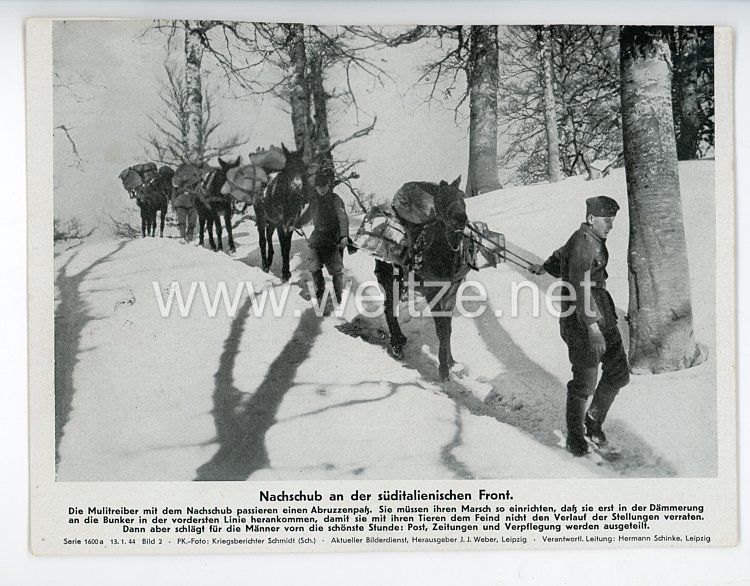
Third Reich - Printed Press Photo “Supply Operations at the Southern Italian Front” January 13, 1944
This press photograph from the Third Reich, dated January 13, 1944, documents the military situation on the southern Italian front during World War II. Measuring 23.5 x 18.5 cm, it corresponds to the standard formats of contemporary press photography and was published by Aktueller Bilderdienst (Current Picture Service), one of the most important photographic agencies of the National Socialist propaganda apparatus.
The Aktueller Bilderdienst was part of the complex propaganda system of the NS regime, operating under the direction of the Reich Ministry of Public Enlightenment and Propaganda headed by Joseph Goebbels. This organization produced and distributed thousands of photographs daily to newspapers, magazines, and other media outlets domestically and abroad. The images were meant to present a carefully curated portrayal of military events and influence public opinion in accordance with National Socialist ideology.
In January 1944, the Wehrmacht in Italy found itself in an increasingly difficult situation. Following the Allied landing in Sicily in July 1943 and the subsequent invasion of the Italian mainland in September of the same year, German troops had gradually retreated northward. The Gustav Line, a heavily fortified defensive position stretching across Italy from the Tyrrhenian to the Adriatic Sea, formed the main line of defense at this time. The famous monastery of Monte Cassino lay on this line and became a symbol of the bitter fighting in southern Italy.
The subject of “supply” was of critical importance to German warfare in Italy. The logistical challenges were enormous: supply lines had to be maintained across the Alps and through Italy's mountainous terrain, while Allied air forces increasingly gained control of the airspace. The Luftwaffe could barely provide effective protection, and transport routes were subject to constant attacks. Despite these difficulties, the Wehrmacht managed to supply its troops in Italy for an extended period, demonstrating both organizational capability and the desperation of German warfare during this phase of the war.
Press photographs of this period served multiple functions. On one hand, they served to document military operations for historical archives and intelligence purposes. On the other, they were essential tools of propaganda. Images of functioning supply operations were meant to signal to the home front and international public that the German Wehrmacht remained effective and well-organized despite setbacks. The careful selection and staging of such photographs was part of a comprehensive strategy to maintain morale and the will to persevere.
The fact that this photograph is unprinted on the reverse suggests it may have been intended as an archival copy or for internal use. Press photos were often provided with detailed captions, dates, copyright notices, and usage instructions on the back when intended for publication. Unprinted copies may have served as templates or reserve copies.
The military situation in southern Italy in January 1944 was characterized by trench warfare reminiscent of World War I battles. The Battle of Monte Cassino would last from January to May 1944 and become one of the most costly and controversial battles of the Italian campaign. Simultaneously, the Allies were preparing the Landing at Anzio, which took place on January 22, 1944, and attempted to outflank the German defenses.
For collectors and military historians, such press photographs represent important primary sources. They offer not only visual documentation of military operations but also insights into the propaganda machinery of the NS regime. The preservation and study of such materials contributes to understanding war history and the mechanisms of totalitarian information control. The good condition of this specimen makes it a valuable historical document from one of the most critical phases of World War II.