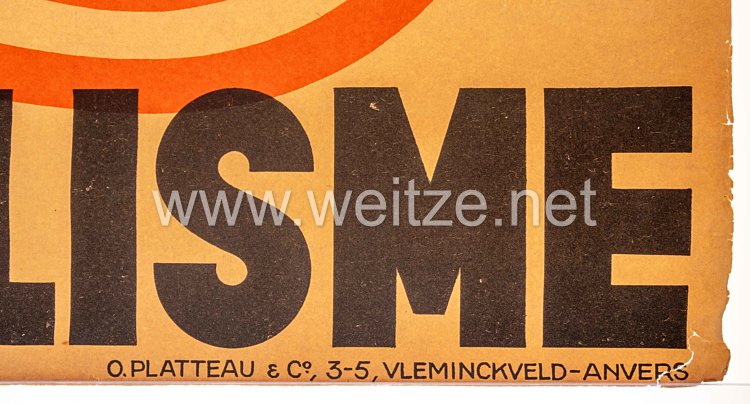
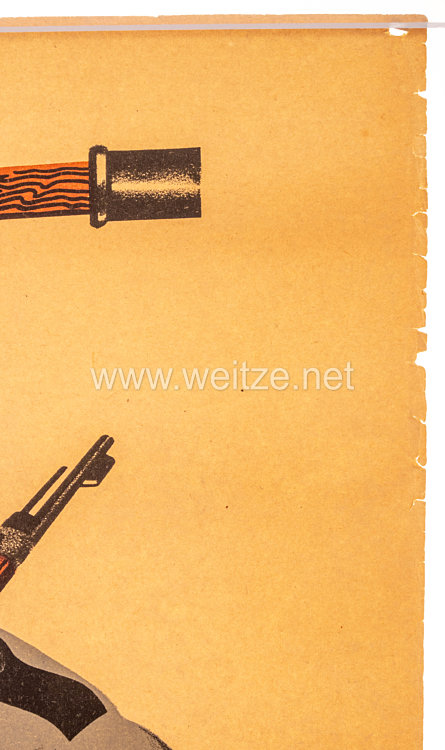
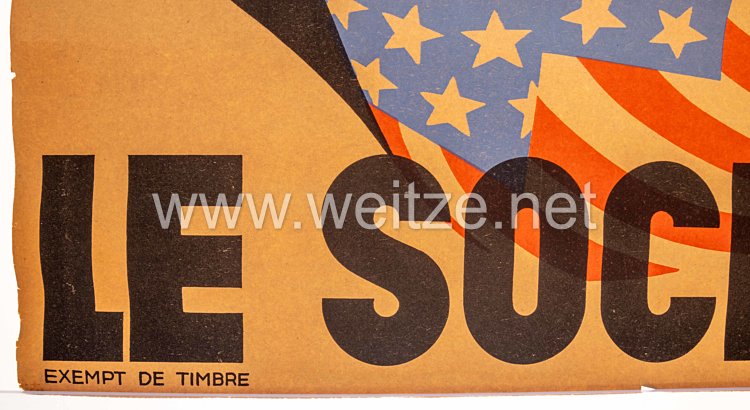
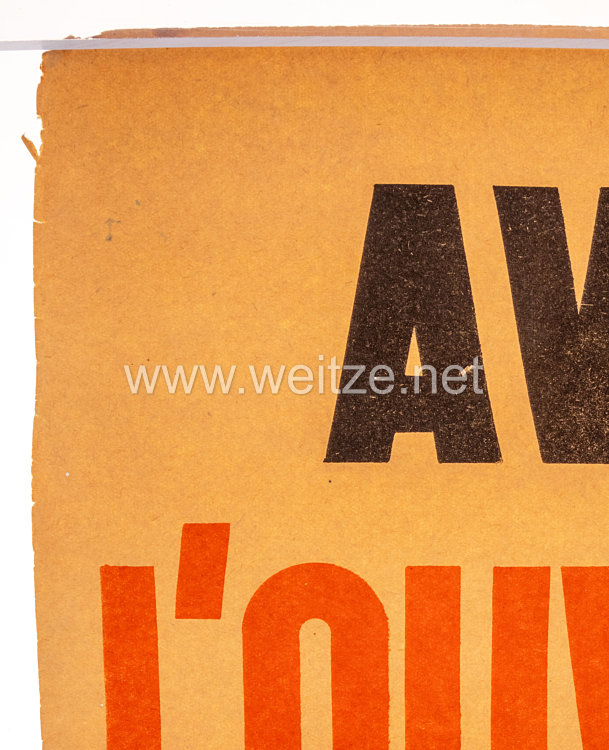
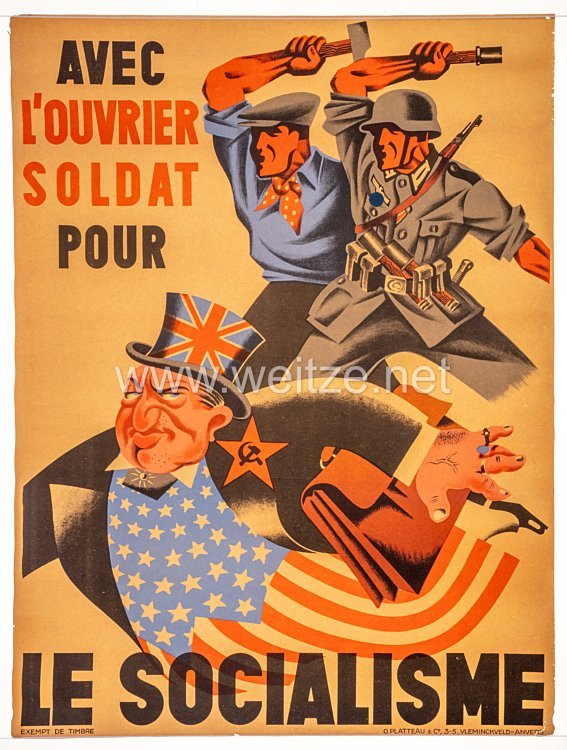
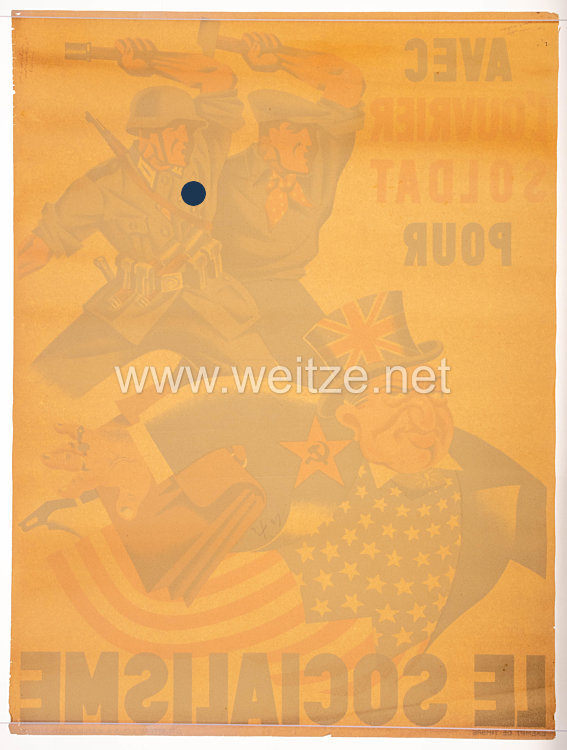
World War II Recruitment Poster for Belgian Volunteer Workers for the German Reich "With the Worker-Soldier for Socialism"

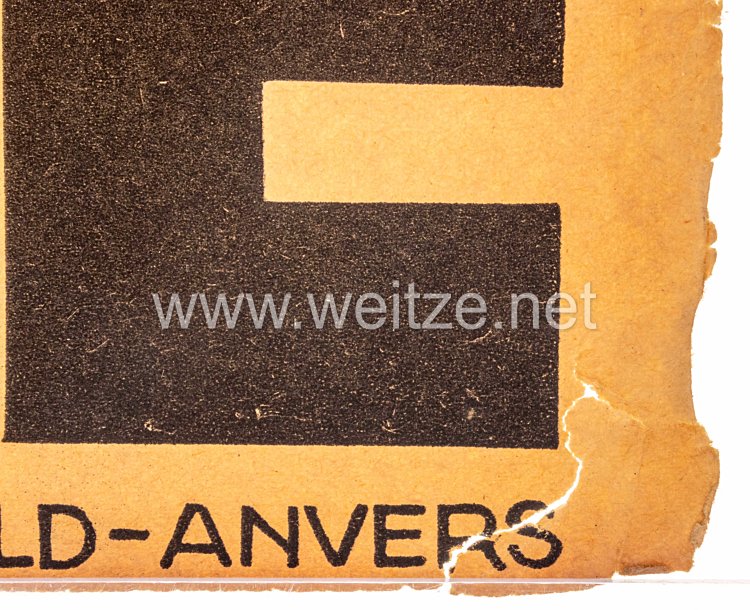
Color poster, dimensions approximately 61 x 81 cm, imprint "Avec L'ouvrier Soldat Pour Le Socialisme", Wieland G 251, manufacturer "O. Platteau & Co. 3 - 5, Vleminckveld - Antwerpen.". Edges slightly damaged, condition 2.

For deliveries to non-European countries, increased shipping costs may apply. We ask for a consultation.
Pour les livraisons dans des pays non européens, des frais d'expédition plus élevés peuvent s'appliquer. Nous demandons une consultation.
426922
1.500,00

World War II Recruitment Poster for Belgian Volunteer Workers for the German Reich "With the Worker-Soldier for Socialism"

This Belgian recruitment poster from World War II represents a significant testimony to German occupation policy in Belgium. With the inscription “Avec L'ouvrier Soldat Pour Le Socialisme” (With the Worker-Soldier for Socialism), it targeted Belgian workers and attempted to recruit them for voluntary labor service in the German Reich.

After the German invasion of Belgium on May 10, 1940 and the country's rapid capitulation, occupied Belgium came under German military administration. The Wehrmacht urgently needed workers for the German war economy, as millions of German men were fighting at the front. Beginning in 1940, the systematic recruitment of foreign workers started, initially on a voluntary basis, later increasingly through coercion.

Propaganda efforts attempted to present labor service in the Reich as an ideological project. The term “worker-soldier” was meant to establish a connection between military service and industrial labor, presenting work for Germany as a contribution to a supposedly socialist Europe. This rhetoric aimed to appeal to left-leaning workers and glorify labor service as a progressive cause.

The printer O. Platteau & Co. from Antwerp was one of several Belgian printing houses that worked for German clients during the occupation. The cataloging as Wieland G 251 refers to the systematic documentation of propaganda material from this period by collectors and historians.

German labor recruitment policy in Belgium went through several phases. Initially, attempts were made to attract volunteers with promises of good wages, accommodation, and provisions. When this proved insufficient, the occupation authorities introduced forced labor from October 1942. In total, an estimated 200,000 to 250,000 Belgian workers were deported to the German Reich.

Such posters were part of a comprehensive propaganda campaign that included newspaper advertisements, radio broadcasts, and public events. However, the reality for workers sent to Germany usually looked very different from what was promised: harsh working conditions, inadequate nutrition, and increasing bombardments characterized their daily lives.

The poster is also a document of the collaboration problem in Belgium. Some Belgian companies and institutions cooperated with the occupation forces, whether out of conviction, economic interest, or under compulsion. After liberation in 1944, many of these activities were legally prosecuted.

Today, such propaganda posters are important historical sources for researching German occupation policy and forced labor during World War II. They document the methods by which the Nazi regime attempted to mobilize people for its war economy and serve as testimonies to a dark period in European history.