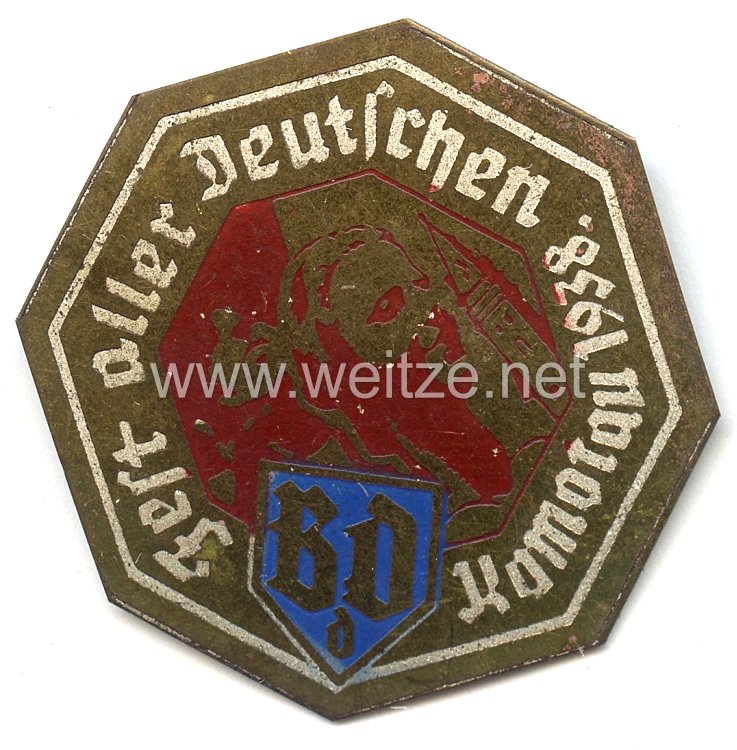
Sudetenland - Bund der Deutschen (BdD) - Festival of All Germans 1938 Komotau
The industrial city of Chomutov (German: Komotau) was the district seat of the former Okres Chomutov in the administrative region Ústecký kraj in Czechoslovakia.
This metal badge documents a significant chapter in Central European history from 1938. It is a commemorative badge of the Bund der Deutschen (BdD - League of Germans) marking the “Festival of All Germans” in Komotau (Czech: Chomutov) in 1938, shortly before the annexation of the Sudetenland by Nazi Germany.
The Bund der Deutschen was a political organization of the German-speaking population in Czechoslovakia, which came increasingly under the influence of National Socialist ideology during the 1930s. After the founding of Czechoslovakia in 1918, approximately 3.5 million German speakers lived primarily in the border regions of Bohemia and Moravia as the largest national minority in the new state. These areas later became known as the Sudetenland, named after the Sudeten mountain range.
Komotau was an important industrial city in northwestern Bohemia and the district capital of the region bearing the same name. The city had a predominantly German-speaking population and developed into a center of the Sudeten German movement. By 1938, political tensions between the German-speaking minority and the Czechoslovak government reached their peak.
The “Festival of All Germans” in 1938 took place in a highly volatile political environment. Under the leadership of Konrad Henlein and his Sudeten German Party (SdP), such events were used to mobilize the German-speaking population and propagate unification with the German Reich. These festivals simultaneously served as demonstrations of strength and as means of creating a collective identity.
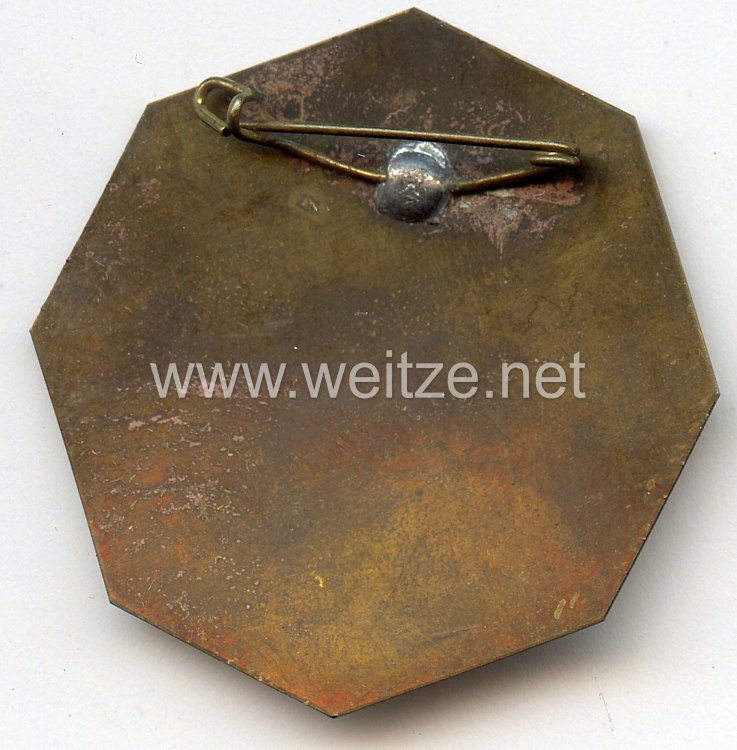
Badges like this one were important propaganda instruments and commemorative items. They were worn at political events, parades, and festivals, serving to identify wearers with the movement. The partially colored design of the metal badge was typical for the period and was intended to attract attention even in large crowds. The pin fastening allowed it to be worn on clothing.
In September 1938, the Sudeten Crisis led to the Munich Conference on September 29-30, where the European great powers (Germany, Italy, Great Britain, and France) decided on the cession of the Sudetenland to Germany without Czechoslovak participation. Between October 1 and 10, 1938, the area was occupied by the Wehrmacht. Komotau belonged to the first occupation zone and was annexed to the German Reich on October 1, 1938.
The historical significance of such badges lies in their function as contemporary documents. They illustrate the mechanisms of political mobilization and the role of symbols and public events in totalitarian movements. For collectors and historians, they offer insights into everyday history and propaganda methods of the late 1930s.
After the end of World War II in 1945, the Sudetenland again became part of Czechoslovakia. The German-speaking population was largely expelled under the Beneš Decrees. Komotau/Chomutov once again became a Czech city and today belongs to the Ústecký kraj (Ústí Region) in the Czech Republic.
The badge stands as an example of a period of dramatic political upheaval in Central Europe that ultimately led to World War II. It recalls the complex national tensions of the interwar period and the fateful consequences of the Western democracies' appeasement policy toward Nazi Germany.