Decorative Certificate for Retirement of a Postamtmann
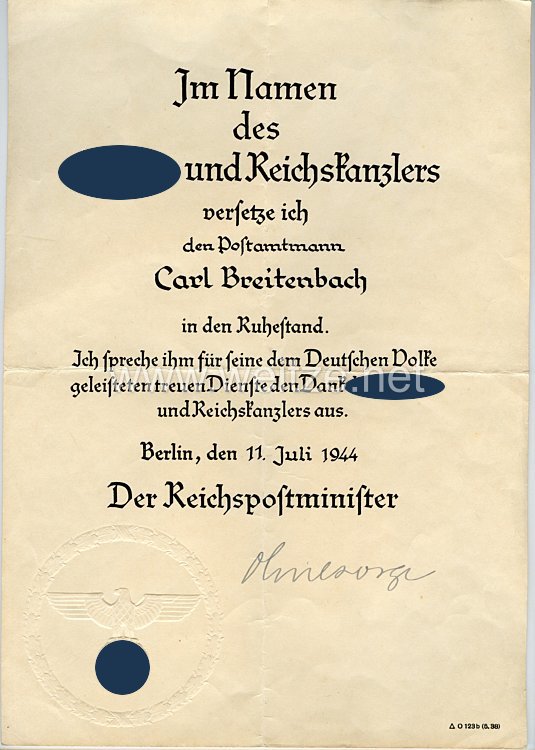
This decorative retirement certificate for a Postamtmann (post office administrator), issued on July 11, 1944 in Berlin by Reich Postal Minister Wilhelm Ohnesorge, represents a significant document from the final phase of World War II and provides insight into the honor system of Nazi Germany.
Wilhelm Ohnesorge (1872-1962) headed the Reich Ministry of Posts from 1937 until the war's end in 1945. As a convinced National Socialist and NSDAP member since 1920, he transformed the German Reich Post into one of the most important infrastructure institutions of the NS state. The Reich Post was not only responsible for civilian communication but played a crucial role in military message transmission and the administration of the German Reich.
The decorations listed on the certificate document an extraordinary career in postal service during the Nazi era. The title “Pioneer of Labor” (Pionier der Arbeit) was established in 1939 by Adolf Hitler as the highest award for achievements in German working life. This honor could only be bestowed upon individuals who demonstrated outstanding performance in their professional field over decades. The award was strictly limited and carried considerable prestige.
The Fritz Todt Ring was a decoration named after Reich Minister for Armaments and Munitions Fritz Todt, who died in 1942, and was awarded for extraordinary merits in technical and organizational achievements. Todt, who founded Organization Todt (OT), was responsible for massive construction projects such as the Westwall and the autobahn system. The ring named after him symbolized technical excellence and organizational skill in service to the Reich.
The Knight's Cross of the War Merit Cross with Swords represented the second-highest level of this decoration, which was established on October 18, 1939. The War Merit Cross honored services in the war economy and home front that contributed to the war effort. The version “with Swords” was awarded for achievements directly related to military operations. The Knight's Cross as an enhancement of the War Merit Cross 1st Class was a rare decoration granted only for extraordinary merits.
The context of issuance in July 1944 is of particular historical significance. At this time, the German Reich found itself in a desperate military situation. Only weeks earlier, on June 6, 1944, the Allies had landed in Normandy. On the Eastern Front, Soviet troops were pushing inexorably westward. On July 20, 1944, just nine days after this certificate was issued, the failed assassination attempt on Hitler by Claus Schenk Graf von Stauffenberg occurred.
Despite the catastrophic war situation, the bureaucratic machinery of the Nazi state continued to function. The issuance of decorative certificates, the awarding of honors, and the formal retirement of civil servants proceeded with meticulous precision. This underscores the importance the regime placed on maintaining normalcy and administrative continuity, even in the face of impending collapse.
Decorative certificates of this type were printed on high-quality paper or parchment and often embellished with elaborate scripts, Reich eagles, and other NS symbols. They served not only as formal documents but also as representative honorary certificates expressing the state's appreciation for long years of service. The mentioned condition 2 (multiple folds) is typical for documents preserved by recipients, often in personal files or family archives.
The Reich Post employed hundreds of thousands of workers during the war and was systemically essential for maintaining communication infrastructure. Senior postal officials such as Postamtmänner bore considerable responsibility for the smooth operation of postal and telecommunications services, which were indispensable for both the civilian population and military purposes.
Today, such documents are important historical sources that provide insight into administrative structures, the honor system, and daily life in Nazi Germany. They document the continuity of state bureaucracy even under extreme conditions and demonstrate the permeation of all areas of life with NS ideology and symbolism.