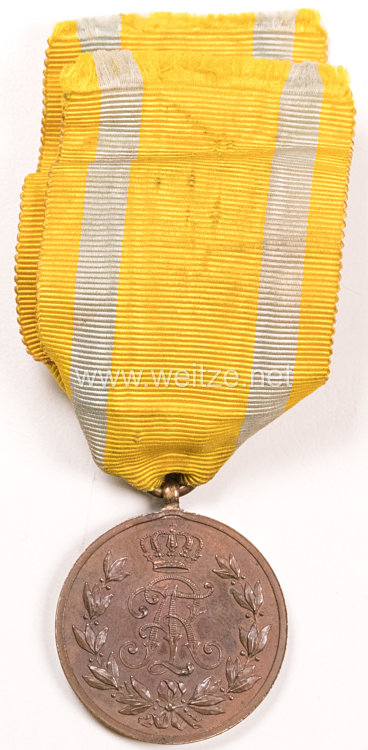
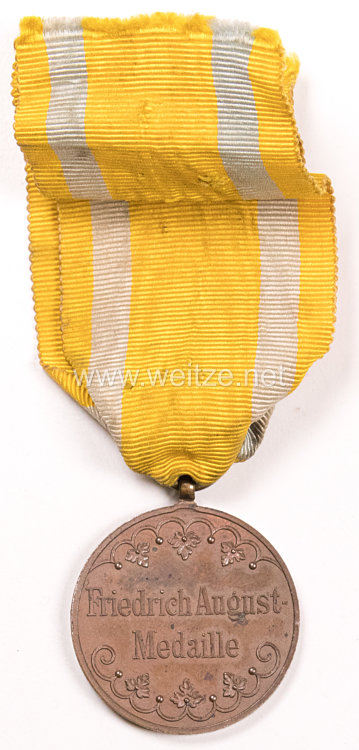
Saxony Kingdom Friedrich August Medal in Bronze

on ribbon, condition 2
302621
45,00

Saxony Kingdom Friedrich August Medal in Bronze

The Friedrich August Medal of the Kingdom of Saxony represents a significant decoration from the late monarchical period of the Saxon state. This medal was awarded in three classes – gold, silver, and bronze – and represents an important chapter in the history of Saxon honors and awards.

The Kingdom of Saxony was among the most important German states in the 19th and early 20th centuries. Following the Napoleonic Wars, Saxony was elevated from an Electorate to a Kingdom in 1806. The Saxon rulers developed a sophisticated system of orders and decorations to honor the merits of military personnel, civil servants, and civilians.

The Friedrich August Medal bears the name of one of the Saxon kings named Friedrich August. In Saxon history, there were three kings of this name: Friedrich August I (the Just, reigned 1806-1827), Friedrich August II (reigned 1836-1854), and Friedrich August III (reigned 1904-1918, the last King of Saxony). The medal was most likely instituted during the reign of Friedrich August III, as it was established during his reign as a merit and commemorative medal.

The bronze version of the medal represented the third class of this decoration and was typically awarded for lesser merits. While the gold and silver variants were reserved for higher officers, officials, and persons with particularly outstanding achievements, non-commissioned officers, enlisted men, and civilians with lesser but still commendable merits received the bronze medal.

The medal's ribbon followed the heraldic colors of the Kingdom of Saxony. Saxon decorations typically bore ribbons in the state colors of green and white, derived from the Saxon coat of arms with its characteristic crancelin (rue crown). This color scheme made Saxon honors immediately identifiable and distinguished them from decorations of other German states.

The medal itself typically displays on the obverse the portrait of King Friedrich August in profile, surrounded by an inscription with his name and title. The reverse usually bears an inscription indicating the occasion or purpose of the award, often decorated with laurel wreaths or other allegorical symbols such as the Saxon coat of arms.

Condition 2 in numismatic and military collecting terminology denotes a very good to good state of preservation. The medal thus shows only minor signs of wear, with details and striking still clearly visible. This suggests that the piece was either carefully preserved or worn only on special occasions.

In the context of German military history, Saxon decorations like the Friedrich August Medal represent important testimonies to the federal structure of the German Empire (1871-1918). Although Saxony was part of the Empire, it retained, like other federal states, the right to award its own orders and decorations. This reflected the autonomy of individual states in military and civil affairs.

The awarding of such medals followed strict regulations. Nominations had to be channeled through the military or civil hierarchy, and final approval rested with the King himself or with designated higher authorities. The medals were presented in official ceremonies and recorded in military passbooks or other documents.

With the end of the monarchy in 1918, when King Friedrich August III abdicated following the November Revolution, the era of Royal Saxon decorations also ended. The Friedrich August Medal was no longer awarded, and Saxony became a Free State within the Weimar Republic.

Today, these medals are sought-after collectibles that provide insight into the military and social history of the Kingdom of Saxony. They document the honor system of a bygone era and commemorate the individuals who were recognized for their service and achievements. The bronze version is more commonly encountered than the gold or silver variants, reflecting its broader award practice.

For collectors and historians, such pieces represent tangible connections to the complex political landscape of pre-World War I Germany, where regional identities remained strong even within the unified Empire. The Friedrich August Medal in bronze, with its original ribbon, serves as a physical reminder of the service and loyalty that characterized the relationship between the Saxon crown and its subjects during the final decades of the German monarchies.

r