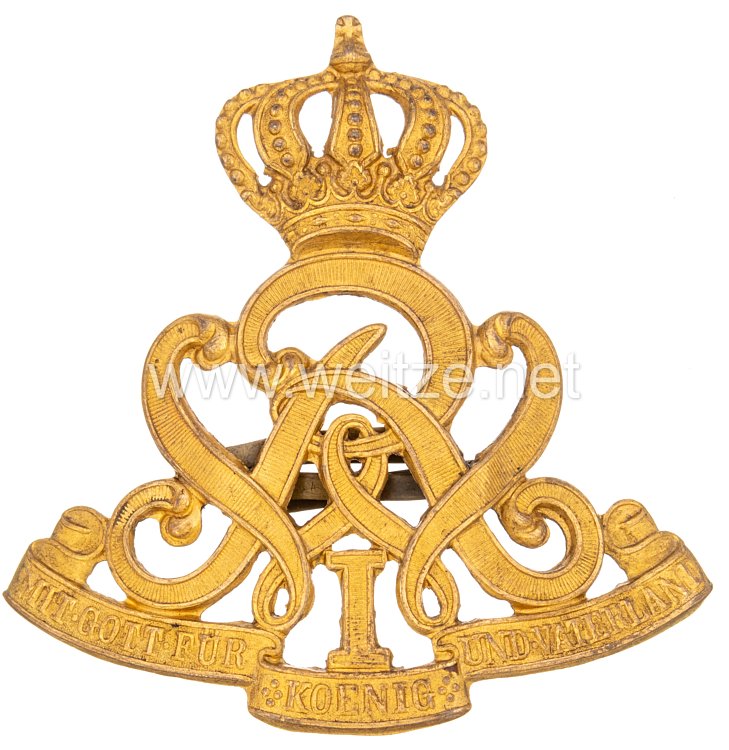
Prussia Busby Plate for Officers of Hussar Regiment König Wilhelm I. (1st Rhenish) No. 7

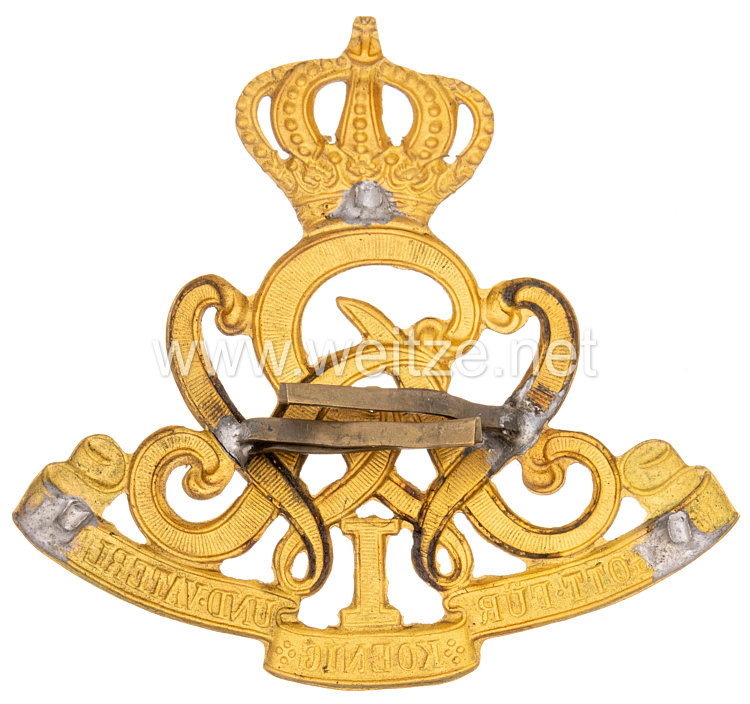
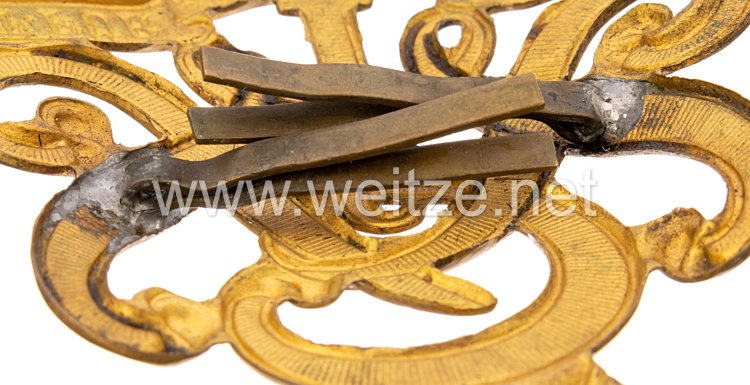
circa 1900. The bandeau with crowned cipher “WR I”, gilt base metal with burnished edges, replaced split pins, otherwise only lightly worn, in good condition. Condition 2-

Height 90mm
194221
380,00

Prussia Busby Plate for Officers of Hussar Regiment König Wilhelm I. (1st Rhenish) No. 7

The fur cap emblem for officers of the Hussar Regiment König Wilhelm I (1st Rhenish) No. 7 represents a significant testament to Prussian military tradition in the late 19th and early 20th centuries. This bandeau, manufactured around 1900 and featuring the crowned cipher “WR I,” embodies the connection between monarchical rule and military tradition in the German Empire.

The Hussar Regiment No. 7 was established in 1815 after the Wars of Liberation as the 1st Rhenish Hussar Regiment and received its garrison in Bonn. The unit initially bore various designations until it received the honorary name “König Wilhelm I” in 1861, when the then Prussian King and future German Emperor Wilhelm I assumed the regimental chieftainship. This tradition of regimental chieftainship by the monarch was characteristic of the Prussian army and was intended to express the special bond between ruler and troops.

The fur cap (also called Kolpak) was a traditional headpiece of hussars that had its origins in Hungarian cavalry. The Prussian hussars adopted this tradition in the 18th century. The high, cylindrical form made of fur—usually bearskin or sealskin—with the characteristic wing (a hanging bag) was not only practical but also gave the hussars their unmistakable, elegant appearance. The emblem on the front part of the cap, the bandeau, served as the most important distinguishing feature.

The crowned cipher “WR I” on this bandeau stands for Wilhelm Rex I (King Wilhelm I) and displays the Prussian crown. The use of the Latin designation “Rex” was common in the Prussian army and emphasized the monarchical character of the military. The gilding of the gun metal and the polished edges were typical of officers' insignia and clearly distinguished them from the simpler versions worn by enlisted men.

The technical execution of the emblem corresponds to the uniform regulations of the Prussian army around 1900. According to the Adjustierungsvorschrift für die königlich preußische Armee (Uniform Regulations for the Royal Prussian Army), the form, size, and material of insignia were precisely specified. Officers wore gilded emblems made of gun metal (a copper alloy), while enlisted men and non-commissioned officers with sword knots received gilded brass versions. Attachment was accomplished by means of split pins that were pushed through the fur of the cap and bent over on the inside.

The 1st Rhenish Hussar Regiment No. 7 was stationed throughout its entire existence in the Rhine Province, initially in Bonn, later also in other Rhenish garrisons. The unit participated in the German Wars of Unification, particularly in the Franco-Prussian War of 1870/71, where it distinguished itself in several engagements. These military successes strengthened the bond between the regiment and its royal chief.

Around 1900, when this emblem was created, the German Empire under Kaiser Wilhelm II was in a phase of military buildup and increased martial prestige. The hussars were considered elite cavalry and enjoyed high social standing. Holding an officer's commission in the hussars meant membership in the military and social upper class of the Reich.

The uniforming of hussars was particularly elaborate and costly. Officers had to procure their uniforms and equipment items themselves, which required considerable financial means. A complete fur cap emblem like the one described here was commissioned from specialized military effects manufacturers. Well-known firms such as C. Ziercke in Berlin, S. Fränkel & Co., or Gebrüder Grünewald in Bonn manufactured such high-quality emblems.

The craftsmanship of these pieces was remarkable. The cipher and crown were typically cast or stamped and then chased to bring out fine details. Gilding was usually done through fire gilding with mercury amalgam, a process that produced a particularly durable and lustrous surface. The “polished edges” were a characteristic feature in which the raised parts were polished bright while the recesses remained gilded, creating an attractive contrast.

With the end of World War I and the abdication of the Hohenzollern monarchy in 1918, such monarchical symbols lost their official significance. The Hussar Regiment No. 7, like all other cavalry units of the imperial army, was dissolved. The emblems and uniform parts became historical witnesses to a vanished era, which today are considered important military-historical collectibles providing insight into the uniform culture and military traditions of the German Empire.

r