Lineol - Army Storm Troop Leader Advancing with Revolver
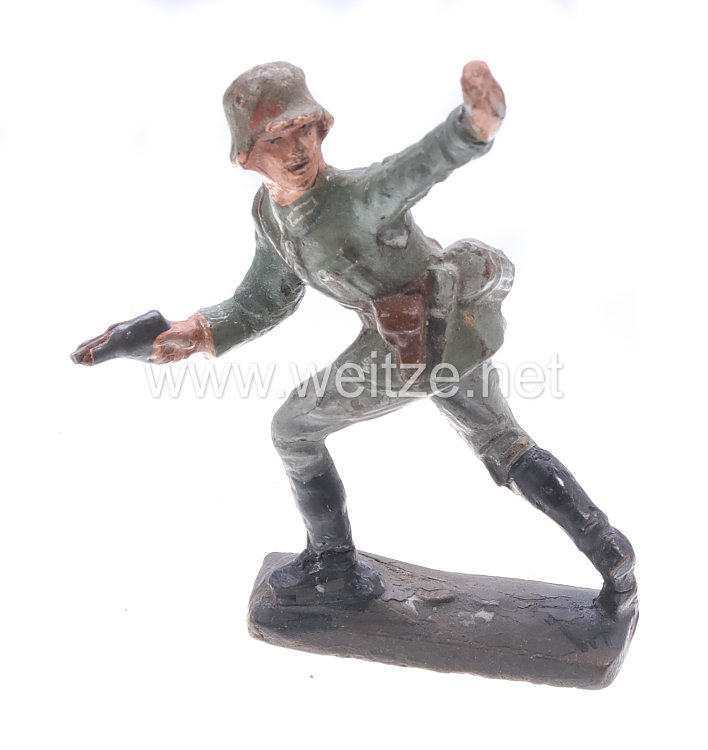
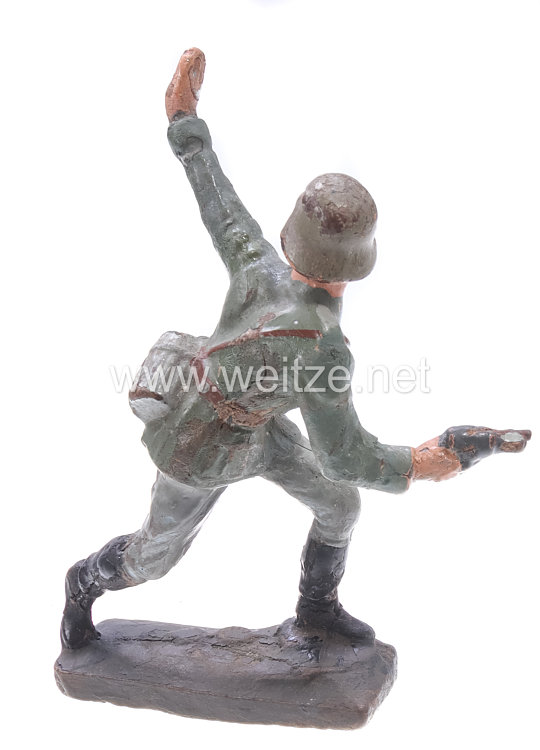
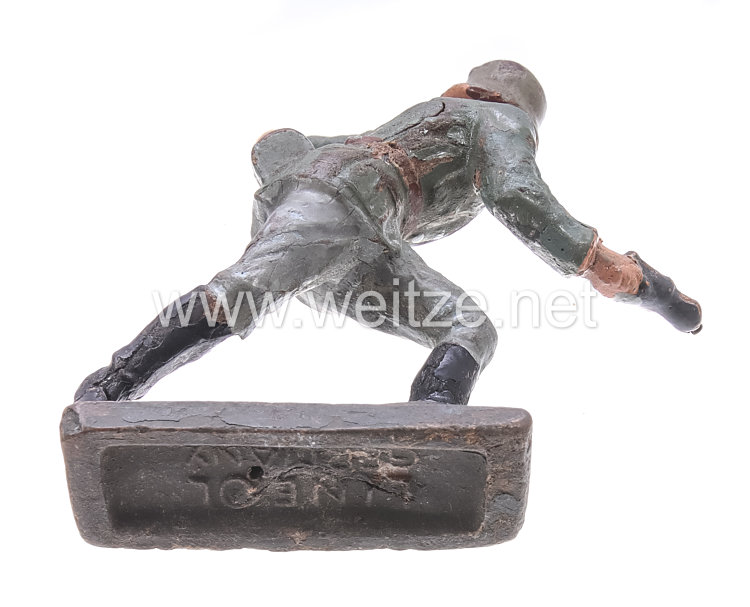
This Lineol figure of an advancing Wehrmacht assault troop leader with revolver represents a fascinating artifact of German toy production during the National Socialist era. At 7.5 centimeters in height, this composition figure belongs to the classic formats of the Nuremberg toy manufacturer Lineol, which ranked among Germany's leading producers of military toys from 1906 until the late 1940s.
The Lineol company was founded by Oskar Wiederhholz and quickly established itself as a competitor to other significant manufacturers such as Elastolin. The name “Lineol” derived from the main component of the material used, a mixture of linseed oil, sawdust, casein, and other binding agents. This composition mass enabled detailed molding while remaining robust enough for play.
The depiction of an assault troop leader (Stoßtruppführer) references a specific military role that originated in World War I. Assault troops developed from 1915 onwards as specialized units for surprise attacks, trench clearing, and reconnaissance missions. This tactic was refined during the interwar period and became incorporated into Wehrmacht military doctrine. The assault troop leader was typically a non-commissioned officer or sergeant who commanded small, highly mobile combat groups.
The figure's armament with a revolver corresponds to historical reality, as assault troop leaders frequently preferred sidearms. In the Wehrmacht, these were usually the Pistole 08 (Luger) or the Walther P38, although simplified revolver forms were often used in toy representations. The advancing posture of the figure symbolizes the offensive, aggressive combat tactics characteristic of assault troop operations.
Beginning in the early 1930s, Lineol increasingly produced figures of the Wehrmacht and other military formations. The company adapted its product range to political circumstances and manufactured extensive series of soldiers in various uniforms and positions. These figures served not only for play but also for the militarization of youth and the popularization of military values in National Socialist society.
The technical execution of these Lineol figures was remarkably detailed. The uniforms display typical features of Army uniforms, including steel helmet, belt, gas mask container, and characteristic field equipment. Painting was done in multiple stages by hand, with base colors sprayed and details applied with brushes. The indicated condition 2/2- suggests a very well-preserved figure with only minimal signs of use, which is rare for these objects over 75 years old.
The collecting and study of such toy figures today constitutes an important area of militaria studies and cultural history. These objects document not only the craftsmanship quality of German toy production but also the propaganda mechanisms and everyday culture of the “Third Reich.” They demonstrate how military ideology was conveyed even in children's rooms.
After 1945, the production of military toys in Germany was severely restricted. Lineol largely ceased production, and many molds were destroyed or reworked. This makes surviving examples from the pre-war and war periods sought-after collector's items. Today, these figures are collected primarily for historical interest and serve as visual material for researching propaganda, everyday history, and material culture of the Nazi era.
For collectors, besides condition, details such as painting, markings, and the specific variant of a figure are significant. Lineol used various production methods and changed material compositions and painting styles over the years, enabling precise dating. The scholarly examination of these objects today occurs within the context of critical memory culture and contributes to understanding the totalitarian penetration of all aspects of life under National Socialism.
These artifacts remind us that the militarization of German society extended into childhood play, serving as tangible evidence of how deeply propaganda permeated daily life. Modern collectors and historians approach these pieces with historical awareness, recognizing their value as primary sources for understanding a dark chapter of European history while appreciating the craftsmanship involved in their creation.