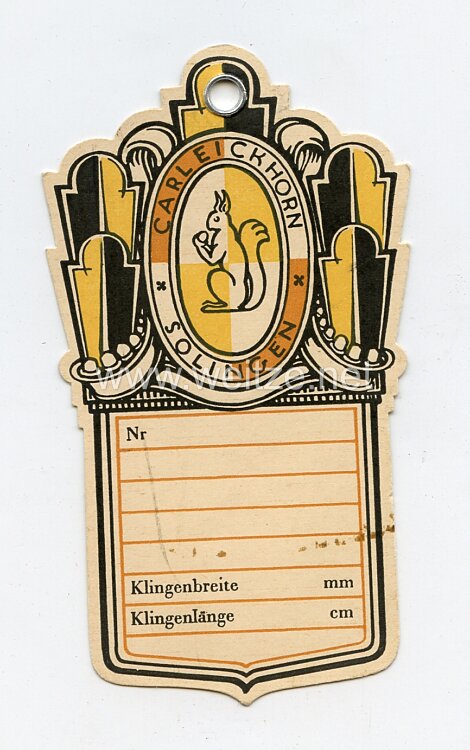
Third Reich Manufacturer Label for Edged Weapons by "Carl Eickhorn Solingen"
This manufacturer's label from the firm Carl Eickhorn Solingen represents a fascinating testimony to the German edged weapons industry during the period of the Third Reich (1933-1945). Such labels were attached by manufacturers to their products to document the authenticity and origin of the weapons.
The Carl Eickhorn Company ranked among the most significant and renowned edged weapon manufacturers in Solingen, Germany's traditional blade-making city. The company was founded in the 19th century and developed into one of the most important suppliers of military edged weapons, particularly sabers, daggers, and bayonets. During the Nazi period, Eickhorn produced a variety of weapons for various organizations, including the Wehrmacht, the Luftwaffe, the Kriegsmarine, as well as paramilitary formations such as the SA, SS, and NSKK.
The use of cardboard labels was common practice in manufacturing at that time. These were usually attached to the grip or scabbard and served multiple purposes: they identified the manufacturer, documented compliance with military specifications, and functioned as quality seals. The shield-shaped design was characteristic of many Solingen manufacturers and was intended to convey a professional, official impression.
Solingen's edged weapon production had a centuries-long tradition. Since the Middle Ages, the city had been renowned for its excellent blades. In the 20th century, several significant manufacturers concentrated there, including, besides Eickhorn, firms such as WKC (Weyersberg, Kirschbaum & Co.), Paul Weyersberg, E. & F. Hörster, and Alexander Coppel. During the Third Reich, these companies were subject to strict state controls and production specifications.
Quality control and standardization of military edged weapons were regulated by various Army Administration Regulations. Manufacturers had to mark their products with specific identifications that included, in addition to the manufacturer's name, inspection marks and sometimes production years. The labels complemented the stamped or etched markings on the weapons themselves.
Carl Eickhorn used various logos and markings throughout its history. The most famous was the Eichhörnchen (squirrel), which served as a trademark. Labels typically featured the company name, the location designation “Solingen,” and often additional graphic elements or quality designations.
The production of edged weapons during the Nazi period underwent enormous expansion. With the rearmament of the Wehrmacht from 1935 and the subsequent mobilization for World War II, the demand for military equipment increased dramatically. Solingen manufacturers worked under high pressure to meet demand. This partially led to simplifications in production and material savings, especially in the later war years.
Unused labels like the present specimen are rare today. Most were shipped with the weapons and were lost over time or damaged during use of the weapons. Collectors and historians value such original documents as they offer authentic insights into the production and distribution practices of that time.
After 1945, the production of military edged weapons in Germany was severely restricted. Many Solingen manufacturers switched to civilian products or specialized in ceremonial weapons for other countries. The Eickhorn company itself underwent various transformations and continues to exist in changed form today. The historical heritage of the Solingen blade industry is documented in several museums, particularly in the German Blade Museum (Deutsches Klingenmuseum) in Solingen.
For collectors and researchers, such manufacturer's labels are important reference objects for authenticating and dating edged weapons. They help identify forgeries and trace the production history of individual weapon models. The condition rating “Condition 2” indicates a well-preserved specimen with minimal signs of use, which is remarkable for paper materials from this period.