Kriegsmarine Sleeve Insignia Cadets Seaman Career Track
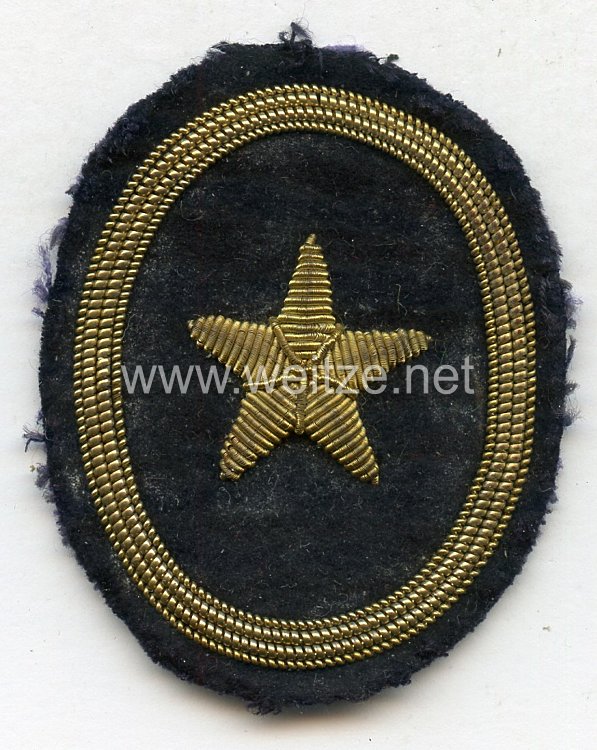
The Kriegsmarine sleeve insignia for cadets of the seamanship career path represents an important aspect of the rank insignia system of the German Kriegsmarine during World War II. This specific badge identified young officer candidates who were completing their training in the seamanship career path, one of the fundamental career tracks within the German Navy.
The Kriegsmarine, officially founded on June 1, 1935, represented the rebirth of German naval forces after the restrictions of the Treaty of Versailles. With its establishment came the development of a complex system of rank insignia and career path identifications that enabled a clear hierarchy and specialization within the naval structure. The cadet system formed the foundation of officer training.
The seamanship career path was one of the four main career tracks in the Kriegsmarine, alongside the engineering, weapons, and administrative paths. Cadets of the seamanship path were trained in navigation, ship handling, and general seamanship, forming the backbone of the naval officer corps. This career path was traditionally the most prestigious within the Navy and followed the classical traditions of the Prussian and Imperial Navy.
The sleeve insignia was manufactured from metal thread, a characteristic technique for high-quality naval badges. This manufacturing method differed from the embroidered enlisted insignia and emphasized the special status of officer candidates. The metal thread, typically made from silver-colored aluminum or tinned copper wire, was applied to dark blue cloth corresponding to the standard color of Kriegsmarine uniforms.
Training to become a naval officer in the seamanship career path began for most cadets at the Naval Academy Mürwik in Flensburg-Mürwik, the central training institution for naval officers. The institution, founded in 1910, trained hundreds of officer candidates during the Kriegsmarine era. Training comprised theoretical instruction in navigation, seamanship, tactics, and naval strategy, as well as practical training aboard training vessels.
After basic training, cadets completed a period of shipboard service on various warships, where they gained practical experience and tested their seamanship skills under real conditions. During this time, they wore the corresponding sleeve insignia that clearly identified their status as cadets of the seamanship career path.
The Kriegsmarine's insignia system was regulated by various uniform regulations and dress codes that precisely specified when and how certain badges were to be worn. These regulations were regularly updated and adapted to the changing needs of the Kriegsmarine. The correct wearing of insignia was not only a matter of discipline but also an important element of military identity and esprit de corps.
The production of such insignia was carried out by specialized firms that manufactured for the Kriegsmarine. Known manufacturers included traditional military insignia firms that had often been working for the German Navy for generations. The quality of execution varied depending on the manufacturer and production period, with earlier war years typically exhibiting higher manufacturing quality than later wartime productions.
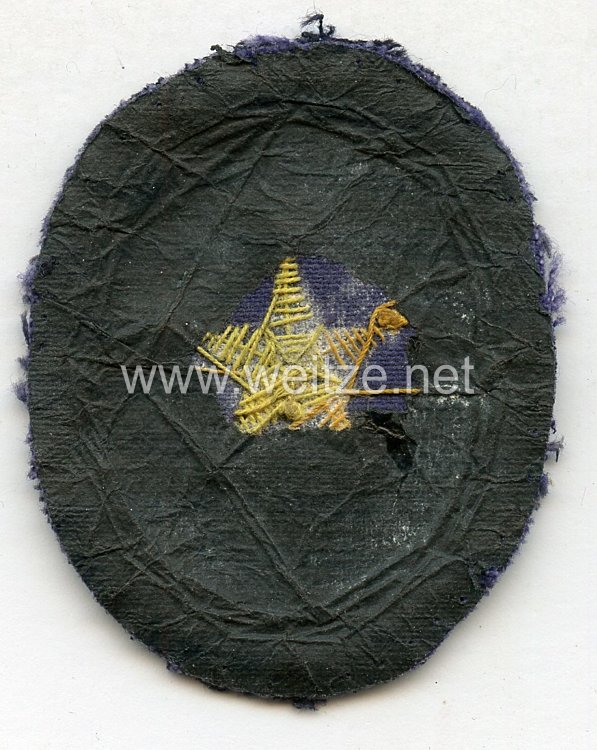
The metal thread execution required special craftsmanship. The threads were either sewn onto a backing or applied directly to the cloth piece, with various techniques being employed. The durability of such insignia was remarkable when professionally manufactured, and many specimens have survived the decades in surprisingly good condition.
With the end of World War II in May 1945, the Kriegsmarine was dissolved, and the entire system of rank insignia and career path identifications came to an end. The Allies initially prohibited all military symbolism, and only with the founding of the Bundesmarine in 1956 did a new, democratically oriented system of rank insignia emerge.
Today, such sleeve insignia are significant historical artifacts preserved by collectors and museums. They serve as material witnesses to an important, though problematic, epoch of German naval history and help to understand the complex system of military hierarchies and training paths that characterized the Kriegsmarine.