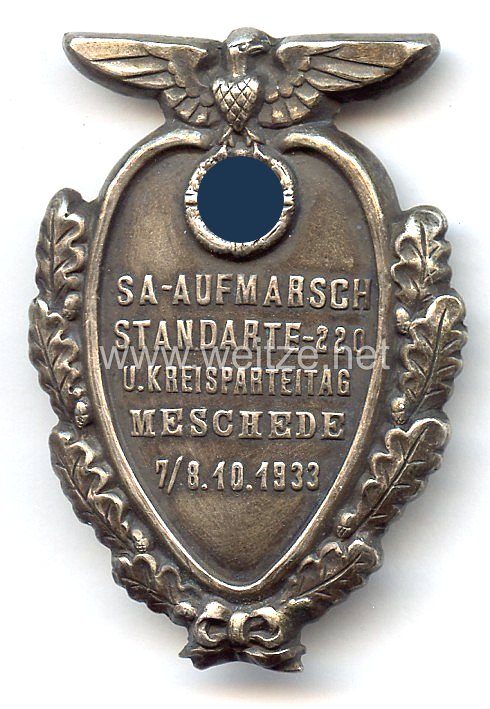
Third Reich - Large Portable Badge for Honored Guests for the “SA-Aufmarsch Standarte 220 u. Kreisparteitag Meschede 7./8.10.1933”

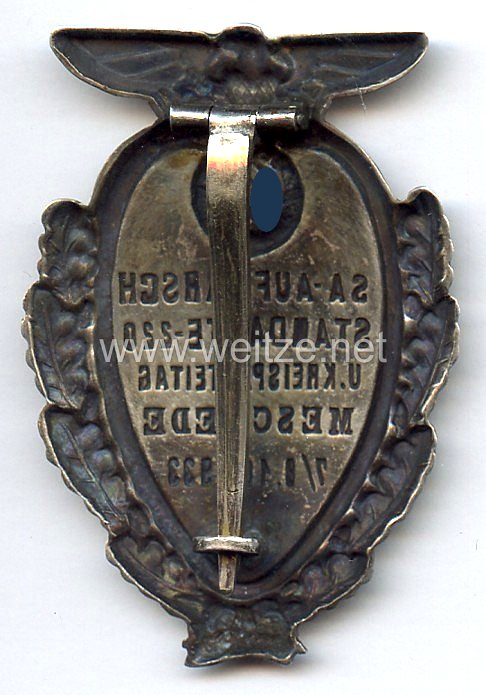
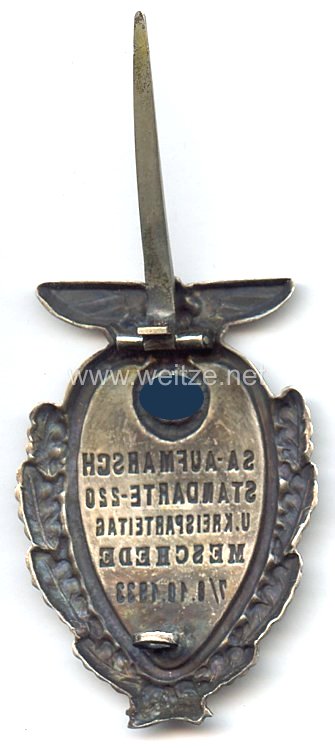
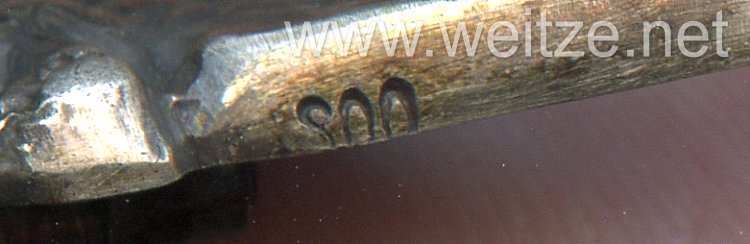
Pin-back badge, manufactured in silver, reverse stamped “800”, with wide vertical pin, condition 2. Very rare.

363220
650,00

Third Reich - Large Portable Badge for Honored Guests for the “SA-Aufmarsch Standarte 220 u. Kreisparteitag Meschede 7./8.10.1933”

The presented portable badge documents a significant local event of the early National Socialist movement: the SA march of Standarte 220 and the simultaneously held district party congress in Meschede on October 7-8, 1933. This event took place during a period when the Nazi regime was consolidating its power in Germany, just months after the seizure of power in January 1933.

The Sturmabteilung (SA) played a central role during this phase in demonstrating National Socialist power at local and regional levels. SA-Standarte 220 was one of numerous regional units of the Sturmabteilung organized throughout the German Reich. Meschede, a town in the Sauerland region of Westphalia, was like many German cities a venue for such mass events that served to consolidate Nazi rule.

The badge itself was designed as an honorary badge for distinguished guests. The manufacture from 800 silver, as evidenced by the hallmark on the reverse, underscores the representative character and importance attached to such events. The use of silver was common for official Nazi-era badges and served to honor important functionaries and invited guests.

The technical execution as a pin badge with a broad vertical needle corresponds to the contemporary standards for wearable honorary insignia. This construction allowed wearers to securely attach the badge to clothing, typically on the lapel or uniform jacket. The vertical pin orientation was common for larger badges as it ensured better stability.

The context of the October 1933 event is of particular historical significance. By this time, the Nazi regime had already largely eliminated political opposition, crushed trade unions, and with the Enabling Act of March 24, 1933, effectively ended the democratic order of the Weimar Republic. The SA under the leadership of Ernst Röhm was at the height of its power, counting millions of members.

District party congresses and SA marches served multiple purposes: they demonstrated the strength and presence of the NSDAP in the region, served to mobilize and ideologically train party members, and were intended to intimidate potential opponents. At the same time, they provided opportunities to honor deserving party members and cultivate relationships with local elites.

The rarity of such badges is due to several factors. First, they were produced only in limited numbers for the actual honorary guests of each event. Second, many such objects did not survive the post-war period, as their owners destroyed them out of fear of consequences. Third, this concerned a local event, which further limited the original edition.

SA-Standarte 220 was presumably stationed in the southern Westphalia area or the adjacent Hessian region. The exact organizational structure of the SA was restructured several times, with Standarten typically comprising several Sturmbanne and being assigned to geographically defined areas.

For historical research, such objects are valuable sources as they provide insight into the organizational structures and activities of the NSDAP at the local level. They document the penetration of social life by National Socialist events and rituals in the early phase of the regime.

The year 1933 marked the beginning of systematic Gleichschaltung (coordination) of all social spheres. Events like the district party congress in Meschede were part of this strategy, through which the NSDAP established its rule down to the smallest regional units. The awarding of honorary badges to selected guests also served to integrate local elites and functionaries.

From a museological perspective, such objects represent important contemporary documents that, when carefully contextualized, can contribute to education about the Nazi era. They illustrate the regime's staging strategies and the mechanisms of securing power at all social levels.

The silver hallmark and craftsmanship indicate that these badges were produced by professional manufacturers, possibly regional jewelers or specialized firms that had contracts with party organizations. The quality of execution reflects the importance the regime placed on such symbolic representations of loyalty and participation.