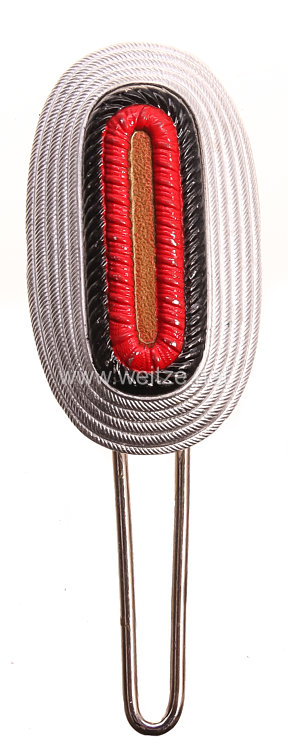
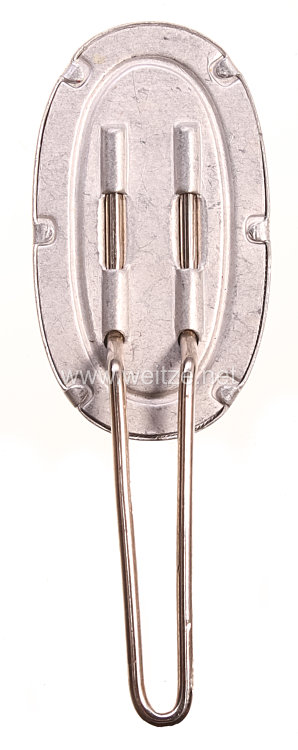
Federal Republic of Germany (FRG) Shako Plate for Police Shako
The field insignia for the police shako of the Federal Republic of Germany from around 1957 represents a significant testimony to the early post-war history of German police forces. This badge, manufactured from aluminum, marks a transitional phase in the development of West German police uniforms and symbolizes the new beginning of democratic police organization after the end of World War II.
Following the establishment of the Federal Republic of Germany in 1949, the young democracy faced the challenge of building new state institutions that clearly distinguished themselves from the structures of the Nazi regime. The police, as an executive body, played a central role in this process. According to the Basic Law (Grundgesetz), police authority rested with the federal states (Länder), which led to different uniforms and insignia across the various regions.
The shako, a cylindrical headgear with military origins, had a long history in German police tradition. As early as the 19th century, this distinctive headpiece was worn by various police units. In the 1950s, the shako experienced a renaissance in some German police formations, particularly for ceremonial occasions and certain units of the riot police (Bereitschaftspolizei).
The choice of aluminum as the material for the field insignia was typical for the period around 1957. This lightweight metal offered several advantages: it was cost-effective to manufacture, corrosion-resistant, and significantly lighter than traditional materials such as brass or bronze. In the post-war era, when resources were scarce, aluminum represented a practical alternative. Additionally, the material allowed for precise processing and an attractive surface finish.
The year 1957 marks an important moment in the history of the Federal Republic. During this year, significant decisions were made, including the signing of the Treaty of Rome, which led to the establishment of the European Economic Community. Domestically, it was also a time of consolidation, when state institutions found their definitive form.
The Bereitschaftspolizei (riot police), which was established in the various federal states in the early 1950s, played a special role in the use of such shako badges. These barracked police units were intended for deployment during large-scale operations, demonstrations, and other special occasions. Their uniforms were deliberately influenced by military traditions but clearly distinguished from Wehrmacht and SS uniforms of the Nazi era.
The design of field insignia typically followed traditional heraldic patterns and frequently incorporated state coats of arms or federal symbols such as the Federal Eagle (Bundesadler). The design was meant to radiate authority and state legitimacy while embodying democratic values. This was a delicate balancing act at a time when distancing from the Nazi past was of paramount importance.
In the late 1950s and early 1960s, however, a rethinking of police uniforms began. The shako was increasingly viewed as too militaristic and impractical for modern police service. Many federal states moved toward introducing more modern and functional headgear. The peaked cap (Schirmmütze) became established as the standard headgear, while the shako was either restricted to ceremonial occasions or abolished entirely.
Today, such field insignia are sought-after collectibles that offer insight into the uniform history of the early Federal Republic. They document a transitional period in which traditional military forms still resonated, but the path toward a more modern, citizen-oriented police force was already being taken. For historians and collectors, these objects are important sources for understanding the institutional development of the Federal Republic of Germany in its founding years.