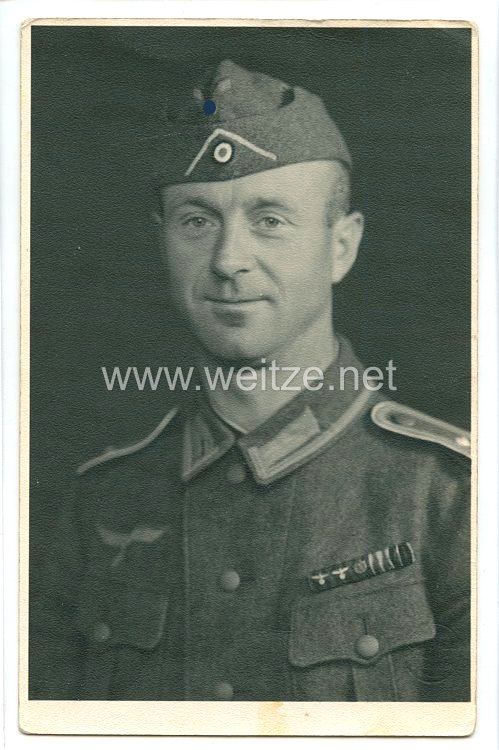
Wehrmacht Heer Portrait Photograph, Feldwebel with Service Ribbon Bar
This postcard-format portrait photograph depicting a Feldwebel (Sergeant) of the Wehrmacht Heer (German Army) wearing a ribbon bar represents a typical example of military portrait photography during World War II. Such photographs held great personal significance for soldiers, serving both as mementos for family members and as expressions of military pride.
The rank of Feldwebel represented an important non-commissioned officer grade in the Wehrmacht hierarchy. Feldwebel functioned as a crucial link between enlisted men and officers, bearing considerable responsibility for leading their units in daily service and in combat. They were typically experienced soldiers who had distinguished themselves through competence, leadership qualities, and military merit.
The ribbon bar (Feldspange) visible in the photograph is of particular historical interest. These narrow fabric ribbons, also called Ordensspange, were worn on the uniform when wearing full decorations was not appropriate, such as with service uniform or field equipment. The ribbon bar consisted of narrow bands in the colors of awarded decorations, arranged in a prescribed order from highest to lowest honor. The Dress Regulations for the Wehrmacht of September 4, 1935, and subsequent amendments detailed the wearing of such awards.
Photographic studios, both at home and in occupied territories, offered soldiers the opportunity to have professional portrait photographs made. The postcard format (approximately 9 x 14 cm) was particularly popular because it was cost-effective and easy to mail. Soldiers frequently had multiple prints made to send to family members, comrades, or pen pals. Personal messages could be written on the reverse.
Military portrait photography followed certain conventions. The soldier was typically photographed in full uniform with all insignia, medals, and decorations. The pose was usually frontal or three-quarter profile, the facial expression serious and dignified. Lighting was chosen to ensure that uniform details and decorations were clearly visible. Professional photographers were familiar with military regulations and ensured that uniforms fit correctly and all insignia were properly placed.
From a cultural-historical perspective, such photographs document not only individual military careers but also the social significance of military service in contemporary society. The fact that soldiers invested time and money to have such photographs made underscores the importance of military identity. For many young men, the uniform expressed masculinity, duty fulfillment, and national belonging.
The used condition of the photograph – possibly showing creases, discoloration, or wear – tells its own story. Such photos were often kept for years, carried in pockets, pasted in albums, or affixed to walls. They survived the turmoil of war, flight, and displacement, becoming important family documents. For relatives, they were sometimes the last memories of fallen or missing soldiers.
Today, such photographs hold multiple values. For military historians, they provide authentic visual documentation of uniforms, insignia, and decorations. Genealogical researchers use them to reconstruct family histories. Collectors appreciate them as contemporary historical documents. At the same time, they serve as reminders for critical engagement with history, as they document participation in a war of aggression that caused immeasurable suffering.
Scholarly examination of such objects requires objectivity and historical context. They are neither to be glorified nor taboo, but understood as sources for researching military, social, and everyday history. They raise questions about individual responsibility, societal constraints, propaganda, and the mechanisms of military mobilization.
The portrait format, standardized across the Wehrmacht, facilitated mass production and distribution. Photography had become affordable by the 1930s-1940s, making it accessible to soldiers of all ranks. These images formed part of a broader visual culture that included propaganda films, newsreels, and illustrated magazines, all contributing to the militarization of German society during the Nazi period.