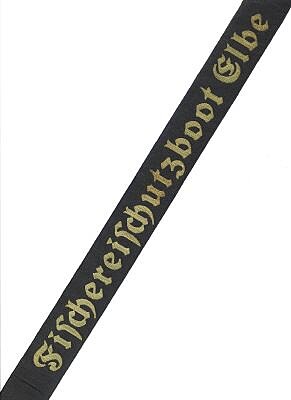
Kriegsmarine Cap Tally "Fischereischutzboot Elbe"

Metal thread woven construction, very well preserved, rare piece. Condition 1-2
33819
100,00

Kriegsmarine Cap Tally "Fischereischutzboot Elbe"

The Kriegsmarine cap tally bearing the inscription “Fischereischutzboot Elbe” (Fishery Protection Vessel Elbe) represents a fascinating chapter in German naval history during the Third Reich period. Cap tallies served as an important means of identification for naval personnel, indicating affiliation with specific ships, units, or formations.

The Kriegsmarine, which existed as the official naval force of Nazi Germany from 1935 to 1945, continued the tradition of the Imperial German Navy whereby enlisted men and non-commissioned officers wore cap tallies bearing ship names. This practice served not only for identification purposes but also strengthened esprit de corps and unit cohesion.

Fishery protection vessels formed a special category within the German Kriegsmarine. Their primary mission consisted of monitoring and protecting German fishing waters, particularly in the North Sea and Baltic Sea. These units played an important role in enforcing maritime rights and controlling fishing zones. During World War II, many of these vessels were additionally deployed for patrol duties, minesweeping operations, and convoy escort tasks.

The present cap tally is manufactured in metal-thread woven execution, indicating high-quality production. The use of metal threads, typically made from gilt or silvered wire, was characteristic of official Kriegsmarine cap tallies. The weaving technique allowed for durable and lustrous presentation of golden lettering against a dark, usually black, background.

The standard dimensions of a Kriegsmarine cap tally measured approximately 120 to 140 centimeters in length and roughly 3 centimeters in width. The inscription was rendered in the characteristic Sütterlin script or a stylized Gothic typeface typical of the Kriegsmarine. The lettering was executed in gold coloring and stood out distinctly against the black background.

The designation “Elbe” refers to one of Germany's most important rivers, which traditionally played a significant role in German maritime infrastructure. In the German Navy, it was customary to name ships and vessels after rivers, geographical locations, or historical figures. The combination of functional designation and geographical name was widespread among auxiliary and special units of the Kriegsmarine.

During the war, fishery protection vessels frequently operated under the command of North Sea Security or corresponding Baltic Sea commands. They typically operated in coastal waters and were equipped with light armament, usually consisting of smaller-caliber guns and depth charges. The crews of these vessels generally comprised experienced sailors familiar with local waters.

The rarity of this cap tally can be explained by several factors: First, fishery protection vessels were numerically far fewer than larger warships. Second, only a small number of these personal equipment items survived the ravages of war. Many were lost in sinkings, destroyed after the war's end, or damaged over the decades through improper storage.

The excellent condition of this specimen is remarkable. The metal threads are evidently not oxidized, and the black base fabric shows no significant signs of wear. This suggests that the tally was either rarely worn or preserved under optimal conditions.

For collectors and historians, such cap tallies offer valuable insights into the organizational structure and daily life of the Kriegsmarine. They document the diversity of maritime units and their specific missions. Each tally tells the story of a particular unit and its crew members.

In military-historical research, these objects serve as important primary sources for reconstructing naval organization and identifying individual units. They complement official documents and help paint a more complete picture of maritime warfare and naval daily life.

The metal-thread weaving technique employed in this tally's production was typically executed by specialized manufacturers who held contracts with the Kriegsmarine. These companies maintained strict quality standards to ensure uniformity across all naval cap tallies. The craftsmanship visible in such pieces reflects the importance placed on military insignia and unit identification during this period.