Kriegsmarine Single Shoulder Board for a Fähnrich
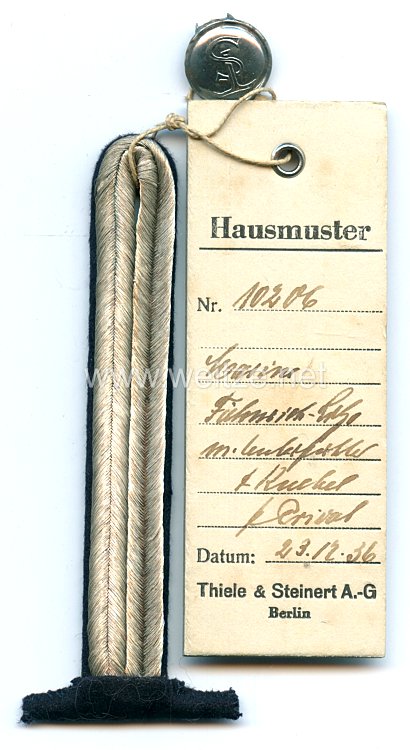
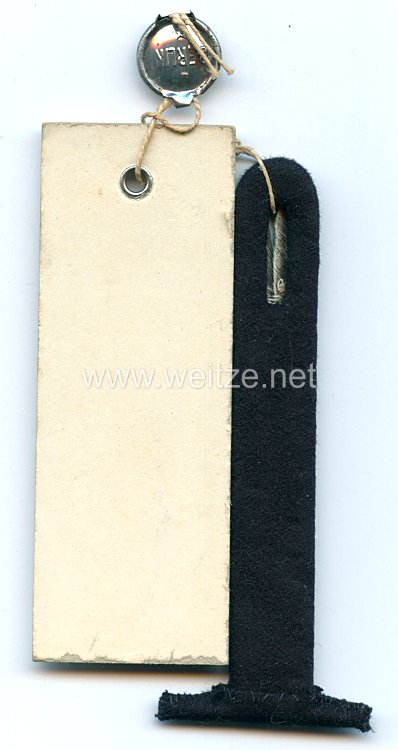
This object is a single shoulder board for a Fähnrich (Midshipman) of the Kriegsmarine, designed for the white summer jacket and bearing the sealed house pattern of the renowned firm Thiele & Steinert. Dated December 23, 1936, this shoulder board originates from a significant period of expansion and restructuring of the German Kriegsmarine under the National Socialist regime.
The Kriegsmarine was officially established on June 1, 1935, after the German Reich openly disregarded the provisions of the Treaty of Versailles. The reintroduction of universal conscription and the systematic buildup of armed forces occurred during this time with remarkable speed. The uniforms and rank insignia of the new Kriegsmarine were oriented toward the traditions of the Imperial Navy but adapted to the new political and military circumstances.
The rank of Fähnrich represented a special position in the Kriegsmarine. Fähnriche were officer candidates who had largely completed their training and were on the verge of promotion to Leutnant zur See (naval lieutenant). They already wore officer uniforms but were distinguished from full officers by specific rank insignia. The shoulder board of a Fähnrich was characterized by distinctive features that clearly indicated his status as an aspiring officer.
The white summer uniform of the Kriegsmarine was an important component of the uniform equipment, particularly for service in warmer climates or during the summer months. It was worn on ceremonial occasions as well as in regular service. The shoulder boards for this uniform were manufactured for insertion and featured loops for attachment, allowing for flexible handling and easy exchange.
The firm Thiele & Steinert was among the established suppliers of military equipment and uniform accessories in the German Reich. Such companies had to meet strict quality standards and manufacture their products according to precise regulations. The sealed house pattern documents official approval and conformity with the prevailing uniform regulations of the Kriegsmarine. These house patterns served as references for production and guaranteed compliance with prescribed standards.
The date December 23, 1936 places this shoulder board in a significant phase of German naval history. At this time, the Kriegsmarine was in a phase of intensive growth. The Anglo-German Naval Agreement of 1935 had allowed Germany to expand its fleet to 35% of British tonnage. This led to extensive new construction programs and a considerable increase in personnel, which in turn created an increased demand for uniforms and equipment.
The fact that this shoulder board remains unworn and in mint condition makes it an exceptional historical document. Such unused pieces are rare, as most uniform items saw service and were subject to corresponding wear. The excellent state of preservation allows for authentic study of the original quality of workmanship, the materials used, and the artisanal precision of that era.
The uniform regulations of the Kriegsmarine were detailed and established in corresponding service regulations. The Dress Regulations for the Kriegsmarine precisely specified which uniform items were to be worn on which occasions, how rank insignia were to be affixed, and which materials and colors were permitted. Shoulder boards had to have exactly specified dimensions and be manufactured from prescribed materials.
For military historians and collectors, such objects are of inestimable value, as they provide authentic insights into the material culture of the Kriegsmarine. They document not only the military hierarchy and rank structure but also the textile industry, craftsmanship, and the economic aspects of armament production in the Third Reich. The sealed house pattern makes this piece particularly valuable for research, as it documents the official standards and quality controls of the time.
The officer candidate system of the Kriegsmarine was highly structured and selective. Young men entering this path underwent rigorous training aboard training ships, at naval academies, and through practical service. The progression from cadet to Fähnrich represented a significant milestone, indicating that the candidate had successfully completed the majority of his training and demonstrated the necessary qualities for naval officership.
In summary, this single shoulder board represents a significant historical artifact that documents the uniform history of the Kriegsmarine, the rank structure of the German Navy in the pre-war period, and the material culture of military life in National Socialist Germany. Its exceptional preservation and provenance make it a valuable testimony to a bygone era.