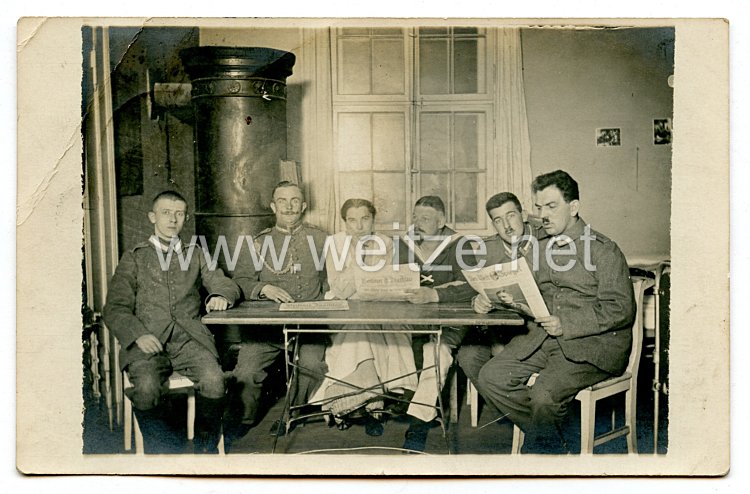
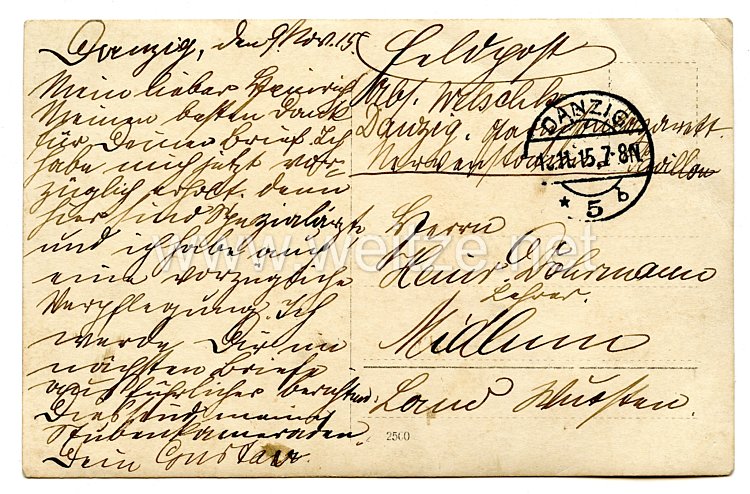
German Empire World War I Photographic Postcard Soldiers Reading Newspaper in Field Kitchen
This photographic postcard from World War I shows German soldiers reading newspapers in a field kitchen and bears a postal stamp from Danzig dated November 10, 1915. It represents a fascinating testament to military daily life during the Great War and documents the importance of communication and information for troop morale.
The field postcard became one of the most important means of communication between front and home during World War I. The German military postal service was a remarkable logistical achievement: millions of letters and postcards were transported daily between soldiers at the front and their families at home. Field post was free of charge for soldiers, which favored its massive distribution. Between 1914 and 1918, an estimated 28.7 billion field post items were transported.
The postal stamp from Danzig is of particular historical significance. At this time, Danzig was an important Prussian city and a major naval base on the Baltic Sea. The city played a central role in supplying the Eastern Front and served as a transit station for troops and materials. In November 1915, the German Reich was in a phase of the war characterized by successful offensives against Russia, while trench warfare raged on the Western Front.
The motif of soldiers reading newspapers in the kitchen is particularly revealing from a cultural-historical perspective. Newspapers played a central role in maintaining troop morale. German military leadership recognized early that informed soldiers were better fighters. Special field newspapers and trench newspapers were published, bringing news from both the front and home. These publications were often a mixture of official propaganda, entertainment, and practical information.
The field kitchen was more than just a place for food consumption. It functioned as a social meeting point where soldiers could exchange ideas, relax, and briefly escape the horrors of war. The famous Gulaschkanone (goulash cannon), as the mobile field kitchen was called in soldier's slang, was a symbol of camaraderie and relative normality amidst chaos.
Photographic postcards like this were produced in large quantities and served multiple purposes. They were part of official war propaganda, intended to convey an image of well-supplied, morally stable troops. At the same time, they documented authentic moments of wartime daily life. Professional photographers and war correspondents were stationed with troops to create such images. Private photographs were increasingly controlled by military censorship.
Censorship was omnipresent in World War I. Both letters and photographs were subject to strict control to prevent militarily sensitive information from reaching the enemy or undermining morale at home. Nevertheless, such postcards provide valuable insights into soldiers' daily lives, their living conditions, and the organizational structures of the army.
November 1915 marks an important point in the course of the war. On the Eastern Front, Germany, together with Austria-Hungary, had achieved great success against Russia in the Gorlice-Tarnów Offensive. The Central Powers controlled large parts of Poland and the Baltic region. On the Western Front, however, trench warfare had solidified, and the enormous losses at Verdun and the Somme were still to come.
Such photographic postcards are today important historical sources for researching World War I. They document not only military aspects but also social and cultural-historical dimensions of the war. The materiality of these objects – the paper, printing technique, stamps – tell their own story about production conditions and communication channels of this era.
For collectors and historians, well-preserved specimens like this one (condition 2 corresponds to very good preservation with only minor signs of use) offer special insights into the past. They are material testimonies of a world-changing event and remind us of the millions of soldiers who wrote, read, and sent these postcards home.