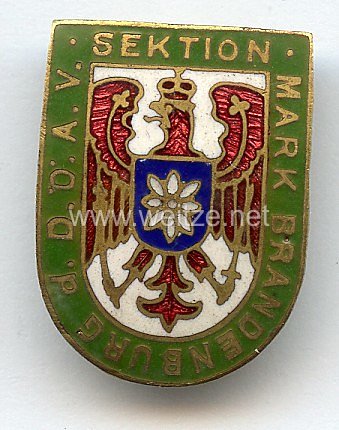
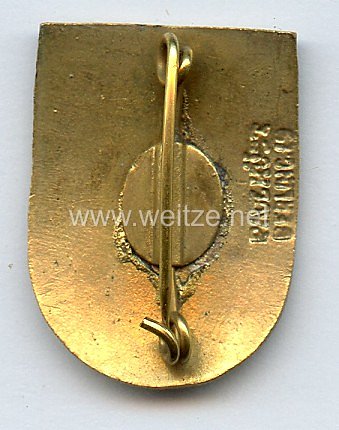
The membership badge of the Mark Brandenburg Section of the German and Austrian Alpine Club (DuÖAV) represents a dark chapter in German associational history. This badge, manufactured by Paul Küst Berlin C19, documents membership in an organization that became notorious during the interwar period for its nationalist and antisemitic orientation.
The German and Austrian Alpine Club was formed in 1873 through the merger of the Austrian Alpine Club (founded 1862) and the German Alpine Club (founded 1869). Originally conceived as an apolitical mountaineering association, the club developed into one of Central Europe's largest alpine organizations with numerous regional sections, including the Mark Brandenburg Section for the Prussian region around Berlin.
The club's increasing radicalization began in the early years of the 20th century. The Vienna Section introduced the so-called “Aryan paragraph” as early as 1905, stipulating in its statutes that only “Germans of Aryan descent” could become members. This unprecedented exclusion of Jewish members from a sports club occurred more than a quarter-century before the Nazi seizure of power. In 1907, the Academic Section Vienna followed suit, then the Academic Section Munich in 1910. In subsequent years, additional sections adopted these discriminatory practices.
This development was part of a broader German-nationalist and Pan-Germanic movement that was particularly pronounced in Austria-Hungary. The Alpine Club increasingly became an instrument of völkisch ideology, with the Alps being defined and defended as “German cultural territory.” Jewish mountaineers excluded from traditional sections subsequently founded their own organizations, including the Austrian Tourist Club (founded 1888) and the Donauland Section (founded 1924), which explicitly accepted Jewish members.
The present membership badge was produced by the Berlin manufacturer Paul Küst, whose workshop was located in Berlin C19. The address refers to the historic postal district of Mitte-East, a center of Berlin's metalworking and jewelry manufacturing. Küst was one of several Berlin manufacturers who produced association badges, orders, and decorations for various organizations. The quality of craftsmanship and use of a pin construction were typical of membership badges from this era.
The Mark Brandenburg Section represented the Berlin area and organized mountain expeditions, lectures, and social events for its members. Like many other sections, it possibly maintained alpine refuges and promoted the tourist development of the Alpine region. The exact dating of the introduction of the Aryan paragraph in this specific section is not clearly documented, but the general tendency of the overall club was unmistakable.
After the Nazi seizure of power in 1933, the DuÖAV was completely coordinated and integrated into the Nazi state apparatus. The club became part of the Reich League for Physical Exercise and was later renamed the “German Alpine Club.” The antisemitic exclusions were now enforced and intensified throughout the Reich.
After World War II, the club was refounded. In West Germany, the German Alpine Club (DAV) was established in 1950, and in Austria, the Austrian Alpine Club (ÖAV) in 1945. However, confronting the antisemitic past did not begin until decades later. Only in the 1990s did intensive historical research and public engagement with this dark history commence. Today's DAV has officially distanced itself from this past and acknowledged the discrimination against Jewish members as an injustice.
Membership badges such as the present one are today important historical sources for researching club history and societal radicalization during the interwar period. They document how deeply antisemitic and nationalist ideologies had penetrated seemingly apolitical spheres of social life, long before the Nazis came to power.