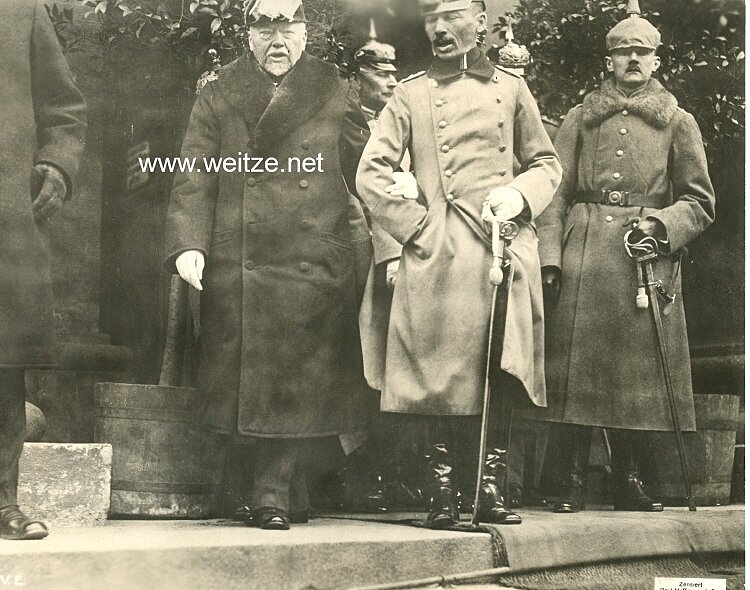
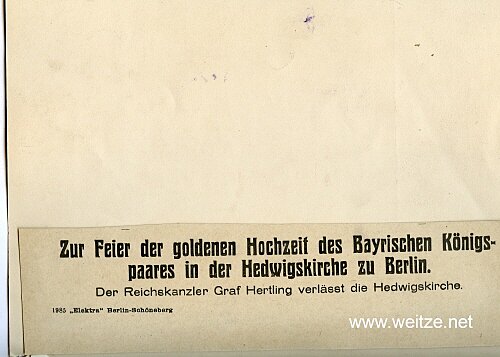
World War I Press Photograph “Reich Chancellor Count Hertling at the Golden Wedding Anniversary of the Bavarian Royal Couple”

approx. 27.5 cm x 22.5 cm, descriptive text on reverse, condition 2
161919
10,00

World War I Press Photograph “Reich Chancellor Count Hertling at the Golden Wedding Anniversary of the Bavarian Royal Couple”

This press photograph from World War I documents a significant social occasion during the final years of the war: the Golden Wedding Anniversary of the Bavarian royal couple Ludwig III and Marie Therese. The image shows Reich Chancellor Georg Count von Hertling at the celebrations and serves as an important testament to the connection between the Prussian-dominated Reich leadership and the southern German monarchies in the German Empire.

King Ludwig III of Bavaria (1845-1921) and his consort Archduchess Marie Therese of Austria-Este (1849-1919) had married on February 20, 1868. Their Golden Wedding Anniversary in February 1918 thus fell during one of the most critical phases of World War I. Ludwig III had only ascended to the Bavarian throne in 1913 following the death of his cousin Prince Regent Luitpold, making him the last King of Bavaria.

Georg Count von Hertling (1843-1919) served as German Reich Chancellor from November 1917 to September 1918. The Bavarian-born politician and philosopher had previously been Bavarian Prime Minister and represented, as one of the few southern German and Catholic Reich Chancellors, a connection between the Protestant-Prussian north and the Catholic south of the German Reich. His presence at the Golden Wedding of the Bavarian royal couple underscored the political significance of this event during wartime.

Press photography during World War I played a central role in information dissemination and propaganda. Although photographic reporting was heavily controlled by military censorship, a professional system of war correspondents and press photographers developed. Such official photographs of state and monarchical events were taken by accredited photographers and distributed through press agencies to newspapers domestically and abroad.

The format of approximately 27.5 x 22.5 cm corresponds to the standard sizes for press photographs of that era. These were frequently mounted on cardboard and provided with descriptions on the reverse, giving editors information about date, location, persons depicted, and context. The reverse inscription is a characteristic feature of authentic press photographs from this period.

The Golden Wedding in February 1918 took place at a time when the German Reich, following peace negotiations with Russia at Brest-Litovsk, still hoped for a possible victory on the Western Front. The Spring Offensive of 1918 was meant to bring the decision, but by summer it became clear that the military situation was hopeless. The Golden Wedding celebrations were intended to demonstrate continuity and stability to the home front.

The Bavarian royal house held a special position during the war. Although Bavaria was part of the German Reich, it maintained its own armed forces, which only came under Prussian supreme command during wartime. The Bavarian Army retained its own structure, uniforms, and traditions. This special status of Bavaria within the federal structure of the Empire made dynastic events of the royal house matters of Reich-wide importance.

After the war's end and the November Revolution of 1918, Ludwig III became the first German monarch to abdicate. The proclamation of the Republic by Kurt Eisner in Munich on November 7, 1918, ended the over 700-year rule of the Wittelsbach dynasty in Bavaria. King Ludwig III went into Austrian exile, where he died in 1921. Queen Marie Therese experienced the end of the monarchy for only a few months, dying in February 1919.

Such press photographs are important historical sources today. They document not only the persons and events depicted but also provide insight into the visual propaganda and public relations of the Wilhelmine era. Professional press photography was at this time in a developmental phase characterized by technical improvements and the growing importance of visual media.

For collectors and historians, authentic press photographs from World War I are valuable documents. They complement written sources with a visual dimension and enable a more comprehensive understanding of the era. The reverse inscription significantly increases the documentary and scholarly value.

r