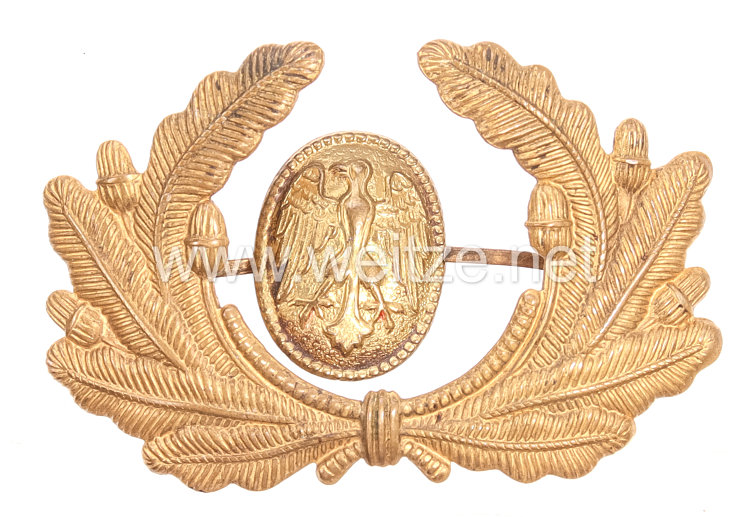
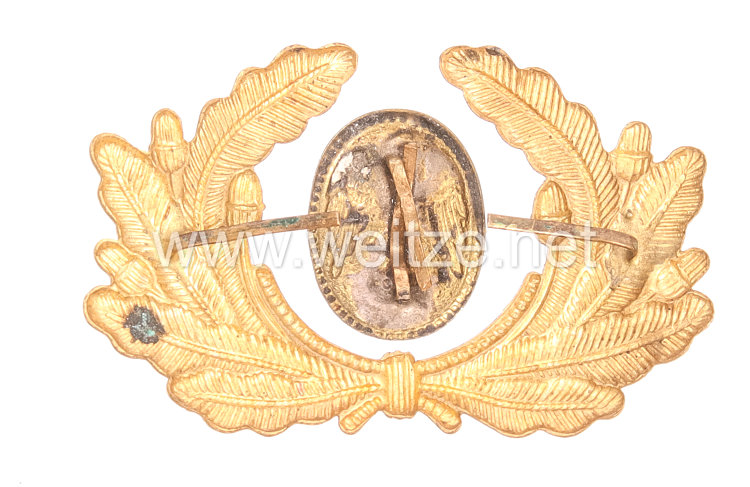
Reichsmarine Oak Leaf Wreath with Cockade for Visor Cap for Non-Commissioned Officers

circa 1925/30. Metal construction, mounted on dark blue cloth base. Worn condition, Condition 2. Rare.
429318
80,00

Reichsmarine Oak Leaf Wreath with Cockade for Visor Cap for Non-Commissioned Officers

The Reichsmarine oak leaf wreath with cockade for the peaked cap of non-commissioned officers represents a characteristic insignia of the German naval forces during the Weimar Republic. This piece, manufactured around 1925/30 in metal execution on a dark blue cloth base, documents a significant transitional phase in the history of the German Navy between the two world wars.

After the end of World War I and the signing of the Treaty of Versailles in June 1919, the German Imperial Navy was dissolved. It was replaced by the Reichsmarine, which had to operate under strict restrictions. The Treaty of Versailles limited the German naval force to a maximum of 15,000 men, including 1,500 officers and non-commissioned officers. The fleet could only consist of older ships, and the construction of modern warships was heavily regulated.

The uniforms of the Reichsmarine were based on the traditions of the Imperial Navy but had to be adapted to the new political realities. The cockade, the circular national insignia, now displayed the colors of the Weimar Republic: black-red-gold, instead of the imperial colors black-white-red. The oak leaf wreath surrounding the cockade symbolized strength, permanence, and German tradition, and had already been an established element of military symbolism during the imperial era.

For non-commissioned officers – the middle leadership level of the Navy – the peaked cap with its characteristic insignia held special significance. The non-commissioned officers formed the backbone of the Reichsmarine and were responsible for training the crews and the practical execution of orders. Their uniform had to clearly distinguish them from ordinary sailors without achieving the splendor of officer ranks.

The metal execution of the oak leaf wreath with cockade was typical for the period and was usually manufactured from non-ferrous metal or silver-plated material. The dark blue cloth base corresponded to traditional naval coloring and formed a high-contrast background for the metal insignia. This combination of noble metal and high-quality cloth emphasized the wearer's status within the hierarchy.

The dating to around 1925/30 is particularly revealing. During these years, the Reichsmarine had recovered from the immediate aftermath of the war and achieved a certain stability. The uniform regulations were standardized, and uniform production had shifted to civilian manufacturers, as military production facilities had been greatly reduced. Various private manufacturers produced uniform parts and insignia according to precisely defined specifications.

The rarity of such pieces today is explained by several factors. First, the Reichsmarine was numerically small, which limited total production. Second, with the Nazi seizure of power in 1933 and the renaming to Kriegsmarine in 1935, new uniform regulations were introduced that changed the cockade back to the colors black-white-red. Many old uniform parts thereby became obsolete and were disposed of or reworked. Third, World War II led to the destruction of many personal possessions and military archives.

The preservation in condition 2 (worn) is remarkable for such an object. It shows signs of wear that make the piece authentic and prove that it was actually worn by a non-commissioned officer of the Reichsmarine. This patina of time makes the insignia a valuable historical testimony of an often overlooked era of German naval history.

For collectors and historians, such insignia offer direct access to the everyday reality of the Reichsmarine. They document not only the formal aspects of uniforming but also the continuities and ruptures in German military history of the 20th century. The Reichsmarine stood in the tension between republican loyalty and monarchist tradition, between democratic ideals and authoritarian structures – a conflict that was also reflected in its symbolism.

r