Prussian Model 71/84 Bayonet - Adapted

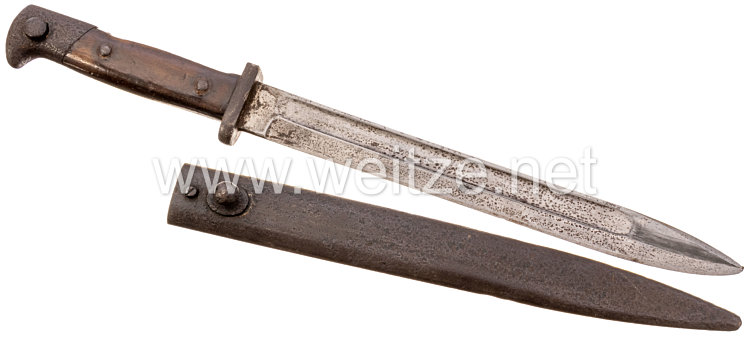
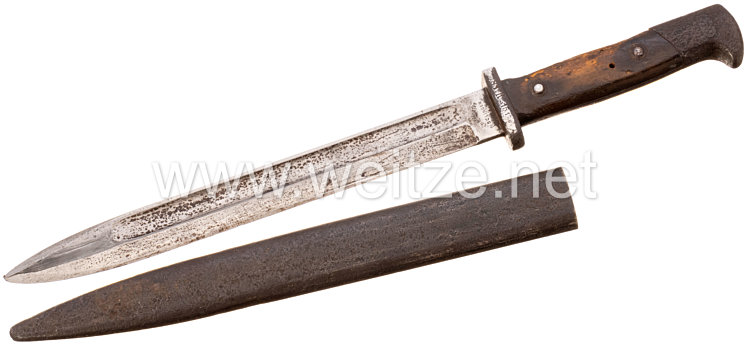
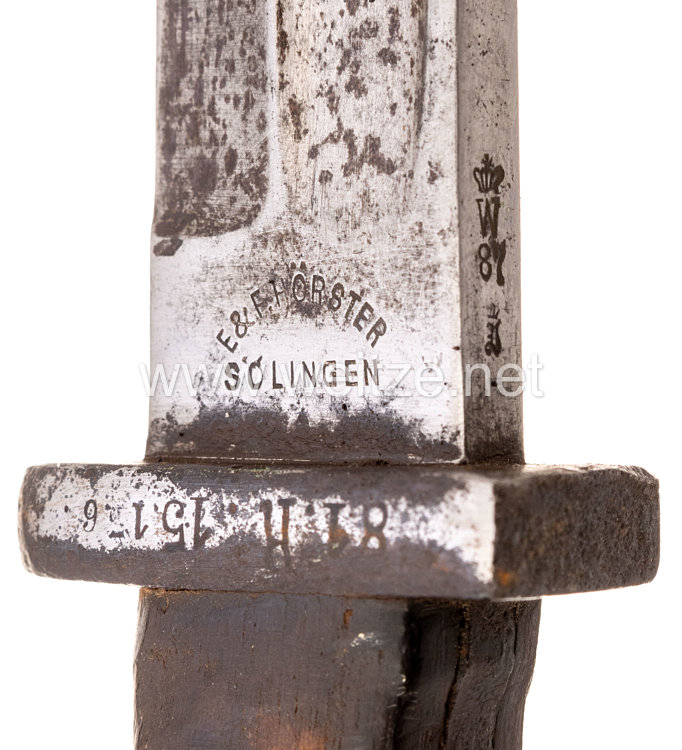
Stained blade, cleaned and reground, short fullers, maker “E.&F. Hörster Solingen”, acceptance mark “W 87”, the muzzle ring was cut off smooth, steel scabbard with very bulbous frog stud, without chape button, externally heavy corrosion traces, clear signs of age, poor condition. Condition 3

Whether this is an official modification or an unauthorized conversion of a found piece, I cannot determine. Bayonet and scabbard have a nearly identical degree of corrosion, so one can assume that the piece has been together this way for a very long time.
430218
200,00

Prussian Model 71/84 Bayonet - Adapted

The Prussian side arm M 71/84 represents a significant chapter in the development of German infantry armament in the late 19th century. This weapon was originally designed for the rifle 71/84, an evolution of the legendary Mauser rifle Model 1871, which served as the first repeating rifle of the Prussian army.

The history of the M 71/84 begins with the introduction of the Infantry Rifle 71 in 1871, immediately following the Franco-Prussian War of 1870/71. The original rifle was a single-shot weapon, but an important modernization took place in 1884 through the work of brothers Alfred and Karl Kropatschek, who developed a tubular magazine system holding eight cartridges. This modification led to the designation M 71/84 and transformed the single-shot loader into an effective repeating rifle.

The accompanying side arm followed the classical principles of Prussian edged weapons. The blade featured characteristic short fullers that reduced weight without compromising stability. The manufacturer E. & F. Hörster from Solingen was among the most prestigious producers of military edged weapons in Germany. The Hörster company supplied the Prussian and later German army with high-quality side arms and other edged weapons for decades.

The acceptance stamps on military weapons of this era are of particular importance for historical classification. The stamp “W 87” indicates acceptance in 1887 and confirms that the weapon met military quality standards. Such stamps were applied by acceptance officers responsible for controlling weapon deliveries.

The present specimen shows an interesting modification: the barrel ring has been sawed off smoothly. This alteration is historically significant as it opens various possibilities. During both World Wars and the interwar period, many older military weapons were modified to make them usable for other purposes. Such adaptations could be carried out officially by military authorities or unofficially by private individuals or local agencies.

The steel scabbard with its characteristic spherical carrying hook corresponds to the usual construction of Prussian side arm scabbards of this period. The absence of the tip button could indicate loss, damage, or possibly a later modification. The heavy corrosion traces on both the weapon and the scabbard suggest that both parts were exposed to the same environmental conditions over an extended period.

In the context of military use, side arms such as the M 71/84 served multiple purposes. Primarily, they were designed as close combat weapons that could be affixed to the rifle to form a type of bayonet. At the same time, they served as tools in field deployment and as part of the infantry soldier's regular equipment. With the increasing mechanization of warfare and the development of automatic weapons, side arms gradually lost their tactical significance but remained part of military tradition.

The rifle 71/84 itself was already replaced in 1888 by the Gewehr 88 (Commission Rifle), which was fired with smokeless powder and represented a significant technological advance. Nevertheless, many M 71/84 rifles and their side arms remained in service for years, particularly with reserve and Landwehr units.

The Solingen blade industry, represented by companies such as Hörster, played a central role in arming German forces. Solingen had established itself as a center of blade manufacturing since the Middle Ages and supplied armies throughout Europe in the 19th century. The craftsmanship quality and material processing of these weapons was legendary.

Today, such modified specimens are of particular interest to collectors and military historians, as they bear witness to the long service life of military equipment and the various adaptations made over time. The state of preservation and visible signs of use silently tell the story of this weapon through different epochs of German military history.

The modification visible on this piece—the removal of the barrel ring—reflects the practical reality that military equipment often underwent unofficial alterations. Whether performed by armories during shortages, by soldiers in the field, or by subsequent owners repurposing the weapon, such changes are part of the object's authentic history and make each piece unique in documenting the complex life cycles of military materiel.