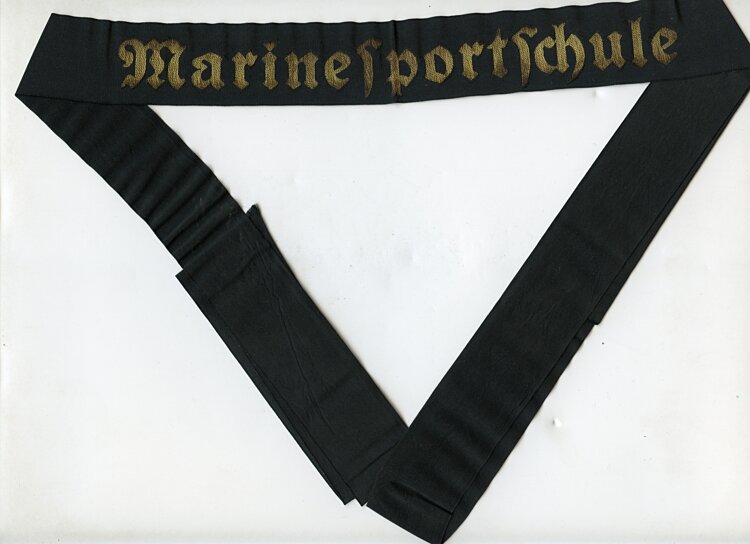
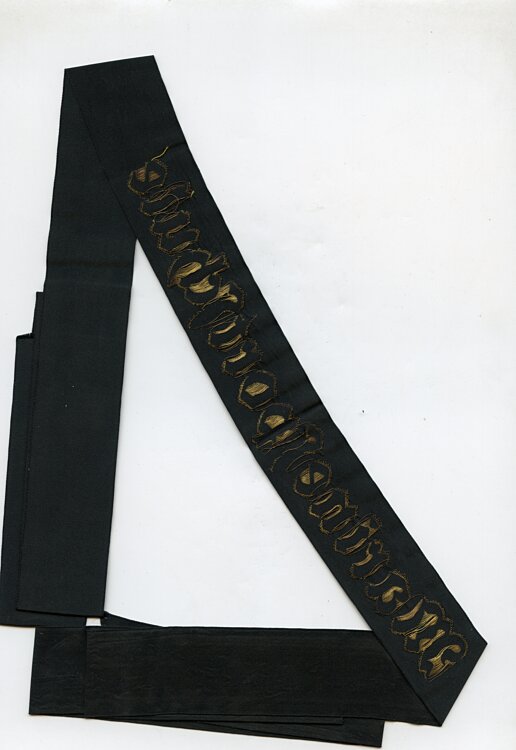
Cap Tally “Marinesportschule”
The cap tally of the Marinesportschule (Naval Sports School) represents a fascinating testament to German naval history, particularly in the field of athletic training and physical conditioning of naval personnel. Cap tallies of the Kriegsmarine were traditionally worn to identify affiliation with specific ships, units, or institutions and formed an important part of uniform identity.
The Marinesportschule was a specialized training facility of the German Kriegsmarine dedicated to the physical conditioning and athletic training of naval soldiers. Sports played a central role in naval military training, as physical fitness was considered an indispensable foundation for fulfilling the demanding duties aboard ship. The Naval Sports School not only trained ordinary sailors but also physical education instructors who would later be responsible for athletic training on ships and in naval garrisons.
This cap tally is manufactured in metal thread execution, indicating high-quality production. This type of execution was typical for officer and non-commissioned officer ranks or for special occasions. The metal threads, usually made of gilt or silvered wire, were artfully woven into the black base fabric and gave the band its characteristic luster. Unlike the simpler cotton bands worn by enlisted men, metal thread bands were considerably more elaborate to produce and correspondingly more valuable.
The tradition of cap tallies in the German Navy dates back to the 19th century. After the founding of the Imperial Navy, cap tallies became an important identifying feature. While the Imperial Navy often used the inscription “S.M.S.” (Seiner Majestät Schiff - His Majesty's Ship) followed by the ship's name, a more differentiated system developed in the Reichsmarine and later the Kriegsmarine. In addition to ship names, shore establishments, schools, and special units also wore their own cap tallies.
The inscription on the cap tally was traditionally done in gold or silver-colored lettering woven into the black band. In metal thread versions, special care was taken with legibility and aesthetic execution. Wearing the cap tally on the peaked cap was mandatory for all naval personnel on duty and subject to strict uniform regulations.
In the context of the athletic training of the Kriegsmarine, the naval sports schools occupied a key position. The program included track and field, swimming, sailing, rowing, boxing, fencing, and other disciplines. Swimming and water sports in particular had existential significance for naval personnel. Training at the Naval Sports School was intensive and followed modern sports pedagogical concepts of the time.
The instructors at the Naval Sports School had to complete special qualifications and were considered elite in the field of military physical conditioning. They wore their cap tally with pride, as it marked their special function and expertise. Assignment to the Naval Sports School, whether as an instructor or for further training, was considered an honor and recognition of athletic achievements.
The condition of this specimen – lightly worn but in good condition – suggests that it was actually used in service. The signs of wear give the object additional historical authenticity. The rarity of such cap tallies is explained by several factors: Firstly, the number of members of the Naval Sports School was relatively small compared to large ship crews. Secondly, many uniform items were destroyed or disposed of after the war.
For collectors and historians, cap tallies are valuable sources as they often bear witness to units and institutions that received little attention in official historiography. The cap tally of the Naval Sports School documents an important but often overlooked aspect of naval daily life: systematic physical training and the importance that sports held in military organization.
The craftsmanship quality of the metal thread execution reflects the high standards that applied in German uniform manufacturing. Specialized manufacturers often produced these bands by hand, with each band taking several hours of work. The use of metal threads required special skill, as the threads had to be precisely woven to achieve a durable and aesthetically pleasing result.
Today, such cap tallies serve as tangible connections to a specific era and specific institutions of German naval history. They provide insights into organizational structure, hierarchy, and the self-perception of various naval branches. The Naval Sports School, though not as prominent as combat ships or famous naval bases, played a crucial role in maintaining the combat readiness and morale of naval personnel through systematic physical training.