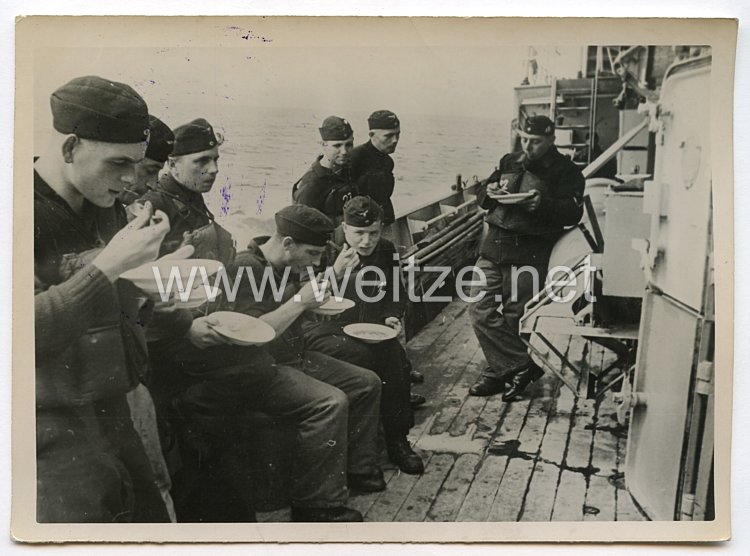
Kriegsmarine Press Photograph: Mealtime Taken on Deck 15.11.1940

Dimensions approx. 13 x 18 cm, inscribed on reverse. Used condition.
345718
20,00

Kriegsmarine Press Photograph: Mealtime Taken on Deck 15.11.1940

This Kriegsmarine press photograph dated November 15, 1940 documents an apparently mundane scene aboard a German warship: sailors taking their meal on deck. Despite the banality of the depicted moment, this image represents an important aspect of the propaganda strategy of the Third Reich during World War II while simultaneously offering valuable insights into the daily life of the German Navy.

In November 1940, Germany was in the second year of the World War. The Kriegsmarine played a central role in the Battle of the Atlantic and in efforts to disrupt British supply lines. The Oberkommando der Wehrmacht (OKW) and the Reich Ministry for Public Enlightenment and Propaganda under Joseph Goebbels recognized early on the importance of photographic documentation and distribution of images from the war.

War reporting was strictly organized and controlled. Naval war correspondents, the so-called Propaganda Companies (PK), were specially trained photographers, journalists, and filmmakers assigned to combat units. These units were established as early as 1938 and followed a clear structure with their own ranks and military training. Their task was to document the war and provide material for the home front and international distribution.

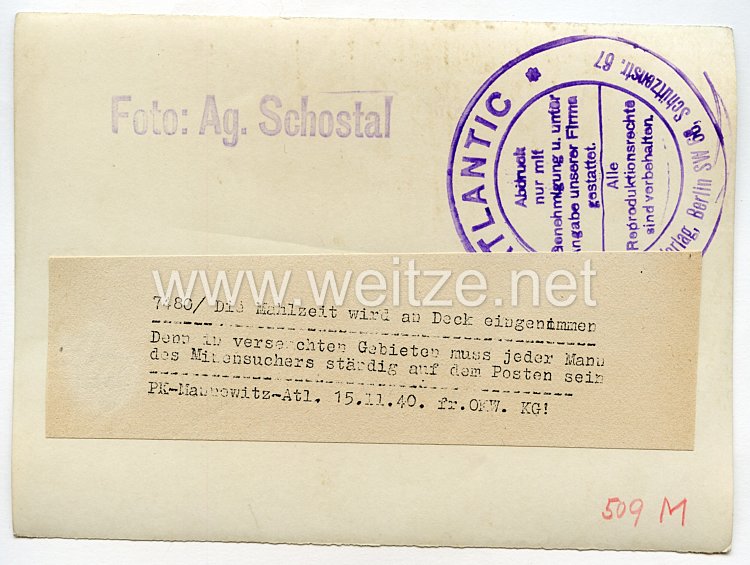
Press photographs like the present one were distributed through various channels. The Weltbilddienst (World Picture Service), a central agency for distributing photographic material, coordinated distribution to German and foreign newspapers, magazines, and newsreels. The images had to pass through strict censorship guidelines and were often provided with prescribed captions attached to the reverse.

The depiction of sailors eating on deck served several propagandistic functions. First, it conveyed an image of normality and camaraderie aboard warships. The home front was to be reassured that the soldiers were well cared for and received regular provisions despite wartime circumstances. Second, such images emphasized the discipline and order of the German armed forces. The Navy was traditionally regarded as an elite branch of service, and images of life aboard helped maintain this image.

Provisions aboard the Kriegsmarine were indeed an important aspect of morale and combat readiness. The Kriegsmarine service regulations contained detailed provisions regarding rations, the so-called Verpflegungssätze. Aboard larger ships, there were trained cooks and bakers responsible for preparing meals. Provisions were generally better than in other Wehrmacht branches, as the special conditions of seafaring and often lengthy deployments required good supply.

The date November 15, 1940 falls during a phase of intense naval warfare. After the successful conquest of Norway in spring 1940 and the French campaign in summer, the Kriegsmarine had significantly expanded its base for Atlantic operations. U-boats operated from French Atlantic ports and achieved considerable success against Allied merchant shipping. The period from July 1940 to February 1941 went down in German naval history as the “Happy Time” (Die Glückliche Zeit), as U-boats inflicted substantial damage with comparatively low losses of their own.

The technical characteristics of the photograph – approximately 13 x 18 cm format with inscription on the reverse – correspond to the standard of press photography of that era. This size was ideal for reproduction in newspapers and archiving. The reverse inscription typically contained information about the date taken, an image number, possibly the name of the photographer or PK unit, and an approved caption. Often censorship stamps from the responsible propaganda offices were also affixed.

Such press photographs are important historical sources today. They document not only the propaganda intentions of the regime but also show authentic details of military daily life, uniforms, equipment, and living conditions. For maritime historical research, they provide valuable information about ship types, technical equipment, and crew composition.

The collection and preservation of such documents is of great importance for historical research. They enable a differentiated understanding of war propaganda and the actual lives of soldiers beyond idealized representations. At the same time, they require critical examination, as they must always be interpreted in the context of their propagandistic purpose.