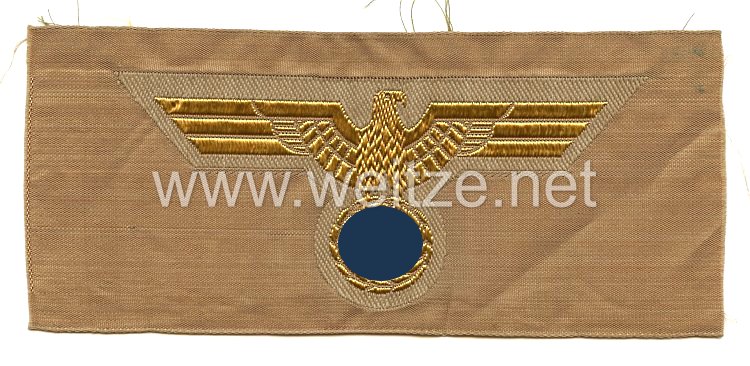
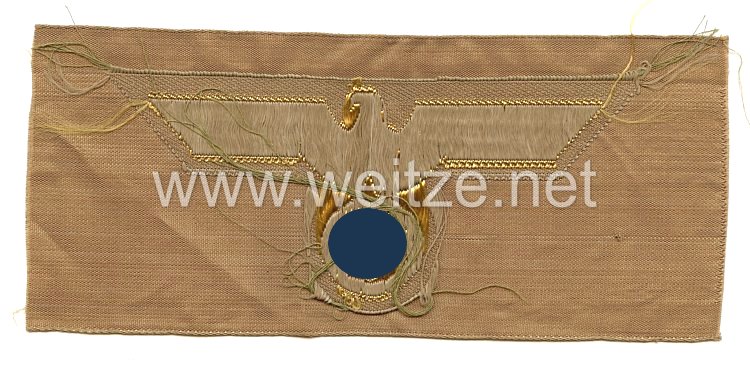
Kriegsmarine Breast Eagle for Tropical Field Blouse

Bevo-woven version in yellow on sand color. Unworn, condition 2+.
423818
230,00

Kriegsmarine Breast Eagle for Tropical Field Blouse

The Kriegsmarine Breast Eagle for Tropical Field Blouse represents a characteristic insignia of the German Navy during World War II, specifically developed for deployment in tropical and subtropical climate zones. This textile national emblem embodies not only the adaptation of German military uniforms to various operational theaters but also the technical sophistication of the textile industry of that era.

The Bevo weaving technique, named after the Barmer Ersatz- und Vorstoff-Industrie, revolutionized the production of military insignia in the 1930s. This mechanical weaving technique enabled mass production of detailed emblems with high precision and durability. Bevo-woven eagles were characterized by their flat construction, clean edges, and the integration of different yarn colors during the weaving process, as opposed to embroidered or appliquéd variants.

The tropical uniforms of the Kriegsmarine were increasingly introduced from 1940 onwards, as German military operations expanded into North Africa, the Mediterranean, and other warm climate zones. The sand-colored base of the tropical field blouses was intended to provide better camouflage in desert and steppe regions, while the lighter fabric reduced heat stress for the wearers. The color combination of yellow eagle on sand-colored background corresponded to specific regulations for tropical clothing and differed markedly from the dark blue-white eagles of standard naval uniforms.

The Reichsadler itself, with spread wings and the swastika in its talons, had been the official national emblem of the Wehrmacht since 1935. For the Kriegsmarine, this eagle was worn on the breast, in contrast to the Army eagle, which was placed on the right upper arm. The precise specifications regarding size, placement, and execution were detailed in the Navy's clothing regulations.

The production of such insignia was carried out by various Wehrmacht suppliers, with strict quality controls ensured. The Bevo technique enabled consistently high quality across large production volumes. The eagles were provided with a woven border that facilitated sewing onto the uniform and prevented fraying.

The operational context of these tropical eagles was diverse: naval units deployed in North Africa to support the Afrika Korps, coastal batteries in the Mediterranean region, U-boat crews in southern waters, and naval liaison officers with allied forces in warm climate zones wore these special uniforms. The Marine Battalion in North Africa and various coastal artillery detachments also received tropical clothing.

The quality rating “Condition 2+” and the designation “unworn” for this specimen are of particular interest from both collector and historical perspectives. Unworn insignia from the World War II period are rare today, as most were either used or destroyed after the war. The excellent state of preservation allows for precise examination of the original colors, weaving technique, and material quality.

After the war, the production and possession of such insignia were strictly regulated in Germany. Many uniform items and badges were confiscated or destroyed by the Allied occupation forces. The surviving specimens found their way into private collections, museums, or were taken as war trophies. The scientific study of these objects only began decades later within the framework of military history research.

From a conservation perspective, textile militaria are particularly susceptible to light, moisture, and insect damage. The dyes used, particularly the yellow tones, tend to fade when exposed to light. Proper storage of such objects requires controlled climatic conditions and protection from UV radiation.

Today, such objects primarily serve historical research and education. They document the material culture of World War II, the development of uniform regulations, and the technical capabilities of the textile industry of that time. Museums and research institutions use these artifacts to paint a more complete picture of military daily life and to convey the history of this era objectively.

The Bevo manufacturing process involved specialized jacquard looms that could create intricate patterns by controlling individual warp threads. This allowed for the production of the eagle's detailed features, including the individual feathers, talons, and the central swastika symbol. The yellow thread used for the eagle design was typically a high-quality rayon or cotton blend that provided both durability and visual appeal against the sand-colored background.

Collectors and historians value these insignia not only for their historical significance but also as examples of wartime manufacturing technology and quality control standards that were maintained even during the later stages of the conflict.

r