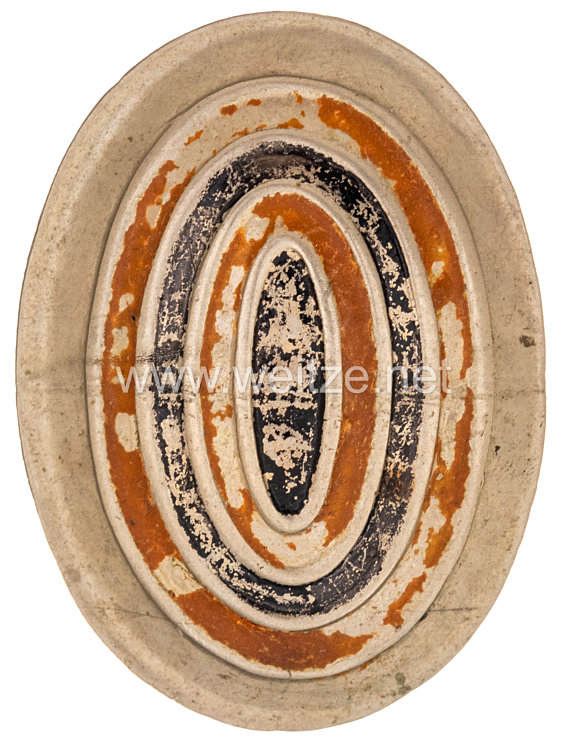
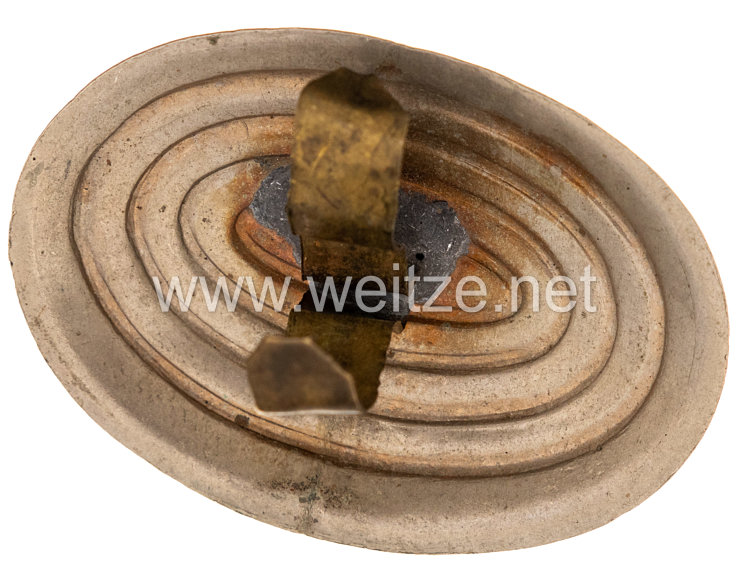
Tsarist Russia - Single Cockade for Enlisted Men's Visor Cap
The present individual cockade for enlisted men's service caps from Tsarist Russia represents an important element of military uniform regulations in the late Russian Empire. This aluminum cockade with a split-pin fastening on the reverse and a height of 3.9 cm embodies the standardized identification marking for ordinary soldiers in the Imperial Russian Army.
In the Russian Empire, the system of military headgear and insignia developed over several centuries. During the reign of Tsar Alexander III (1881-1894) and especially under Tsar Nicholas II (1894-1917), comprehensive uniform reforms were implemented that also affected the design and material selection of cockades. The use of aluminum for enlisted men's cockades was a practical decision that combined durability with economy.
The cockade served in the Tsarist military system as an immediate symbol of belonging to the Imperial Army and symbolized loyalty to the Tsar. The classic Russian cockade traditionally displayed the national colors in concentric circles: black, orange, and white, which had been recognized as imperial colors since Peter the Great. This color combination was deeply rooted in Russian imperial symbolism.
The service cap (Russian: фуражка, furazhka) became the standard headgear for the Russian Army in the 19th century. It increasingly replaced older forms of headgear and was worn in various versions for different ranks and branches of service. While officers wore more elaborate cockades made of gilt or silvered materials, enlisted men (ordinary soldiers) received standardized, more economical versions made of aluminum or other base metals.
The split-pin fastening on the reverse was a robust and practical solution for military daily life. This attachment method enabled secure mounting of the cockade to the cap while still allowing replacement when necessary. The height of 3.9 cm corresponds to the standardized measurements established in Imperial Russian uniform regulations.
In the context of Russian military history, these cockades saw practical use during significant historical events. The years before World War I were characterized by extensive modernization efforts in the Russian Army. The military reforms under War Minister Vladimir Sukhomlinov from 1909 onward also affected details of uniforming. Millions of such cockades were produced for the Imperial Army, which comprised approximately 1.4 million active soldiers in 1914.
During World War I (1914-1918), Russian soldiers wore these cockades on all fronts of the conflict, from the battlefields in East Prussia and Galicia to the Caucasus. The massive mobilization brought millions of Russian men under arms, all of whom needed to be equipped with appropriate uniform components. The industrial mass production of such standard components was a logistical challenge for the Tsarist regime.
With the February Revolution of 1917 and the overthrow of the Tsarist regime, the era of this imperial symbolism officially ended. The Provisional Government initially attempted to hold the army together, with many soldiers continuing to wear their old cockades. After the October Revolution and the beginning of the Russian Civil War (1918-1922), Tsarist cockades were replaced by Soviet symbols in the newly formed Red Army, while the White Armies partially continued to use the old imperial insignia.
Today, such cockades are important military historical collectibles that provide insight into the material culture of the defunct Russian Empire. They document not only military uniform regulations but also industrial manufacturing techniques, material usage, and the organizational structure of one of the largest armies of that era. The condition of such objects, now over a hundred years old, varies greatly, with well-preserved examples being particularly valued.
The scholarly significance of these artifacts lies in their ability to create concrete connections to the history of ordinary soldiers, whose personal stories often remain untold, while their equipment items serve as silent witnesses to historical upheavals.