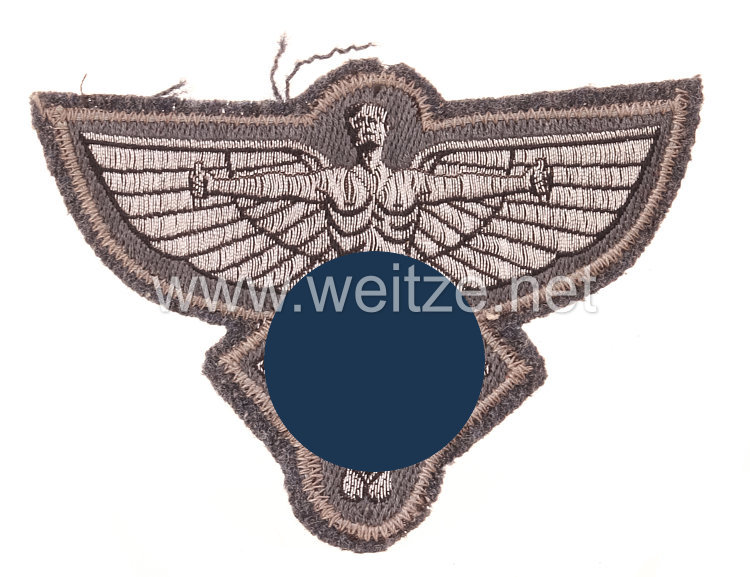
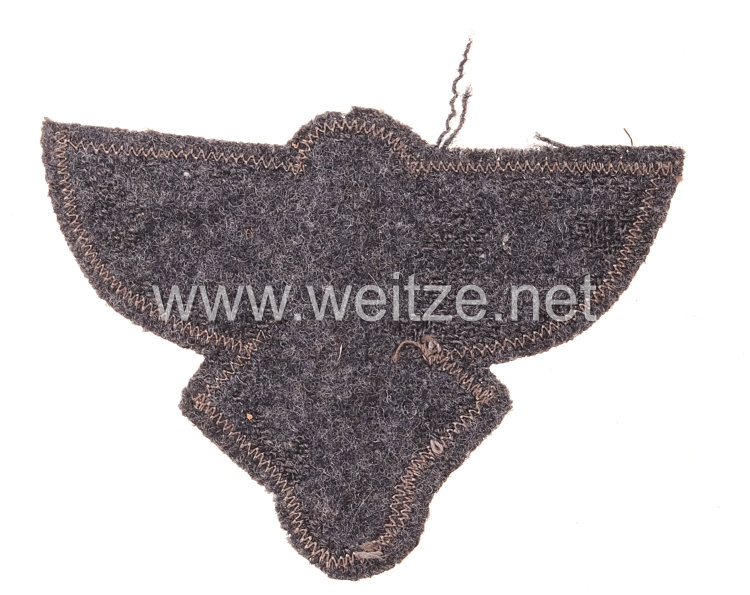
National Socialist Flying Corps (NSFK) Breast Eagle for Service Tunic
The Nationalsozialistisches Fliegerkorps (NSFK) breast eagle for the service tunic represents a significant uniform insignia of the National Socialist aviation organization that existed between 1937 and 1945. This example, manufactured using the Bevo weaving technique on gray cloth, exemplifies the characteristic uniform design of this paramilitary formation.
The NSFK was established on April 17, 1937, through the merger of the German Air Sports Association (Deutscher Luftsportverband, DLV) and other aviation organizations. The corps leader was NSKK-Obergruppenführer Friedrich Christiansen, who directed the organization until the end of the war. The NSFK primarily served as a preliminary flight training organization for young men who would later be conscripted into the Luftwaffe. With over 400,000 members by 1944, it represented a significant training ground for pilots, glider pilots, and aviation technical personnel.
The breast eagle in question was worn on the gray service tunic according to uniform regulations. The Bevo weaving technique, named after the company Bandfabrik Ewald Vorsteher from Wuppertal-Barmen, enabled the mechanical production of detailed textile insignia. This process involved weaving the insignia directly in one piece, allowing for precise representation of the eagle form with outstretched wings and the swastika clutched in its talons.
The NSFK's uniforming closely followed military models. The gray service tunic was the standard dress for members and leaders of the corps. The breast eagle was affixed centrally on the right breast, as stipulated in the NSFK uniform regulations. The gray base color of the cloth corresponded with the overall color scheme of NSFK uniforms, which distinctly differed from the blue Luftwaffe and brown SA uniforms.
The production of such insignia was carried out by various suppliers who had to meet the strict quality standards of National Socialist organizations. Besides the Bevo company, other textile manufacturers also produced these breast eagles, with the woven version being preferred due to its durability and precise representation. Alternative manufacturing methods included embroidered or printed variants, but the Bevo weaving technique was considered particularly high-quality.
The NSFK was divided into various branches: powered flight training, glider training, model aircraft training, as well as technical and communications training. Thousands of young men completed these training programs before being conscripted into the Wehrmacht, particularly the Luftwaffe. The organization maintained its own flight schools, workshops, and training facilities throughout the German Reich and occupied territories.
The wearers of these uniform insignia were members of all ranks within the NSFK, from simple flight students to senior corps leaders. Rank insignia were displayed through collar patches, shoulder boards, and sleeve stripes, while the breast eagle served as the fundamental badge of organizational membership.
Following the collapse of the German Reich in 1945, the NSFK was dissolved and banned by the Allied Control Council along with all other National Socialist organizations. The uniforms and insignia lost their official function and were largely destroyed or confiscated.
Today, such breast eagles serve as objects of study for military historians and uniform specialists. They document the organizational structure and visual culture of paramilitary formations of the Third Reich. The preservation and scholarly documentation of such objects serves historical research and education, always emphasizing the historical context and the criminal nature of the Nazi regime.
The condition grade 2 of this specimen indicates a well-preserved example that has largely retained its original weaving technique and coloration. Such objects enable researchers to study and document the manufacturing techniques, material quality, and uniform regulations of this era.