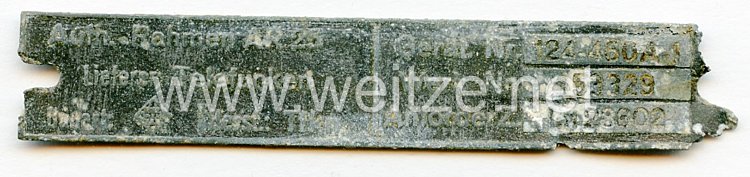
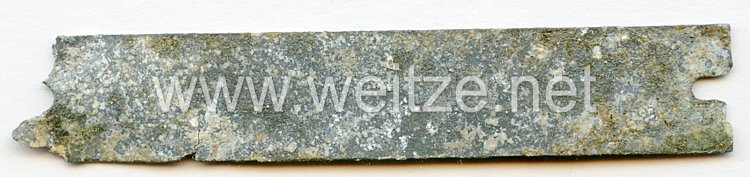
Luftwaffe Type Plate - Telefunken Company Device Number 124 - 460A1

single-sided printed metal plate, “Auth-Rahmen Serial Number 53329 Anfor: Ln28602” 1.4 x 7 cm, Condition 5
399217
20,00

Luftwaffe Type Plate - Telefunken Company Device Number 124 - 460A1

This Luftwaffe type plate manufactured by Telefunken represents an authentic artifact from the German Air Force signals service of World War II. Measuring 1.4 x 7 cm, this small but historically significant metal plate was attached to electronic equipment used by the Luftwaffe.

Telefunken, formally Telefunken Gesellschaft für drahtlose Telegraphie m.b.H. (Telefunken Society for Wireless Telegraphy), was one of Germany's leading manufacturers of radio technology and electronic equipment. Founded in Berlin in 1903, the company played a central role in developing and producing communications equipment for the German armed forces. During World War II, Telefunken manufactured a wide range of military equipment, including radio sets, radar systems, navigation devices, and aircraft instrumentation.

The inscription “Auth-Rahmen” (authentication frame) indicates a specific component, possibly an authentication or authorization frame for a larger electronic system. The works number 53329 identifies the individual device within the production series. The marking “Anfor: Ln28602” refers to the military requirement number of the Luftnachrichtentruppe (Air Signals Corps), designated by the abbreviation “Ln”.

The equipment number 124-460A1 follows the Luftwaffe's standardized designation system. This systematic numbering was introduced to catalog and manage the multitude of different devices and components. The system enabled unambiguous identification of equipment across all units and greatly facilitated maintenance, repair, and spare parts procurement.

Type plates like this were not merely simple labels but fulfilled important administrative and logistical functions. They allowed technicians and maintenance personnel to quickly identify equipment, consult the correct manuals, and obtain appropriate spare parts. In the Wehrmacht's complex supply chains, precise marking was essential.

The Luftnachrichtentruppe was responsible for all aspects of communication, navigation, and electronic warfare for the Luftwaffe. It operated ground radio stations, maintained aircraft equipment, and developed new technologies to improve communications and air situation reporting. Telefunken equipment was found in command posts, airfields, aircraft, and mobile units.

Production of military equipment at Telefunken occurred under strict quality control and according to military specifications. Each device had to pass acceptance tests before being delivered to the troops. The assignment of works numbers enabled traceability in case of defects or technical problems.

Toward the end of the war, German armaments production was increasingly affected by material shortages, bombing raids, and labor shortages. Nevertheless, industry attempted to maintain supply to the troops. Many production facilities were decentralized or relocated to underground installations.

After 1945, Telefunken and other German technology companies were investigated by the Allies. Many developments in German radio technology and electronics significantly influenced post-war technology. Telefunken itself was reconstructed and continued its activities in the post-war period, initially under Allied control.

For collectors and historians, such type plates are valuable primary sources. They document industrial manufacturing, military logistics, and technological development of this era. Each plate tells the story of a specific device that was part of the complex military machinery.

The condition of such objects varies greatly. After more than 75 years, many plates show signs of corrosion, mechanical damage, or weathering. Well-preserved examples with legible inscriptions are particularly valued, as they provide complete information about manufacturer, equipment type, and military assignment.

The study of these small artifacts contributes to our understanding of the technological and organizational aspects of World War II. They represent the intersection of industrial production, military requirements, and technological innovation during one of history's most consequential conflicts.