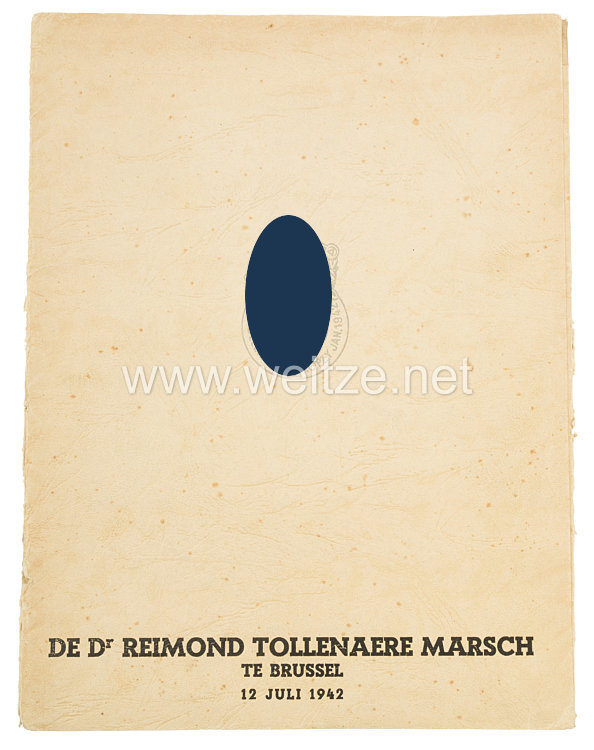
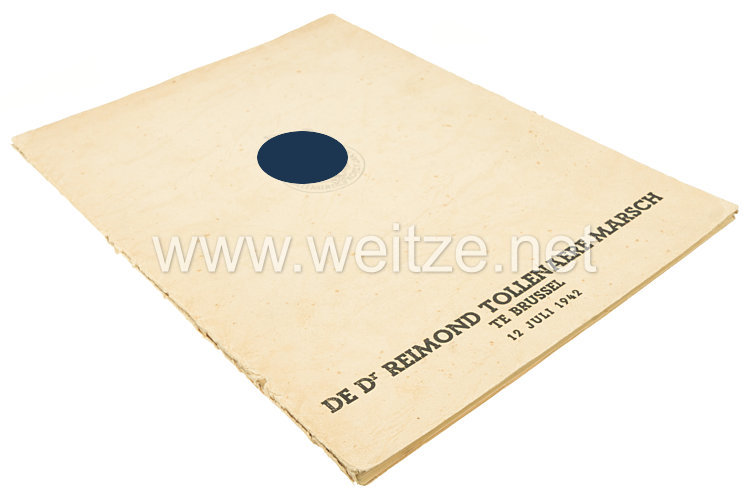
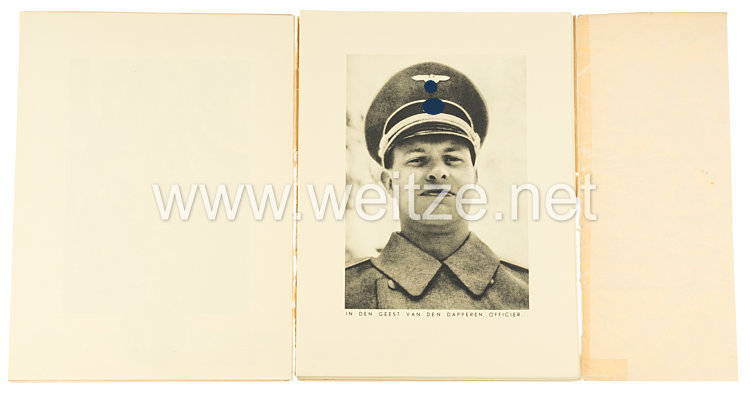
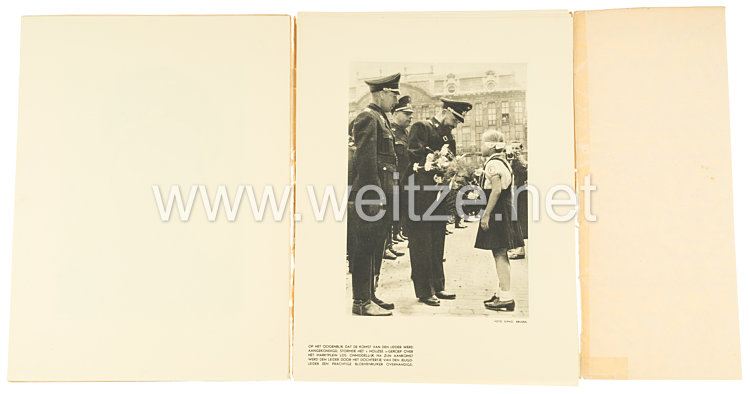
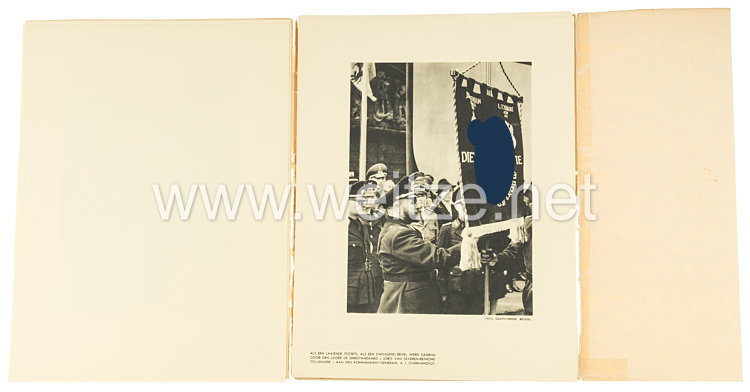
“The Dr. Reimond Tollenaere March in Brussels 12 July 1942”

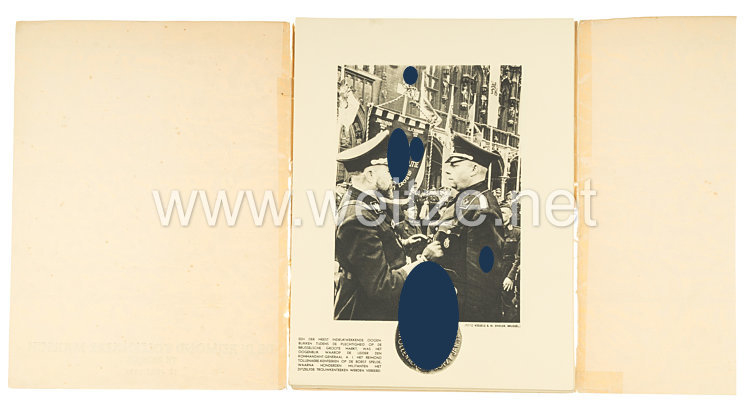
Large format 24 x 32 cm in portfolio folder (glued). With “Trouw” badge logo. 20 illustrated single sheets, 2 facsimile writings by Staf De Clercq and Joris Van Steenland, and 1 large illustrated double sheet. Including images of the grave of Reimond Tollenaere, Eastern Front soldiers, Dm-ZB-Korps, Dietsche-Miliz flag, 15,000 Dietsche soldiers, foreign guests, march past the Stock Exchange, etc. Age-related wear, condition 2
420216
650,00

“The Dr. Reimond Tollenaere March in Brussels 12 July 1942”

This collection documents the Dr. Reimond Tollenaere March that took place on July 12, 1942 in Brussels. This comprehensive documentation folder measuring 24 x 32 cm contains 20 illustrated single sheets, two facsimile writings, and one large double sheet, representing a significant historical testimony of Flemish collaboration during the German occupation of Belgium in World War II.

Reimond Tollenaere (1909-1942) was a central figure in the Flemish nationalist movement during World War II. As a leading member of the Vlaamsch Nationaal Verbond (VNV) and bearer of the “Trouw” (Loyalty) badge, which signified loyalty to the Flemish cause, he represented that segment of the Flemish movement that saw in German occupation an opportunity for Flemish autonomy. Tollenaere fell on January 22, 1942, at the Eastern Front near Kopzy in the Soviet Union while serving as a volunteer in the Waffen-SS.

The commemorative march held in July 1942 was a large-scale propaganda event serving multiple purposes. First, it aimed to portray Tollenaere as a martyr for the Flemish cause and the struggle against Bolshevism. Second, the event served to mobilize additional Flemish volunteers for service at the Eastern Front. The 15,000 Dietsche soldiers mentioned in the documentation reference the scale of mobilization that the VNV and related organizations could achieve.

The VNV under Staf De Clercq, whose facsimile writing is included in the collection, was the leading Flemish nationalist party in Belgium during the occupation period. De Clercq (1884-1942) ironically died in the same year as Tollenaere and was likewise styled as a martyr of the movement. Joris Van Severen, possibly referenced here as Van Steenland, was another key figure in the Flemish and later pan-Dutch nationalist movement, though he was killed by French soldiers as early as 1940.

The Dietsche Militie (Dietsche Militia), whose flag is depicted in the documentation, was a paramilitary formation of the VNV. The term “Diets” referred to a Greater Dutch concept that sought to unite Flanders and the Netherlands culturally and politically. This militia was later integrated into larger SS structures.

The presence of foreign guests at this event underscores the international dimension of the collaboration movement. Representatives of other fascist and National Socialist movements from across Europe regularly attended such events to propagate the idea of a European crusade against Bolshevism.

The march past the Stock Exchange in Brussels was symbolically significant. The Stock Exchange was located in the heart of the Belgian capital and represented a central public space where the collaboration movement could demonstrate its strength. Such public marches were part of the National Socialist aesthetic of power and served to intimidate opponents while motivating supporters.

The documentation also contains images of Tollenaere's grave, which underscores the death cult built around fallen collaborators. This martyr cult was an important element of propaganda to glorify sacrifice and recruit additional volunteers.

After the war, participation in such events and organizations was prosecuted in Belgium. Many VNV members and collaborators were charged with treason. The historical evaluation of this movement remains complex, as it combined Flemish cultural aspirations with collaboration with the Nazi regime.

Today, such documentation serves as important historical sources for understanding the history of collaboration in Belgium. They document not only the political and military aspects but also the propaganda methods and visual culture of that era. The condition rating of “2” indicates relatively good preservation despite age-related wear, which is remarkable for a nearly 80-year-old document.

r