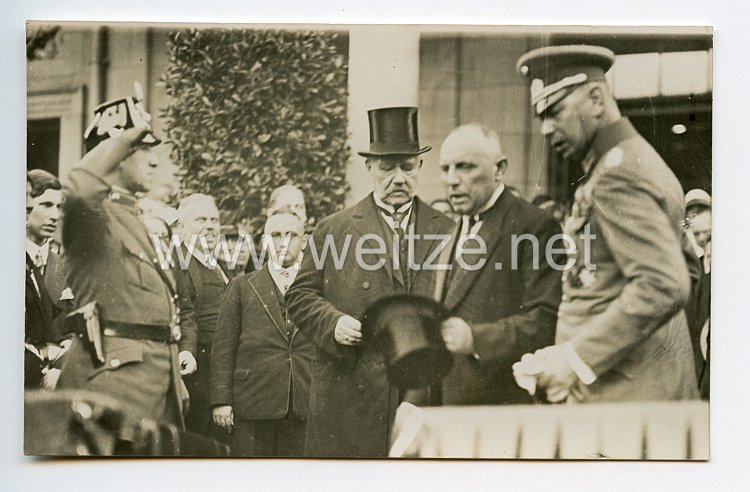
Weimar Republic Photograph, Reich President Paul von Hindenburg
Historical Context: Photographic Postcard of Reich President Paul von Hindenburg from the Weimar Republic
This postcard featuring the portrait of Paul von Hindenburg represents a characteristic artifact of the political visual culture of the Weimar Republic (1918-1933). Such photographic postcards were a widely distributed medium during this era for disseminating images of political personalities, serving both propagandistic purposes and personal veneration.
Paul von Hindenburg (1847-1934) was one of the most influential figures in early 20th-century German history. As a Field Marshal, he achieved legendary fame during World War I, particularly through his victory at the Battle of Tannenberg in August 1914 against Russian forces. This military success transformed him into a national icon and established the “Hindenburg myth,” which significantly enabled his later political career.
After the war, Hindenburg initially withdrew from public life but returned to politics in 1925. During the 1925 Reich Presidential Election, he was elected as the second Reich President of the Weimar Republic at the age of 77, succeeding Friedrich Ebert. His election represented a compromise among various conservative and national forces who saw him as a stabilizing factor. He was re-elected in 1932, paradoxically supported by democratic parties to prevent Adolf Hitler's election.
Photographic postcards like this one were a significant medium of political communication in the Weimar Republic. They were produced in large editions and served multiple functions: campaign advertising, collectible items, autograph cards, and popular souvenirs. The postcard industry experienced its golden age in the 1920s and early 1930s, with nearly all prominent politicians, military figures, and cultural personalities immortalized in this format.
The depiction of Hindenburg on such cards typically followed a specific pattern: he was frequently shown in uniform, sometimes in civilian dress, always dignified and projecting authority. This iconography served to convey stability, experience, and national continuity during times of political turbulence. The “substitute emperor,” as Hindenburg was sometimes called, was meant to satisfy the longing for monarchical authority in the young republic.
The technical production of such postcards was typically handled by specialized publishers and photographers. Official portraits were created by renowned photographers and then released for reproduction. Quality ranged from simple black-and-white prints to elaborately colored versions. The standard format corresponded to the contemporary postcard dimensions of approximately 9 x 14 cm.
Historically, these postcards document not only Hindenburg's person but also the political culture of the Weimar Republic. They demonstrate how strongly the young democracy still depended on traditional authority figures and how the monarchical legacy persisted. Simultaneously, they illustrate the role of mass media in constructing political personalities.
The irony of history lies in the fact that Hindenburg, elected as a pillar of the republic, appointed Adolf Hitler as Reich Chancellor on January 30, 1933 – a step that sealed the end of the Weimar Republic. After Hindenburg's death on August 2, 1934, Hitler seized the opportunity to merge the offices of Reich President and Reich Chancellor, declaring himself “Führer and Reich Chancellor.”
For collectors and historians, such postcards are today valuable sources for researching political visual culture, propaganda methods, and public perception of political personalities. They document the visual strategies of political self-representation and the mechanisms of heroization in the interwar period. The condition of such objects varies greatly, with well-preserved examples being particularly valued by collectors.