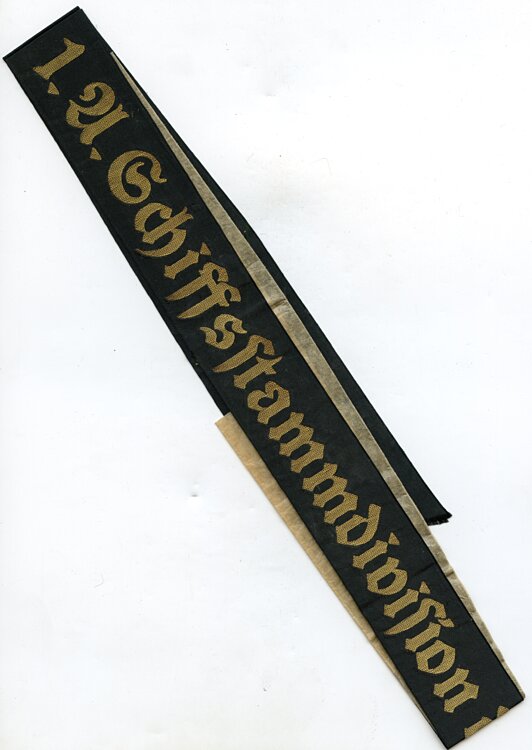
Kriegsmarine Cap Tally "1.A. Schiffsstammdivision der Nordsee 1.A."
The Kriegsmarine cap tally represents a fascinating artifact of German naval history during World War II. This particular tally bears the inscription “1.A. Schiffsstammdivision der Nordsee 1.A.” and represents an organizational unit of the Kriegsmarine responsible for training and administration of naval personnel.
The Schiffsstammdivisionen (Ship Base Divisions) were administrative and training units of the Kriegsmarine that played an important role in organizing naval personnel during World War II. These divisions were organized by geographical areas, with the North Sea Division naturally responsible for the North Sea region. The designation “1.A.” indicates a specific subdivision within this organizational structure.
Cap tallies were worn on the peaked cap (Tellermütze) of German naval personnel and served as an important identifier of the respective unit. The tradition of displaying ship names or unit designations on cap tallies in the German Navy dates back to the Imperial era. This practice was continued by the Kriegsmarine and regulated by various directives.
The Kriegsmarine, officially established in 1935 following Germany's rearmament, replaced the Reichsmarine of the Weimar Republic. Under the High Command of the Kriegsmarine, strict uniform regulations were issued that also governed the design and wearing of cap tallies. These regulations were specified in the dress regulations (Anzugbestimmungen) and were regularly updated.
The present specimen is in virtually mint condition and is partially preserved with its original wrapping paper. This suggests it may never have been worn or was kept as a spare item. The length of 118 cm corresponds to the standardized measurements for Kriegsmarine cap tallies, which were wrapped around the cap band and tied in a bow at the back.
Cap tallies were manufactured by specialized textile companies that supplied the Kriegsmarine. The lettering was typically executed in golden-yellow color on a black background, with the letters machine-woven. The quality and execution were subject to strict military standards to ensure uniformity and durability.
Ship Base Divisions had several functions: they were responsible for personnel administration, basic training of recruits, assembling crews for new ships, and managing personnel stationed ashore between deployments or during their ships' dockyard periods. Particularly toward the end of the war, as many ships were lost or could no longer be deployed due to fuel shortages, the importance of these base divisions increased significantly.
The North Sea was of strategic importance to the Kriegsmarine. Important operations took place here, significant naval bases such as Wilhelmshaven and Cuxhaven were located here, and from here U-boats and surface units operated against Allied convoys and warships. The Ship Base Division of the North Sea was therefore a large and significant organizational unit.
For collectors and historians, such cap tallies are important sources as they provide insight into the organizational structure of the Kriegsmarine. The exceptionally good condition of this specimen makes it a particularly valuable historical document. The fact that parts of the original packaging are still preserved is extremely rare and significantly increases its documentary value.
It is important to emphasize that such military-historical objects should today be viewed exclusively from the perspective of historical documentation and research. They serve as material witnesses of a past era and help us better understand history and learn from it.