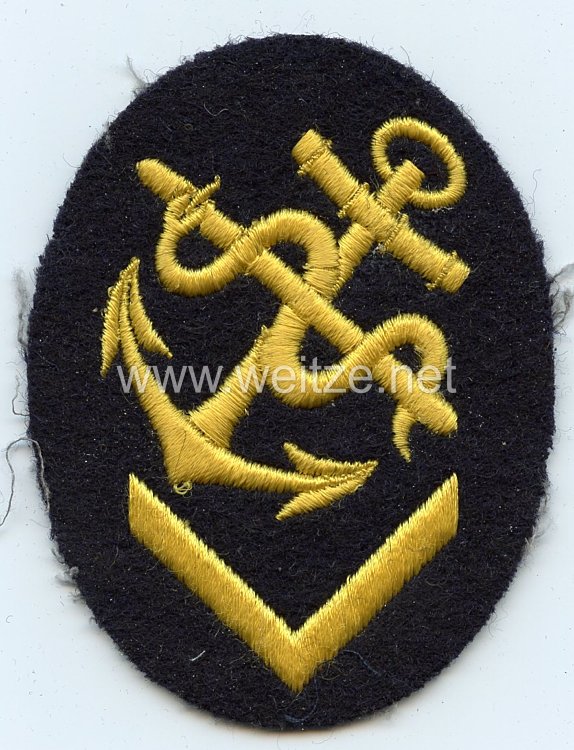
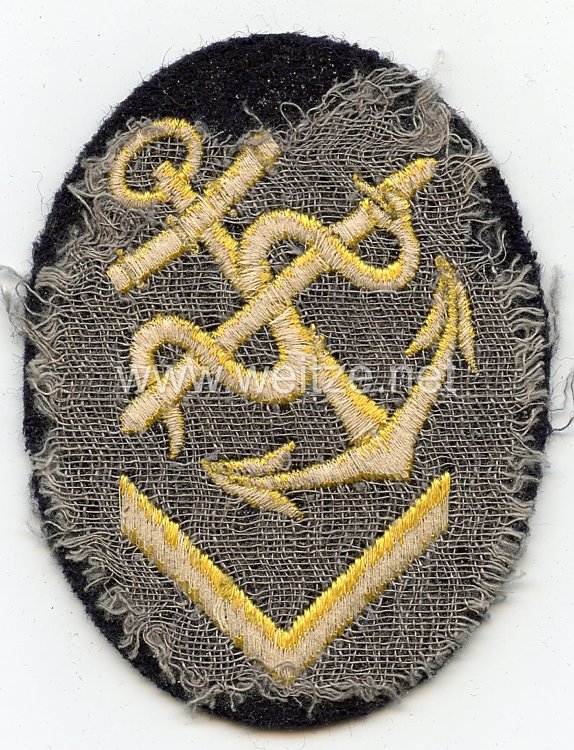
Kriegsmarine Sleeve Insignia Medical Chief Petty Officer (Sanitätsobermaat)

machine-embroidered, for the blue jumper. Condition 2-
376816
35,00

Kriegsmarine Sleeve Insignia Medical Chief Petty Officer (Sanitätsobermaat)

The sleeve insignia of the Sanitätsobermaat (Senior Medical Petty Officer) of the Kriegsmarine represents a significant artifact of military rank insignia and medical service within the German Navy during World War II. This machine-embroidered badge was worn on the blue uniform and designated a specific rank within the maritime medical hierarchy.

The Kriegsmarine, officially established in 1935 following the repudiation of the Versailles Treaty restrictions, developed a complex system of rank insignia and service identification. The Sanitätsobermaat belonged to the non-commissioned officers of the medical service and held an important position in providing medical care aboard warships. The rank of Obermaat roughly corresponded to that of a senior sergeant in other Wehrmacht branches and represented an experienced non-commissioned officer.

According to the dress regulations of the Kriegsmarine, the sleeve insignia was worn on the blue blouse, which was part of the standard uniform. The blue uniform was the typical service dress for shipboard duty, worn in contrast to the white summer uniform or the dark blue dress uniforms. The placement of sleeve insignia followed strict regulations detailed in the Kriegsmarine's clothing directives.

The machine embroidery of these insignia was characteristic of production methods in the late 1930s and 1940s. While earlier badges were often hand-embroidered, machine manufacturing enabled standardized mass production necessary for the expanding Kriegsmarine. Embroidery typically utilized light blue or white threads on dark base fabric, with the medical service symbols—usually an Aesculapius staff—prominently displayed.

The Medical Service of the Kriegsmarine had a long tradition in the German Navy. A well-organized medical system aboard ships already existed in the Imperial Navy of World War I. The Kriegsmarine adopted and modernized these structures. Senior Medical Petty Officers and other medical NCOs were responsible for basic medical care of the crew, assistance during surgical procedures, administration of shipboard hospitals, and implementation of hygiene measures.

Training to become a Sanitätsobermaat required extensive medical knowledge and practical experience. Candidates underwent specialized training courses in naval hospitals and medical schools, where they were instructed in anatomy, nursing, first aid, surgery, and maritime medicine. The particular challenges of medicine at sea—limited resources, space constraints, combat injuries, and maritime diseases—required highly specialized personnel.

The rank structure in the medical service was clearly defined: below the Sanitätsobermaat were the Sanitätsmaat (Medical Petty Officer) and Sanitätsgefreiter (Medical Lance Corporal), while above followed various grades of senior medical NCOs and finally the medical officers, including naval staff physicians and senior physicians. This hierarchy reflected military organization and ensured effective medical care under all conditions.

The wearing of insignia on the blue blouse followed precise regulations. The sleeve badge was attached to the upper arm, with the exact position specified by service regulations. In addition to the sleeve insignia, Senior Medical Petty Officers also wore corresponding shoulder straps or epaulettes identifying their rank. The combination of various rank insignia enabled immediate identification of rank level and service branch.

Historically, such sleeve insignia document not only military structures but also the technological and textile production of their time. The quality of embroidery, materials used, and manufacturing methods provide insight into the production capacities and standards of the Third Reich. Many of these badges were manufactured by specialized firms holding contracts with the Wehrmacht.

Following the end of World War II in 1945, the Kriegsmarine was dissolved, and its uniforms and insignia became historical artifacts. Today, such pieces are important sources for military historical research and help understand the structure, organization, and daily life of the Kriegsmarine. They are preserved in museums, archives, and private collections, contributing to the documentation of this significant period in military history.

The condition and preservation of these insignia vary greatly depending on storage conditions and use. Machine-embroidered pieces like this one often show characteristic aging patterns, including fading of colors, loosening of threads, and wear to the base fabric. Nevertheless, they remain valuable testimonies to the complex system of military identification and the crucial role of medical personnel in naval warfare.

r