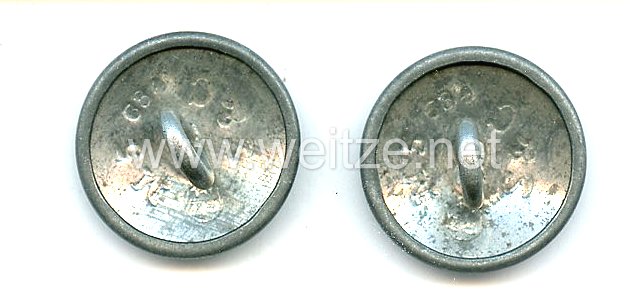
Hitler Youth (HJ) Pair of Gefolgschaft Shoulder Buttons No. 17
The Hitler Youth (Hitlerjugend, HJ) was the youth organization of the National Socialist German Workers' Party (NSDAP), existing from 1926 to 1945. Within this organization, uniforms and insignia played a central role in identification and hierarchical structure. The Gefolgschaft shoulder buttons described here, bearing the number 17, represent a typical example of the identification system within the HJ structure.
The Gefolgschaft formed a mid-level organizational unit within the HJ hierarchy. The structure followed a military-style organization: the smallest unit was the Kameradschaft (squad) with approximately 15 boys, several Kameradschaften formed a Schar (troop), and several Scharen constituted a Gefolgschaft with typically 150 to 200 members. Multiple Gefolgschaften were in turn combined into an Unterbann (sub-district). This strict hierarchical order was intended to instill discipline and military virtues from an early age.
The numbering of Gefolgschaften occurred regionally within the respective Banne (districts) and Gebiete (regions), the superior administrative units of the HJ. The number 17 thus identified a specific Gefolgschaft within its Bann. These numbers were not uniform across the Reich but referred to the local organizational structure. Shoulder buttons bearing such identification numbers were worn in pairs and enabled quick identification of an HJ member's unit affiliation.
The marking with the RZM manufacturer on the reverse is of particular historical significance. The Reichszeugmeisterei (RZM) was the central procurement and inspection office of the NSDAP, established in 1929. After the seizure of power in 1933, the RZM received a monopoly on the production and distribution of party and organizational insignia. Each authorized manufacturer received an RZM number that had to be affixed to the products. This system was intended to ensure quality standards and prevent unauthorized production. Today, RZM marking is considered an important authenticity feature when evaluating such objects.
The HJ uniform was detailed in several service regulations. The characteristic brown shirt with black neckerchief and leather knot, along with black uniform trousers or shorts and the shoulder strap system, defined the appearance. Shoulder straps and buttons were integral components of this uniform and were attached to the shoulder areas of the shirts. They served not only for identification but were also part of the uniform overall appearance intended to demonstrate uniformity and belonging.
Membership in the HJ was gradually expanded. While initially voluntary, it became effectively mandatory through the Law on the Hitler Youth of December 1, 1936. The law declared all German youth obligated to be educated in the HJ. In 1939, membership became definitively compulsory through the Youth Service Obligation. At its peak, the organization comprised approximately 8.7 million members.
HJ activities initially included sports, field games, evening meetings, and camping. However, as war approached, the focus shifted heavily toward pre-military training. From 1939, HJ units also assumed war-essential tasks such as harvest assistance, air raid protection, and collection services. In the final phase of the war, HJ members were even directly involved in combat operations, resulting in significant losses among the youth.
From today's perspective, such uniform pieces and insignia are significant historical sources. They document the totalitarian penetration of society by the Nazi regime, which systematically indoctrinated and militarized even children and adolescents. The meticulous organization, evident in the detailed numbering and marking, demonstrates the bureaucratic character of the system. At the same time, these objects raise important questions about responsibility, education, and the manipulation of young people by authoritarian regimes.
The collection condition “2” indicates a well-preserved state with only minor signs of use. Such objects are today preserved in museums, educational institutions, and private collections, where they serve as illustrative material for historical-political education. Their study helps understand the mechanisms of totalitarian rule and the instrumentalization of youth – an important task for preventing similar developments.