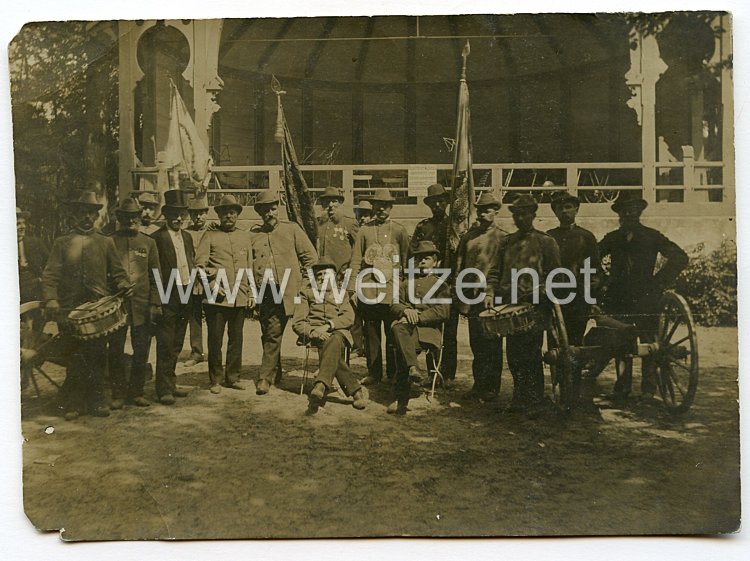
German Empire Group Photograph of a Shooting Guild/Marksmanship Association

circa 1910, postcard size, damaged. Condition 2-.
347016
10,00

German Empire Group Photograph of a Shooting Guild/Marksmanship Association

This object is a group photograph of a shooting guild or shooting club from the German Empire, dating to approximately 1910. Such photographs document an important tradition of German associational life that traces its roots to the Middle Ages and experienced its golden age in the 19th and early 20th centuries.

Historical Context of Shooting Clubs: German shooting guilds originated in medieval civic militias responsible for defending cities. Over the centuries, these militias evolved into social organizations that, alongside marksmanship, assumed social and cultural functions. With the founding of the German Empire in 1871 and advancing industrialization, associational life experienced tremendous growth. Shooting clubs became important pillars of social life, particularly in smaller towns and rural areas.

Around 1910, when this photograph was taken, the German Empire was at the height of its power under Kaiser Wilhelm II. Society was highly militarized, and shooting clubs were seen as expressions of bourgeois virtues such as discipline, camaraderie, and patriotism. The clubs regularly organized shooting festivals where members competed for the title of Schützenkönig (Shooting King).

Photographic Documentation: Group photographs like this were a popular medium for club self-representation around 1910. The postcard size of the object corresponds to the standard format of approximately 9 x 14 cm that had been standardized since the 1870s. Such photographs were frequently produced on special occasions like anniversaries, shooting festivals, or club outings. They served both documentation and distribution purposes, as postcards were a popular means of communication.

The typical staging of such group photos followed fixed conventions: members usually posed in several rows, often wearing their club uniforms or formal attire. Frequently visible were club flags, shooting targets, trophies, or other insignia expressing the pride and identity of the club. Rank badges and medals were demonstratively displayed.

Social Significance: Shooting clubs were by no means purely military organizations but fulfilled important social functions. They provided space for social gathering, promoted local identity, and created social networks. Membership extended across various social strata, with craftsmen, merchants, and civil servants frequently represented. Women were generally excluded from active membership during this period but participated in social events.

Political Context: In the Wilhelmine era, shooting clubs were also understood as instruments of national integration. They conveyed patriotic values and contributed to strengthening national consciousness. At the same time, they remained sites of local and regional identity. After World War I (1914-1918) and the collapse of the Empire, the significance of these clubs changed considerably.

Condition and Collector Value: The object is described as damaged with a condition rating of 2-, indicating moderate signs of use and damage. Today, such photographs are important historical documents providing insights into social life, fashion, club culture, and the mentality of the Imperial era. For local historians, social historians, and collectors of military-historical memorabilia, they represent valuable primary sources.

The photograph thus represents an authentic testimony to German associational life in the late Imperial period and documents a tradition that, despite all the political upheavals of the 20th century, continues in modified form to this day.