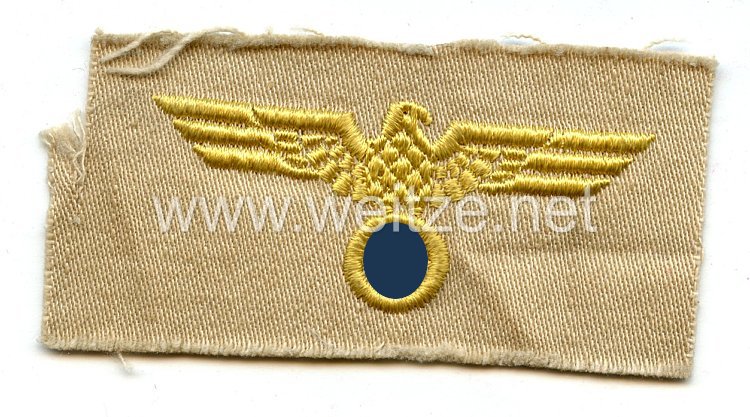
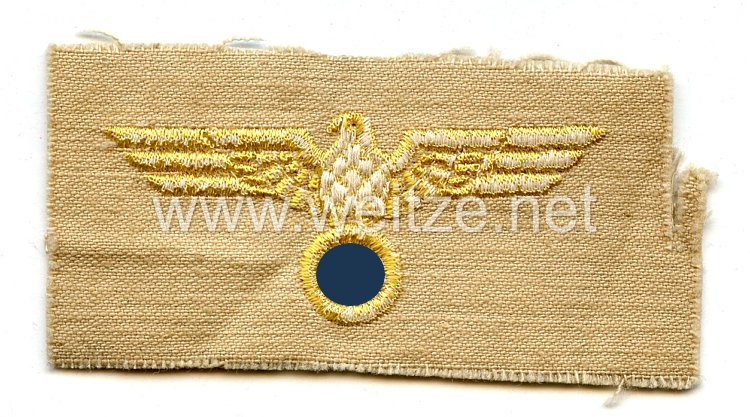
Kriegsmarine Tropical Side Cap Eagle for Enlisted Personnel

Machine-embroidered version in yellow on sand-colored background. Unissued condition, condition grade 2.
422415
140,00

Kriegsmarine Tropical Side Cap Eagle for Enlisted Personnel

The Kriegsmarine Ship Cap Eagle for Enlisted Personnel represents a characteristic insignia of the German Navy during World War II. This particular specimen was manufactured for the tropical ship cap, the headgear worn by naval personnel in tropical and subtropical deployment areas.

The Kriegsmarine, officially established in 1935, developed a comprehensive system of uniforms and insignia that accommodated different ranks, functions, and climatic conditions. The national emblem in the form of an eagle with outstretched wings clutching a swastika in its talons was mandatory on all Wehrmacht uniform items and symbolized National Socialist state leadership.

The Schiffchen (ship cap), also known as a side cap or garrison cap, was a flat, boat-shaped headgear without a visor, worn with service uniform and during certain duties. For deployment in tropical regions – such as North Africa, the Mediterranean, or southern waters – a special version in light sand-beige color was developed, which was better suited for hot climates than the darker standard version.

The machine-embroidered execution of this eagle in yellow on sand-colored background corresponds to regulations for tropical insignia. While eagles for the dark blue standard uniform were rendered in white or silver-gray, yellow or golden-yellow insignia were used for tropical uniforms to ensure sufficient contrast with the light base material. Machine embroidery enabled cost-effective and standardized mass production, which was preferred for equipping enlisted ranks, while officers often wore more elaborate, hand-embroidered or metal-thread insignia.

The distinction between enlisted and officer insignia was strictly regulated in the Kriegsmarine. Enlisted personnel wore simpler, more robust versions that had to meet the practical requirements of shipboard service. Machine production ensured consistent quality and enabled rapid production of large quantities for the expanding navy.

The Kriegsmarine's deployment in tropical areas encompassed various operations: U-boat bases in southern France and Italy, naval bases in North Africa, fleet units in the Mediterranean, and isolated deployments in even more southerly regions. Tropical clothing was first introduced in the late 1930s and was further developed and standardized throughout the war.

The Kriegsmarine's uniform regulations were laid down in detailed dress codes that precisely specified when which uniform and which insignia were to be worn. The attachment of national emblems on headgear followed precise specifications regarding size, placement, and execution. The eagle was typically placed centrally on the front of the ship cap.

The unworn condition of this specimen is remarkable, as most uniform items from this period were intensively used and often worn to the point of being unserviceable. Unworn pieces can have various explanations: they may have been stored as spare parts, not issued by war's end, or not used for other reasons. Such pieces offer valuable military-historical insights into the original condition and quality of equipment items.

The manufacture of uniform insignia was a significant industry during the war, involving numerous textile companies. Production was subject to military quality standards and supervised by the responsible army administration offices. As the war progressed and material shortages increased, there were occasional simplifications in manufacturing and the use of substitute materials.

Today, such insignia are important objects of study for military historians, uniform researchers, and museums. They document not only military organizational structure and uniform regulations, but also the textile manufacturing techniques of the period and the adaptation of military equipment to various operational conditions. The scientific examination of such objects contributes to understanding the everyday reality of soldiers during World War II.

The study of Kriegsmarine tropical insignia provides particular insights into the global scope of German naval operations and the logistical challenges of equipping forces in diverse climatic zones. These seemingly small objects represent broader historical narratives of military expansion, industrial production under wartime conditions, and the practical adaptations required for naval service across multiple theaters of operation.