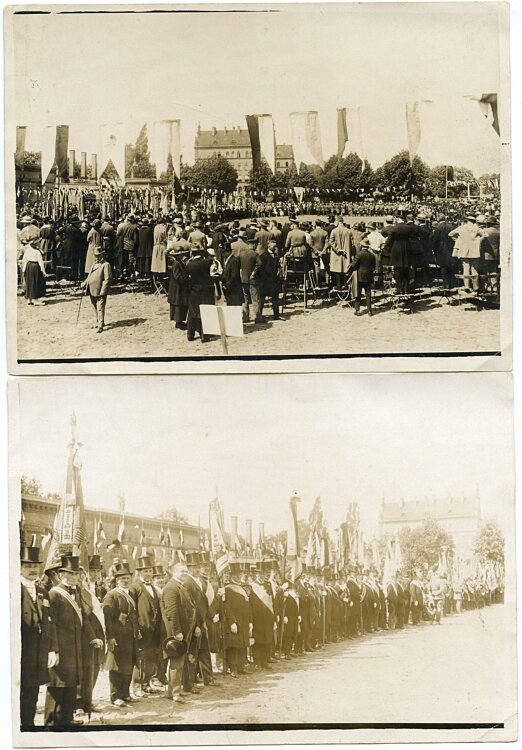
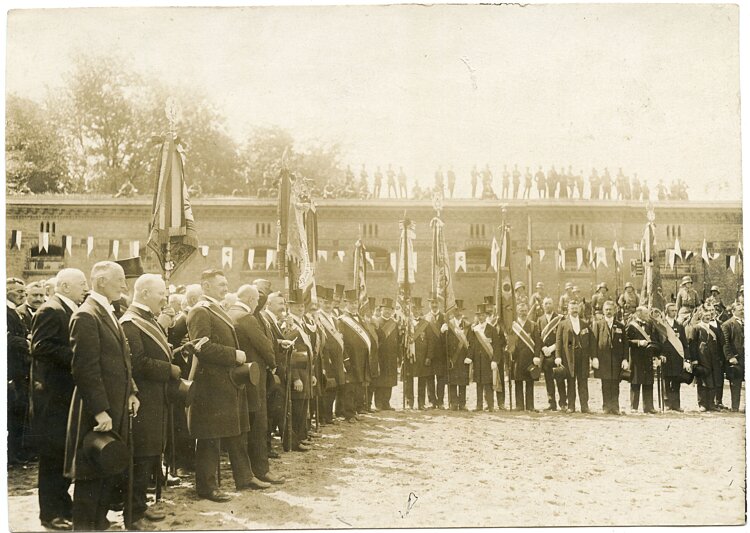
Photograph, Reservist Meeting of the Landwehr
These photographs of a Landwehr reservist reunion document an important aspect of German military culture in the late 19th and early 20th centuries. Such images provide valuable insights today into the social organization and self-perception of former soldiers in the German Empire.
The Landwehr had been an integral component of the German military system since the Prussian army reforms under Gerhard von Scharnhorst and August Neidhardt von Gneisenau (1807-1814). Following the conscription legislation of 1814 and subsequent reforms, men after their active service first belonged to the Reserve before being transferred to the Landwehr. Landwehr I comprised men from ages 28 to 32, while Landwehr II included those from 33 to 39 years of age.
The reservist system developed into a significant social phenomenon in the German Empire. After completing their service, former soldiers organized themselves into reservist and veterans' associations, which grew substantially in numbers. By 1900, the Kyffhäuserbund, the umbrella organization of veterans' associations, counted over 2.8 million members in more than 31,000 individual clubs.
Reservist reunions were important social events that fulfilled several functions. They served to maintain camaraderie, commemorate shared service time, and demonstrate military virtues in civil society. These gatherings typically occurred annually and included parades, church services, banquets, and social meetings. Veterans often wore their uniforms or special club uniforms with corresponding insignia and decorations.
Photography played a central role in documenting such events. From the 1880s onward, technical developments in photography – particularly the introduction of the gelatin dry plate and later more portable cameras – enabled the widespread distribution of photographic images. Professional photographers, as well as ambitious amateurs, captured reservist reunions for posterity. The standard formats, such as the approximately 13 x 18 cm size present here, corresponded to the then-common standards of studio and documentary photography.
Typically, such photographs show group portraits of assembled reservists, often in military formation or before significant local buildings. Other popular subjects included parades through streets, the display of flags and standards, and social gatherings during banquets. The men presented themselves in their finest clothing, often with reservist badges, medal bars, and other military decorations.
Landwehr reservists in their presentation often differed from active soldiers through the combination of civilian and military clothing elements. Characteristic items included reservist steins, sashes, special caps, and badges documenting membership in specific regiments and units. These accessories were often richly decorated and bore inscriptions with names, service locations, and service periods.
The historical significance of such photographs lies in several aspects. They document the militarization of civil society in the German Empire, where military values such as discipline, obedience, and patriotism were considered desirable bourgeois virtues. Reservist associations contributed to the integration of various social classes, although officer ranks remained mostly reserved for the upper class.
At the same time, these images reflect regional identity. Landwehr units were territorially organized, and reservist reunions strengthened local and regional ties. The gatherings were often connected with public festivals and shaped social life in towns and communities.
From an art historical perspective, such photographs demonstrate the development of documentary photography and group photography. The image composition, staging of persons, and technical execution provide insight into photographic practices of the era. The indicated condition grade 2 suggests well-preserved prints that have largely retained their original image quality.
After World War I, the significance of such reunions changed fundamentally. The traumatic war experiences, defeat, and political upheavals of the Weimar Republic led to a reorientation of veterans' organizations. The old reservist photographs from the Imperial era became documents of a bygone epoch.
Today, such photographs are important historical sources for researching military history, social history, and everyday culture of the German Empire. They complement written sources and enable insights into the visual self-representation and collective memory of military communities.