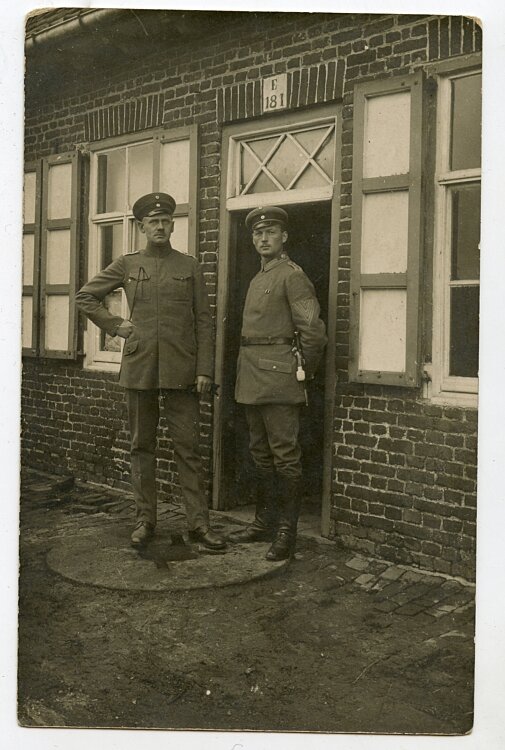
World War I Photograph, Wachtmeister of the Feldgendarmerie with Sidearm

Postcard size. Condition 2.
202615
10,00

World War I Photograph, Wachtmeister of the Feldgendarmerie with Sidearm

The Feldgendarmerie in World War I: Sergeants and Their Equipment

The Feldgendarmerie (Field Gendarmerie) constituted an indispensable military police unit of the German armed forces during World War I (1914-1918). Photographs of field gendarmes, particularly those in postcard format, document not only the uniforms and equipment of these soldiers but also their important role in maintaining military order behind the front lines.

Organization and Duties

The Feldgendarmerie was structured according to the Prussian army organization and deployed in all German armies. The rank of Wachtmeister (sergeant) corresponded to a non-commissioned officer and was a typical service position within gendarmerie units. Sergeants bore considerable responsibility for conducting police duties in the war zone, including traffic control, supervision of troop movements, deserter searches, and general maintenance of military discipline.

Field gendarmes were organized into Feldgendarmerie-Abteilungen (Field Gendarmerie Detachments) assigned to individual armies. Each army typically had one such detachment, which was further divided into several squads. These squads operated both in rear areas and near the front.

The Side Arm as Identifying Feature

The Seitengewehr (side arm, bayonet or sword bayonet) was an essential component of a field gendarme's equipment. While regular infantrymen primarily used their bayonets as attachment weapons for rifles, field gendarmes wore them as side arms on their belts. Typically, this was the Model 98/05 bayonet or similar models that belonged to the standard equipment of the Imperial Army.

Wearing the side arm emphasized police authority and, together with other equipment items such as the characteristic Ringkragen (a metal neck chain with badge, though largely discontinued by 1914) and special armbands, served as an identifying mark of the Feldgendarmerie.

Uniforms and Insignia

Field gendarmes wore the regular field-gray uniform of the German Army, as introduced from 1910 onward, replacing the older colorful uniforms. However, they were distinguished by special markings, including orange-red Waffenfarben (branch colors) on collars and shoulder straps, as well as special sleeve badges. In the field, they frequently wore an armband inscribed with “Feldgendarmerie” or corresponding symbols.

The Wachtmeister, as a non-commissioned officer, wore corresponding rank insignia, typically braided piping on the shoulder straps. The exact design could vary depending on the point in the war and available materials.

Photographic Documentation

Photographs in postcard size were extremely popular during World War I. Soldiers had their pictures taken in professional studio ateliers or by field photographers to send these images to their families. These photographs served both personal remembrance and maintaining connection with home.

Field gendarmes particularly enjoyed being photographed in full uniform with their characteristic equipment, as this emphasized their special status within the army. The side arm was often prominently displayed, either worn on the belt or held in hand.

Historical Significance

Such photographs are important historical documents today. They enable researchers and collectors to study details about uniforms, equipment, and the self-perception of these military police units. The Feldgendarmerie played an often underestimated but essential role in the logistics and organization of German warfare.

Throughout the war, the importance of the Feldgendarmerie grew, especially during the great retreat movements of 1918, when maintaining order and preventing desertion became increasingly difficult. After the armistice in November 1918, field gendarmerie units were also involved in the orderly withdrawal of German troops.

Collector Value and Preservation

Photographs of field gendarmes from World War I are highly sought after by collectors of military historical documents. The condition of such photographs, over a century old, varies considerably. Well-preserved examples enable detailed studies of equipment and uniforms and constitute important contributions to military history research.

r