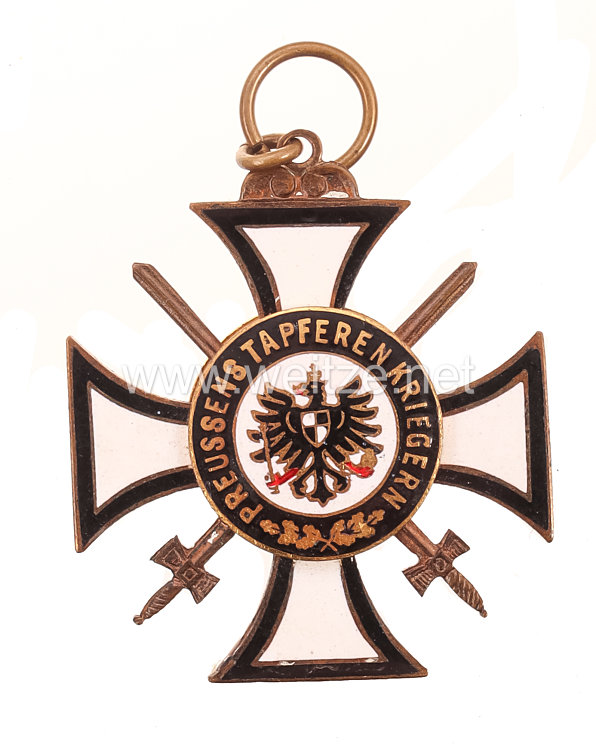
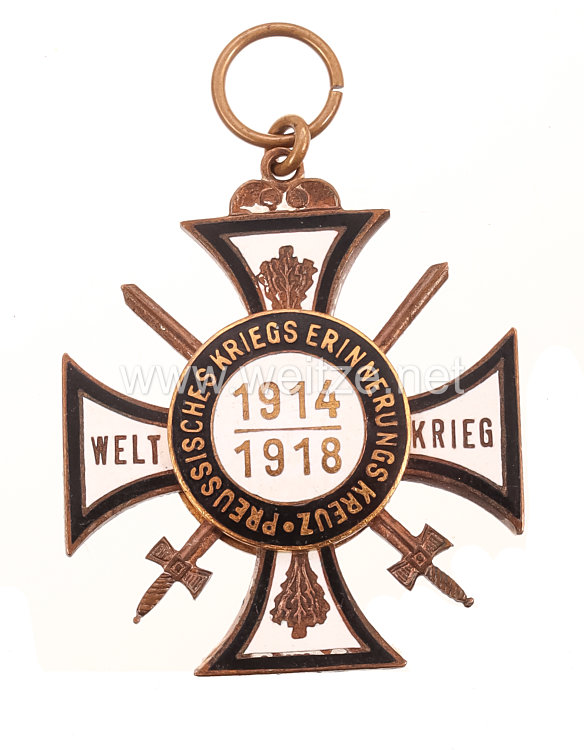
Prussian Landeskriegerverband Honor Cross 2nd Class "Preussens tapferen Kriegern" 1914-1918

Silver-plated non-ferrous metal, partially gilt and enameled, without ribbon, condition 2.
440414
200,00

Prussian Landeskriegerverband Honor Cross 2nd Class "Preussens tapferen Kriegern" 1914-1918

The Honor Cross 2nd Class of the Prussian State Warriors' Association bearing the inscription “To Prussia's Brave Warriors” represents a significant commemorative decoration from the period of World War I. This award was not instituted by the Prussian state itself, but rather by the Prussian State Warriors' Association (Preußischer Landeskriegerverband), one of the largest and most influential veterans' organizations of the Weimar Republic.

The Prussian State Warriors' Association was founded in the 19th century and developed into a powerful organization that counted several million members after World War I. As an umbrella organization, it united local warriors' clubs and veterans' associations throughout Prussia. After the lost war and the dissolution of the monarchy, such associations assumed an important role in preserving the memory of fallen comrades and supporting disabled veterans and their bereaved families.

The present Honor Cross was awarded in two classes, with the 2nd Class representing the lower grade. The decoration was intended for veterans of World War I who belonged to the State Warriors' Association or had acquired special merits in veterans' work. The inscription “To Prussia's Brave Warriors” refers to the traditional Prussian military tradition and the pride in military achievement that was maintained despite the defeat.

The manufacture and design of this association decoration typically utilized base metal that was partly silver-plated and partly gilt. The enameling of individual areas gave the decoration its characteristic colored design. This manufacturing technique was widespread in the 1920s and enabled relatively inexpensive production while maintaining an attractive appearance. The combination of silver plating and gilding was intended to emphasize the value and significance of the decoration, even though it was not a state decoration.

Unlike state orders and decorations of the Imperial or Weimar periods, association awards such as the Honor Cross of the State Warriors' Association were private foundations. They could be awarded without state approval and were not subject to the strict bestowal regulations of official orders. This led to a multitude of different veterans' badges and honor crosses instituted by various organizations.

The historical classification of this decoration is inseparably linked with the veterans' movement of the Weimar Republic. The warriors' clubs played an ambivalent role in Germany's first democracy. On one hand, they provided important social support for war participants and their families; on the other hand, many of these associations cultivated pronounced militarism and were skeptical toward the democratic order. The Prussian State Warriors' Association belonged to the conservative organizations that upheld the monarchist tradition.

The years 1914-1918 noted on the decoration mark the duration of World War I, in which the German Empire fought alongside Austria-Hungary against the Entente Powers. For Prussia as the largest federal state of the Empire, this war meant an enormous burden. Millions of Prussian soldiers served in the armed forces; hundreds of thousands were killed or wounded.

The absence of the ribbon on the described specimen is not unusual, as many of these decorations have lost their original ribbons over the decades. The ribbons were typically designed in the Prussian colors of black and white or in other symbolically significant color combinations.

After the Nazi seizure of power in 1933, many traditional veterans' associations were coordinated or dissolved. The Prussian State Warriors' Association lost its independence and was integrated into National Socialist organizations. This marked the end of an era of traditional warriors' clubs.

Today, such association decorations represent important historical sources that provide insight into the culture of remembrance during the interwar period. They document how veterans of World War I processed their experiences and what significance military traditions retained in the Weimar Republic. Collectors and museums preserve these pieces as testimonies to a complex and contradictory epoch of German history.

r