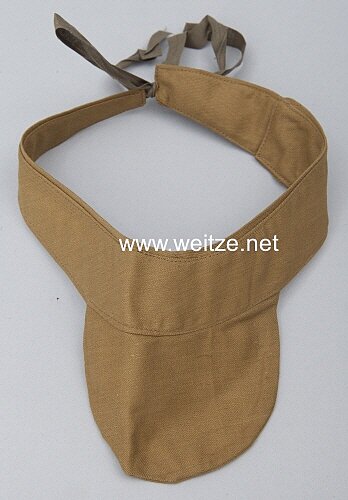
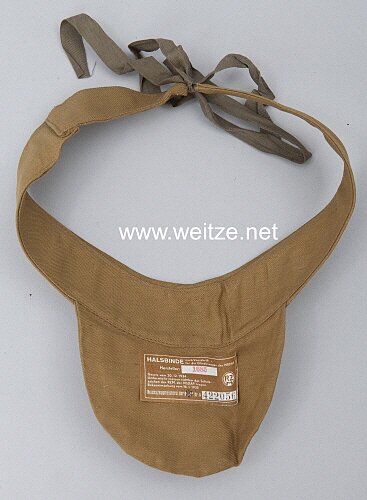
NSDAP/SA Neck Tie

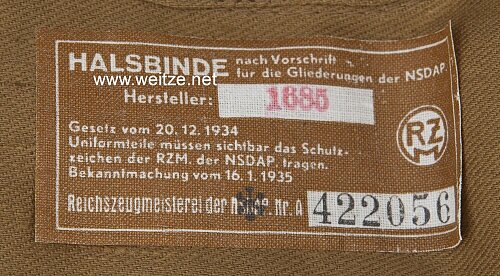
for the closed service tunic, light brown version, lace-up ties, with RZM label “Halsbinde nach Vorschrift” (neck tie according to regulation), unworn, condition 2+.
223414
40,00

NSDAP/SA Neck Tie

The NSDAP/SA neck tie (Halsbinde) was an essential component of the uniform worn by the Sturmabteilung (SA), the paramilitary organization of the National Socialist German Workers' Party. This light brown neck tie was worn with the closed service tunic and represented an important part of the uniformed appearance of SA men during the National Socialist period.

The Sturmabteilung was founded in 1920/21 and developed into the largest paramilitary organization of the NSDAP. The characteristic brown uniform, which included the neck tie, shaped the public image of the organization. The choice of brown was partly pragmatic: after World War I, large quantities of brown tropical uniform fabric were available and could be acquired inexpensively.

This example bears the RZM label with the inscription “Halsbinde nach Vorschrift” (neck tie according to regulations). The Reichszeugmeisterei (RZM) was the central procurement office of the NSDAP, established in 1929. It controlled the manufacture and distribution of party badges, uniform parts, and other NS equipment items. The RZM system was designed to ensure quality standards and prevent unauthorized production. Each approved manufacturer received an RZM number that was affixed to the products.

The neck tie was manufactured according to the SA clothing regulations, which were refined and standardized several times over the years. The light brown design corresponded to the official coloring of the SA uniform. The lacing ribbons allowed individual adjustment to the wearer and ensured secure attachment to the closed service tunic.

The closed service tunic was the formal uniform of SA men, worn at official events, meetings, and marches. The neck tie served not only functional purposes but was part of the uniform appearance intended to demonstrate discipline and membership in the organization. The SA placed great emphasis on a uniform appearance of its members.

Within the SA hierarchy, there were various service grades and ranks, indicated by collar patches, shoulder pieces, and other insignia. The neck tie itself, however, was a general uniform item worn by SA men of various ranks. The uniform regulations were established in official service instructions and had to be followed by all members.

The significance of the SA reached its peak in the early 1930s. After the seizure of power in 1933, the organization grew massively and at times counted several million members. The “Röhm Affair” or “Night of the Long Knives” from June 30 to July 2, 1934, however, marked a turning point: the SA leadership under Ernst Röhm was liquidated on Hitler's orders, and the organization lost considerable political significance in favor of the SS.

After 1934, the SA continued to exist but played an increasingly subordinate role. Uniform parts continued to be produced according to RZM standards, but the organization focused more on pre-military training and propaganda activities. During World War II, the SA lost further significance as many members were drafted into the Wehrmacht.

This piece in unworn condition is a historical testament to the NS period and the uniforming practices of totalitarian organizations. Such objects are today important sources for historical research and museums, as they document the material culture of this period. They remind us of a dark chapter in German history and serve historical education and enlightenment about the mechanisms of totalitarian rule.

The scholarly examination of such uniform parts helps understand the importance of symbols, uniforms, and external appearances for identity formation and cohesion of paramilitary organizations. The RZM marking makes the object a documented example of centralized control over all aspects of public life in the NS state.